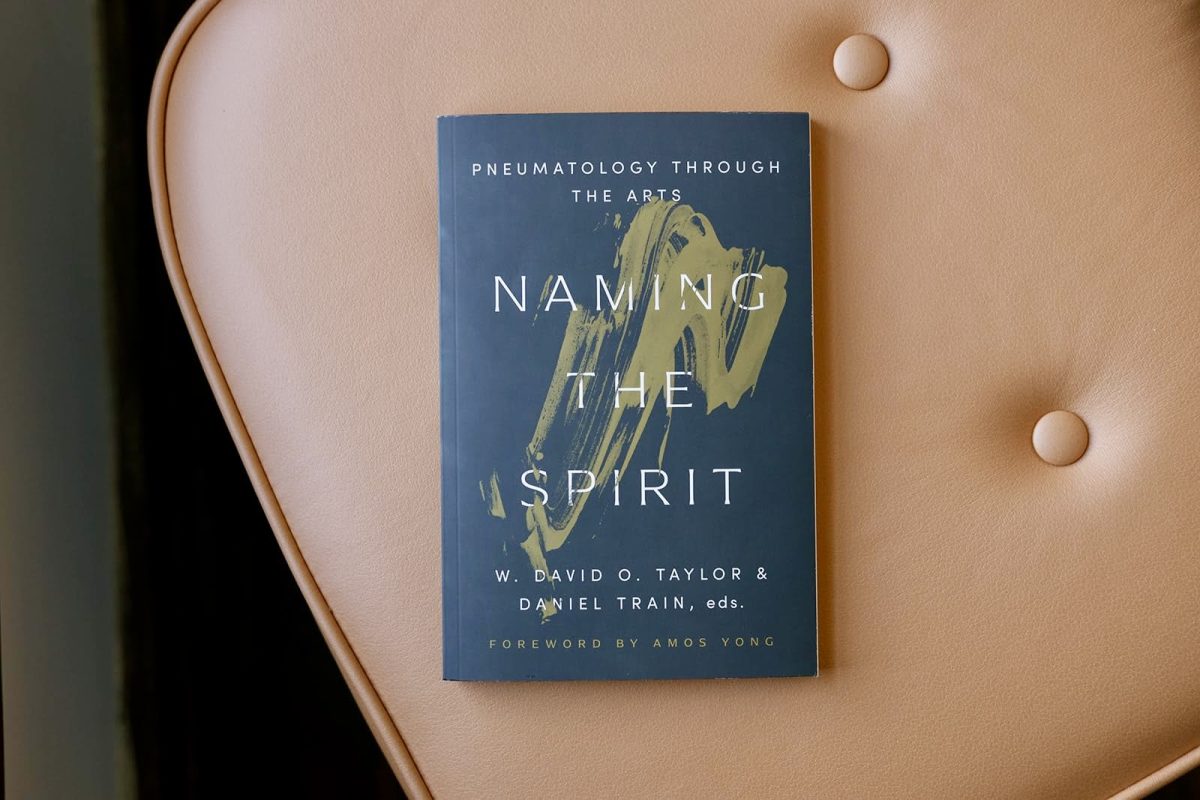

NAMING THE SPIRIT: Pneumatology Through the Arts. Edited by W. David O. Taylor and Daniel Train. Foreword by Amos Yong. Downer’s Grove, IL: IVP Academic, 2025. Xiii + 233 pages.
What does the Holy Spirit have to do with the arts and culture? It’s possible that there is a strong connection between the Spirit and the arts. Of course, when it comes to defining the person of the Holy Spirit, there are many definitions. After all, the Spirit is like the wind that cannot be tamed. Using that metaphor, like the wind, it can be tapped into but not controlled. Perhaps something similar could be said about the arts, at least in terms of the variety of definitions. The arts include paintings and sculpture, but also film, photography, writing, and more. So, might it be possible to consider the nature of the Holy Spirit (pneumatology) through the arts? That is the premise of Naming the Spirit.

Robert D. Cornwall
Naming the Spirit: Pneumatology Through the Arts offers the reader a series of essays edited by W. David O. Taylor, Associate Professor of Theology and Culture at Fuller Theological Seminary, and Daniel Train, an assistant professor of theology and the arts at Duke Divinity School. The book features a foreword by Amos Yong, a Pentecostal theologian and professor of theology and mission at Fuller Theological Seminary. As Yong reminds us, the essays we find in Naming the Spirit” help us “experience the beautiful as pneumatized” (p. xiii). That is what we find in this collection of essays: a reflection on various forms of beauty that reveal something intriguing about the Holy Spirit.
Taylor and Train have brought together a series of essayists, who have been charged with reflecting on the work of the Holy Spirit through the lenses provided by the arts. This project is part of a larger movement within the discipline of theology to engage with the arts. In this case, the editors and the essayists they engaged to participate in this project seek to “pursue a doctrinally rigorous engagement of the arts. Such an engagement, we believe, is best done when informed by the full resources of church tradition and scriptural imagination, while also critically attentive to the unique challenges of the Christian faith in our contemporary times and grounded in the real-world concerns of our neighbors” (p. 3). When it comes to defining the arts, the essayists remind us that art is more than paintings and sculpture. Therefore, as I noted above, the essayists reflect on pneumatology through forms of art and culture that range from paintings to music to film to landscape architecture. As the editors note, they “invited the contributors of this volume to focus on the doctrine of the persona and work of the Holy Spirit and to explore how such a doctrine might both illuminate and be illuminated through a work of art.” With that in mind, each of the essayists was asked to choose one of the names of the Holy Spirit and then bring that name or concept into conversation with a “particular form of art” (pp. 3-4).
Appropriately, I suppose, the first essay, which is authored by Steven Guthrie, focuses on “The identity of the Holy Spirit and the Posture of the Artist.” This chapter provides the foundation for what is to come by connecting the Holy Spirit with the work of the artist, whatever art form that might involve. The keyword spoken of here is the Greek word pneuma and the Hebrew ruach, which can also be translated as wind and breath. However, the focus here is on the Spirit (pneuma/ruach) as the “life-giving breath of God.” As such, Guthrie reminds us that as the breath of life, the Spirit is ubiquitous. That is the Spirit is “within us and around us, preceding and following, the source and supply of all that is, the life of God, given to creation that it might live, sustaining all that breathes, by God’s own divine breath” (pp. 17-18). With Guthrie’s reminder as to the nature of the Spirit, we move to Chapter 2, which is authored by Jonathan Anderson. He adds another level to the discussion by imagining the outpouring of the Spirit on the day of Pentecost and its influence on the way the arts are understood. This chapter does include images and reflections on them, allowing us to consider the visual nature of theology, especially pneumatology.
With these opening chapters laying a foundation for further reflection, the remaining essayists pick out images of the work of the Holy Spirit and engage them through specific forms of art, including music, film, poetry, and landscape architecture. What we discover here is a rather nuanced and fulsome encounter with the Holy Spirit. Thus, Christina Carnes Anandias explores Basil of Caesarea’s understanding of the Trinity, which develops more fully the doctrine of the Holy Spirit in his book On the Holy Spirit, through the lens of Olafur Eliasson’s piece titled “Beauty.” There is an essay by Erin Shaw and Taylor Worley titled “The Spirit of Shalom” that reflects on the idea of kincentricity through contemporary Native art. There are several essays that reflect on the intersection of poetry and pneumatology, as well as essays about music, including Black spirituals and Charles Wesley’s hymns. Finally, there is an essay about the art of landscape architecture. The message that one finds relayed through these essays is that in the diverse expressions of artwork, one can better understand the fuller dimensions of the person of the Holy Spirit.
Collections of essays are difficult to review because each essay is different in scope and focus. The two connectors here are the theological category of pneumatology and the diverse nature of art, whether paintings or landscape architecture, poetry, or music. One of the benefits of a book like this is that it underscores the premise that humanity shares in the creative nature of God, through the life-giving breath of God (the Holy Spirit). Too often in history, we have failed to acknowledge the creative potential intrinsic to humanity and how this creative potential can help us better understand the nature of God. As with any collection of essays, some essays will be of greater interest to a reader than others. That is to be expected and welcomed. It is important to know going in that this is not a book about painting and sculpture, though they are included in the conversation. This is art writ large. As readers engage with the essays found in Naming the Spirit, they will gain a fuller understanding of the doctrine of the Holy Spirit, but also how art reflects the presence of the Spirit in the world.
This review originally appeared on BobCornwall.com.
Robert D. Cornwall is an ordained minister in the Christian Church (Disciples of Christ). Now retired from his ministry at Central Woodward Christian Church (Disciples of Christ) of Troy, Michigan, he serves as Minister-at-Large in Troy. He holds a Ph.D. in Historical Theology from Fuller Theological Seminary and is the author of numerous books, including “Eating With Jesus: Reflections on Divine Encounters at the Open Eucharistic Table” and “Second Thoughts About Hell: Understanding What We Believe” coauthored with Ronald J. Allen. His blog Ponderings on a Faith Journey can be found here.