JERUSALEM (RNS) — Every year before Easter, Elias Hazin’s phone would ring with pilgrims booking trips to visit Bethlehem, the birthplace of Jesus. This year, Hazin says, there have been only cancellations. The tourism industry in Bethlehem is “basically dead,” said Hazin, co-owner of the Bethlehem Star Tours & Travel agency on Manger Square.
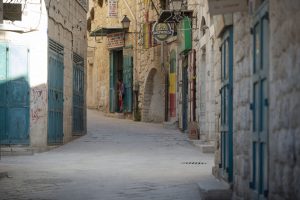
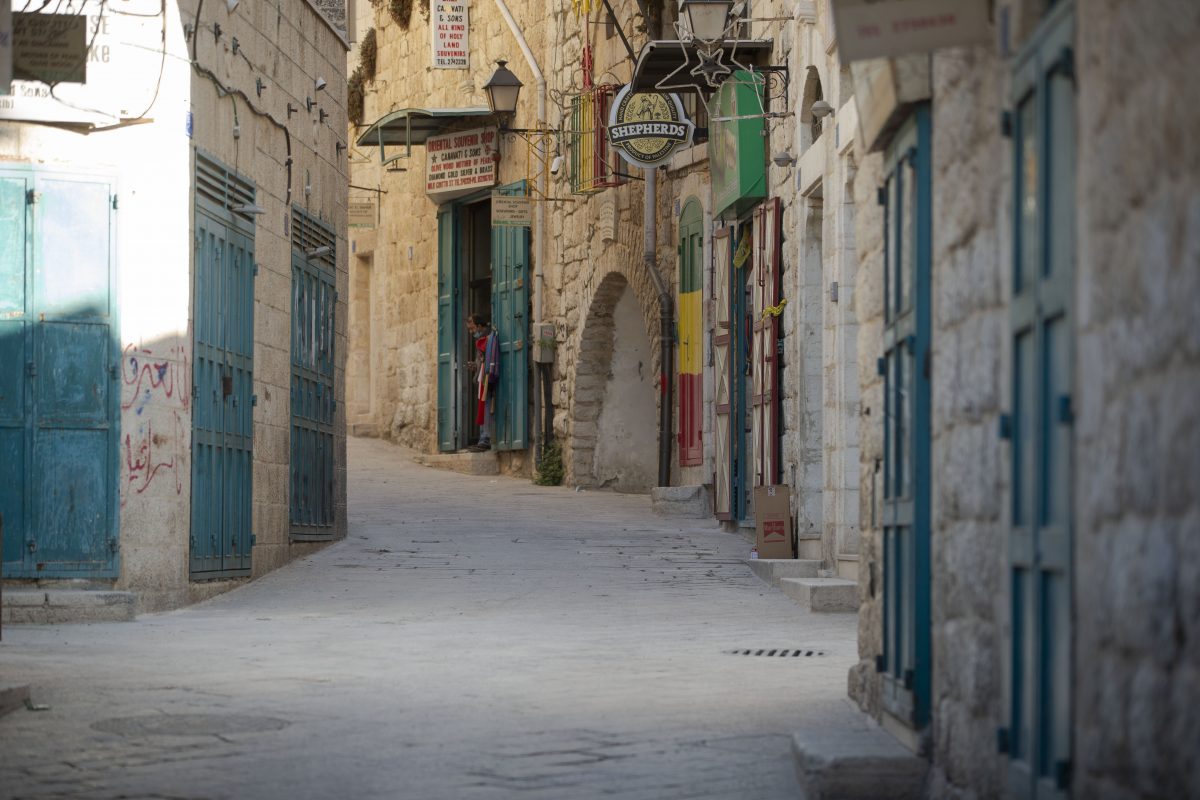
A vendor stands in front of his shop near the Church of the Nativity, traditionally believed to be the birthplace of Jesus Christ, in the West Bank City of Bethlehem, Nov. 23, 2020. (AP Photo/Majdi Mohammed)
Tourism to Bethlehem and surrounding areas has been deteriorating since the Oct. 7, 2023, Hamas attack on Israel and the subsequent war in Gaza. According to one estimate, Bethlehem was losing approximately $2.5 million daily in tourism revenue in mid-2025, and unemployment jumped to 31%. But the Iran war could be the final blow to Bethlehem’s tourism industry — and to the already-dwindling Christian population as well, locals say.
Almost every tourist hotel, restaurant, and souvenir shop in Bethlehem is closed now, due to the Iran war. “If the residents who depend on tourism for their livelihood are unemployed, (that) affects everyone else in the community,” said Hazin. “The truth is that people are only buying the necessities to keep them going as long as possible.”
Anton Salman, who served as Bethlehem’s mayor from 2017 to 2022 and 2024 to 2025, said that more than half of the area’s 30,000 Christians work in the tourism sector, which has traditionally accounted for 70% of the local economy. While thousands of tourists visited Bethlehem during the last Christmas season, thanks to the October 2025 Israel-Hamas ceasefire, the Iran war and widespread flight cancellations have scared away tourists.
Since the Oct. 7 attack and Gaza war, Salman said, he has seen many Bethlehem-area residents, both Christian and Muslim, emigrate. “They left because of a lack of security and a lack of work,” he said. “They left in search of a better life and better opportunities.”

Overlooking Bethlehem in the West Bank on May 31, 2018. (RNS photo/Dan Rabb)
The trend is hitting the small, close-knit Christian community especially hard, given that it represents just 1% of the West Bank Palestinian population. “We are fewer in number, so we feel the loss acutely,” Salman said.
Hazin used to employ three people. Now he is down to one employee, whom he pays from his own pocket since his business is losing money every month.
The little business he has left is now tied to outbound travel — mostly Christians in the West Bank seeking a better future in Europe, the U.S., and South America. “They want to secure a good lifestyle for themselves and their children.”
Yousef Barakat, director general of the Notre Dame of Jerusalem Center, which has a pilgrims hostel, chapel, and visitors center, already instructed his son, who recently completed his university studies in the U.S., to remain there. Barakat now worries there is no future for his children in the volatile Middle East.
“Every two or three years we have a crisis. I think that even when this war ends, it will be very challenging for Christians to live here,” he said, adding that he may himself emigrate in “a few years.”
The lobby of the Notre Dame center, a stately edifice, is once again empty, reflecting the cancellation of every Easter-timed reservation. “I’ve had to send all the employees home. All we have now is a maintenance crew,” Barakat said.
In the meantime, Hazin is urging Christians around the world to support Holy Land Christians so they can remain in Christianity’s oldest community. In addition to purchasing online handicrafts created by artisans that are now sitting in shuttered stores and workshops, he said he hopes that Christians abroad will help local people create initiatives, such as small factories, to help them feed their families.
“We are not asking for charity. We are asking them to protect the Christians who remain.”