“I believe in an America … where religious liberty is so indivisible that an act against one church is treated as an act against all.”
U.S. Sen. John F. Kennedy made that declaration in September of 1960 as he found himself locked in a tight race for the presidency against Vice President Richard Nixon. Sixty-six years later, the warnings in his speech again ring true as Republican politicians attack a United Methodist congregation as a partisan tactic for undermining the U.S. Senate campaign of Rev. Adam Hamilton, who is the Democratic nominee in Kansas.
Seeking to become the first Catholic to place his hand on the Bible and take the presidential oath of office, Kennedy found his campaign hurt by anti-Catholic bigotry. Leading the charge was Rev. Norman Vincent Peale, a supporter of Nixon (who would later serve as Donald Trump’s pastor and performed Trump’s first wedding). Evangelist Billy Graham, who was also close to Nixon (and whose son, Franklin, is a leading Trump supporter today), encouraged the effort to politically question Kennedy’s faith.
So with less than two months before election day, Kennedy trekked to a meeting of a group of Protestant ministers in Houston, Texas, to address “the so-called religious issue.”
“I believe in an America where the separation of church and state is absolute, where no Catholic prelate would tell the president (should he be Catholic) how to act, and no Protestant minister would tell his parishioners for whom to vote; where no church or church school is granted any public funds or political preference; and where no man is denied public office merely because his religion differs from the president who might appoint him or the people who might elect him,” Kennedy declared.
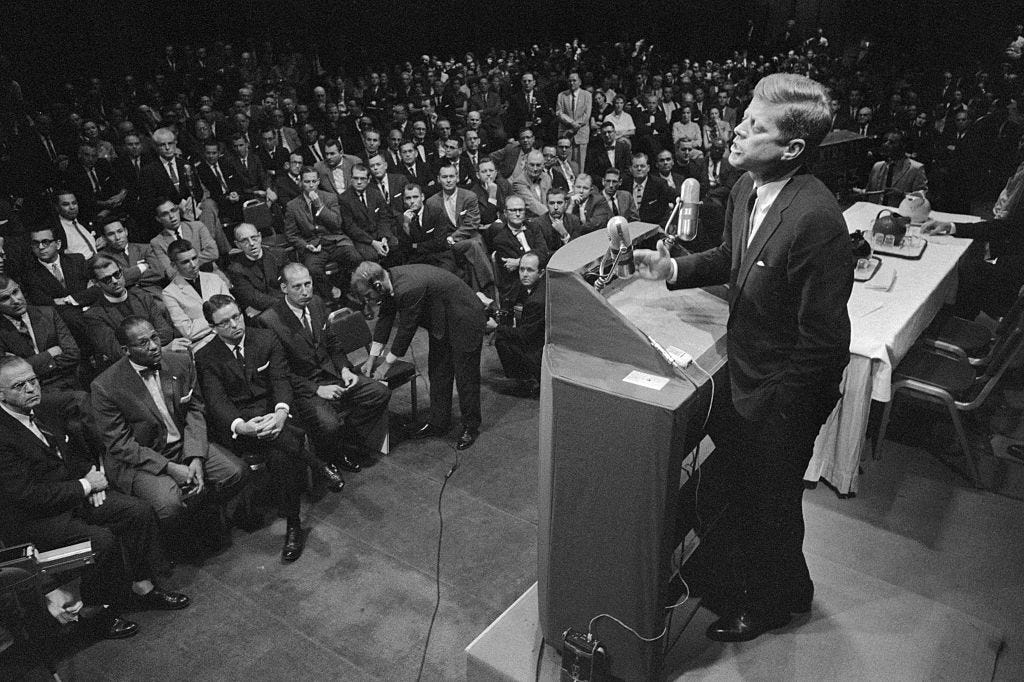
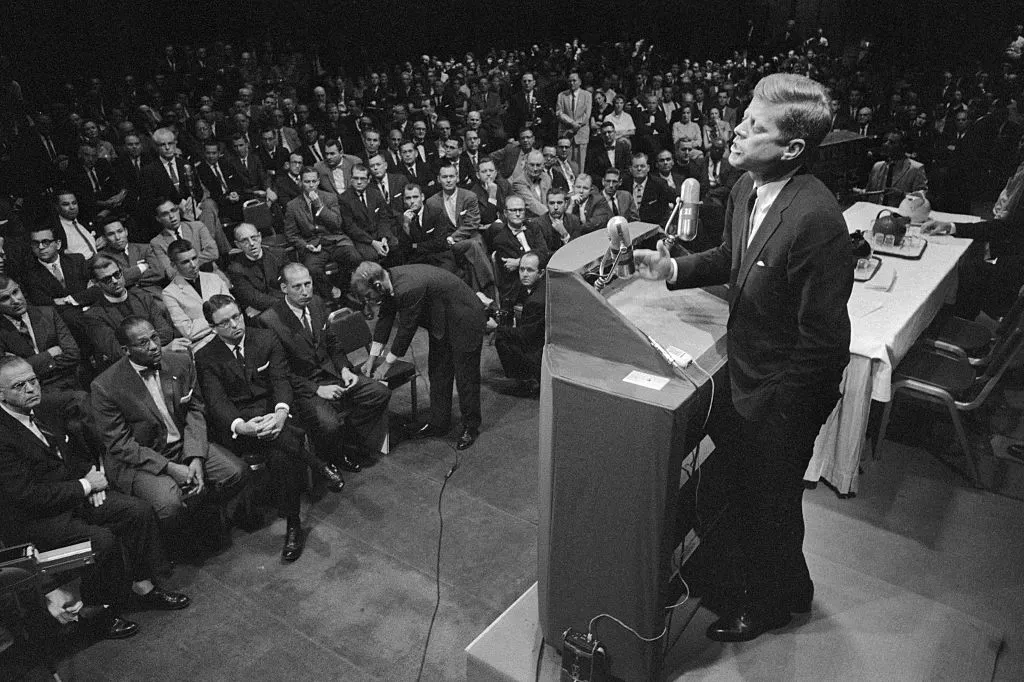
John F. Kennedy speaks to the Greater Houston Ministerial Association in Texas on Sept. 12, 1960. (Getty)
As Kennedy outlined his vision of the type of America he believed in and had fought for in World War II, he also offered a clear warning. When partisan politics threatens the religious liberty rights of one group, it endangers those rights for all.
“For while this year it may be a Catholic against whom the finger of suspicion is pointed, in other years it has been, and may someday be again, a Jew or a Quaker or a Unitarian or a Baptist. It was Virginia’s harassment of Baptist preachers, for example, that helped lead to Jefferson’s statute of religious freedom,” Kennedy explained. “Today I may be the victim, but tomorrow it may be you — until the whole fabric of our harmonious society is ripped at a time of great national peril.”
As Kennedy predicted, the finger of suspicion continues to point at different targets. And this year, one of the main ones is the largest congregation in the United Methodist Church. So this issue of A Public Witness looks at how some politicians are attacking the faith of mainline Christians and how United Methodists are pushing back against the bigotry.
Not Christianity?
In 1990, Hamilton started the Church of the Resurrection with only about 10 people in a funeral home. As the church grew, it moved to other locations before building its first facility in 1994. Now, it’s a megachurch with weekly worship attendance of nearly 10,000 people at nine locations in the greater Kansas City area (mostly in Kansas but also in Missouri). It’s not only the largest congregation in the UMC but also the largest of any denomination in Kansas and in the largest 80 in the country. Additionally, Hamilton has authored several books that are widely used in Sunday School and Bible study groups in numerous denominations.
Hamilton and Resurrection have also long had a reputation for being in the middle and not aligned with a political party. A 2024 local NPR piece highlighted the church’s election-season kindness campaign with campaign-style signs going up around the Kansas City area with slogans like “Love your neighbor,” “Do Unto Others,” or “Kindness.” Hamilton mentioned in the piece how he and the church view themselves in the midst of partisan polarization: “We try to listen to people on both sides and we try to find places where we can learn from each other, grow from each other and hold to this ‘radical center’ if you will.” Even a recent pastor of Marshall’s own church, a Christian Church (Disciples of Christ) congregation, called Hamilton “a middle-of-the-road pastor who is willing to listen to all sides.”
True to that reputation, Hamilton initially considered running this year as an independent. After several weeks traveling around Kansas in the Spring as he tested the waters for a run, Hamilton in May announced he was running but doing so as a Democrat in order to avoid splitting the vote and thus helping incumbent Republican Sen. Roger Marshall win reelection.
The rest of this piece is only available to paid subscribers of the Word&Way newsletter A Public Witness. Subscribe today to read this essay and all previous issues and receive future ones in your inbox.