NOTE: This piece was originally published at our newsletter A Public Witness.
As I read through some U.S. Department of Homeland Security documents in August that showed DHS spied inside churches in Minnesota and Michigan, I reached out to pastors of the congregations. None knew about the spying until it showed up in court documents and news reports. One of them made a comment to me on the phone that particularly stuck out.
“It’s a strange time,” Rev. Steve Sylvester, then the intentional interim lead pastor at Prince of Peace Lutheran Church in the Twin Cities suburb of Roseville, told me. “Even with the kind of aberrations that we’ve been dealing with, typically people don’t sit down and think, ‘Well, the Stasi might know what I’m doing.’”
Earlier this week, his remark about the Stasi (the secret police force of the Communist regime in East Germany) spying on churches came to my mind as I stood in two of the churches that show up in DHS’s files. Documents in a federal case against liberal activists in Minnesota revealed DHS had secretly spied inside at least four churches in the Twin Cities and another in Michigan. As first reported by A Public Witness, one of those churches was covered by a federal injunction. Court filings show that DHS agents on at least four occasions — including on two Sundays — surveilled people entering or leaving University Baptist Church.
So while in Minneapolis on Sunday, I went to UBC. I wanted to see the signs they had on the property and doors informing agents of a federal injunction that prevented warrantless enforcement actions at the church or within 100 feet of an entrance to the building. The signs were already up when agents recorded people entering and exiting the building, and the signs were there when an agent walked right past them to secretly record people attending a Mixed Martial Arts class led by a progressive group in UBC’s building (and then the agent had to go back into the building to recover the recording device after realizing she had dropped it).
I parked in the lot that DHS claimed, under oath, they were unable to determine whether it was within 100 feet. As I noted in August, it was clear from Google Maps that the lot was well within 100 feet of a door — and the denominational groups that won the injunction have submitted documentation proving that. Getting out of my car, I realized UBC sat even closer to the parking lot than it seemed from Google Maps. I could just about touch the building and my car at the same time — and I promise my wingspan is nowhere near 100 feet! (You can see my perspective of the church from the parking lot in a video I recorded.)
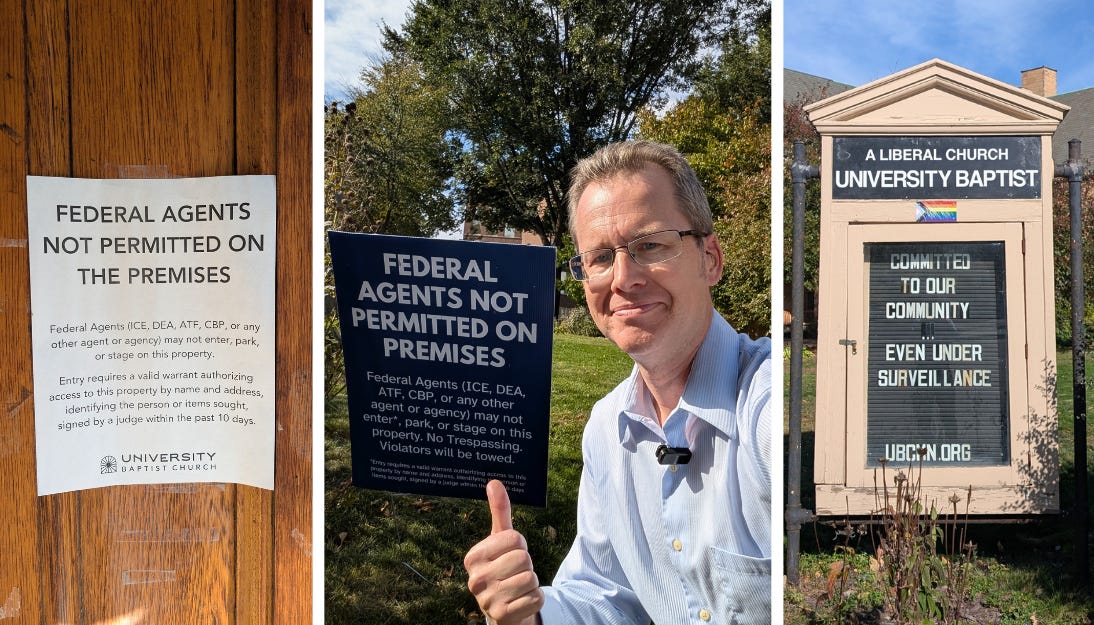
Some of the signs at University Baptist Church in Minneapolis, Minnesota. (Brian Kaylor/Word&Way)
The next day, I was in another church that shows up in the DHS surveillance records. Hennepin Avenue United Methodist Church is not one of the five churches (that we know of) where DHS agents secretly went inside. But the church does show up in the surveillance records, complete with photos of the building, as agents tracked an individual to the church’s parking lot. Although not preemptively targeted, the church’s leaders had previously been outspoken against DHS’s violent actions in the Twin Cities, even hosting a “singing resistance” event.
The church, along with the Minnesota chapter of Christians Against Christian Nationalism, hosted a discussion about my book The Bible According to Christian Nationalists. It was a great evening as I shared about the political misuse of Scripture and then was joined on stage by Minneapolis-based journalist and Lutheran minister Angela Denker. She’s the author of Disciples of White Jesus and Red State Christians, a Word&Way board member, and a monthly guest along with Beau Underwood on my Dangerous Dogma podcast. We talked about Christian Nationalism, church-state separation, journalism, and more. And then we signed copies of our books, which people could get at the event from local independent bookstore Magers & Quinn.
As I have done at other churches over the past year, I shared some examples of how DHS and the Pentagon are co-opting Bible verses and twisting the sacred texts out of context to justify imperial violence. But it hit differently for me to show some of DHS’s misuse of Scripture to a crowd that so closely experienced DHS’s terror this year. And doing so in a church that shows up in DHS surveillance records brought to mind the remark by Rev. Sylvester about the Stasi. It’s a history we would do well to remember.
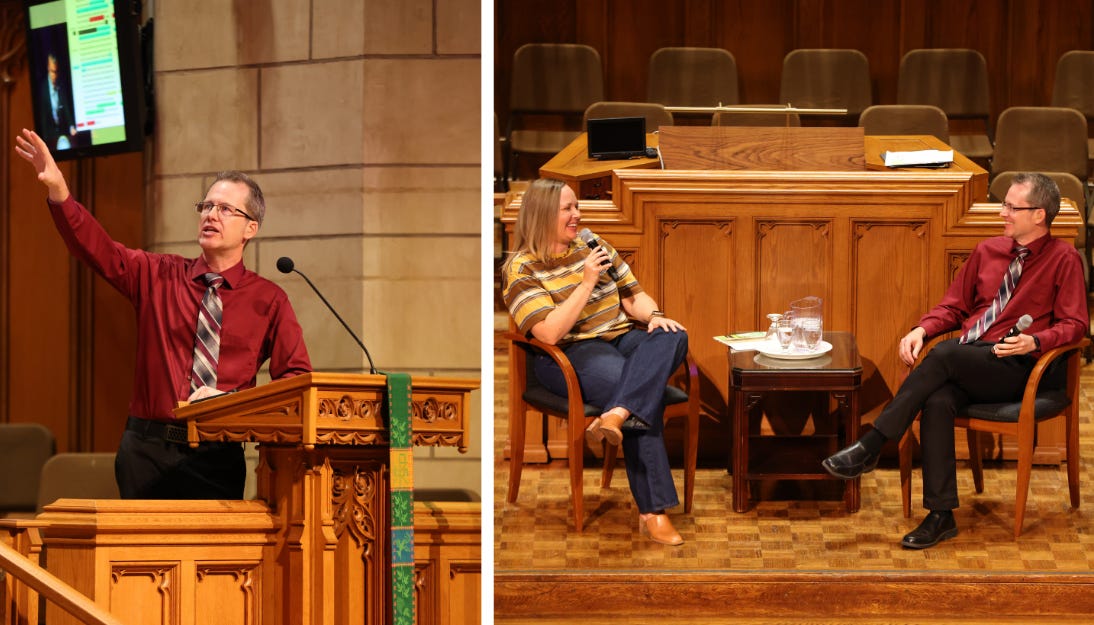
Left: Brian Kaylor speaks at Hennepin Avenue United Methodist Church in Minneapolis, Minnesota, on Oct. 12. 2026. Right: Angela Denker joins Kaylor for dialogue during the event. (photos courtesy of Hennepin Avenue United Methodist Church)
‘Most Successful Church Espionage Operation in Modern History’
Two of the churches that we know DHS spied on are Lutheran. That’s not surprising since the Evangelical Lutheran Church in America is strongest in the Upper Midwest. Additionally, many ELCA ministers, like Denker, have been involved in the anti-ICE advocacy in Minnesota.
But it’s also interesting that Lutheran churches are being spied on since that’s who the Stasi in East Germany especially targeted — again in large part due to size. And we’ve been learning this as people uncover the agents in the files from the regime that fell with the Berlin Wall. No one has documented the story more than Elizabeth Braw, a Swedish journalist who has focused on security and defense issues (and whose father was a minister). Her book, God’s Spies: The Stasi’s Cold War Espionage Campaign Inside the Church, is a fascinating and alarming look at how the authoritarian regime spied inside churches.
“Ever since East Germany was founded, it was important for the Stasi to minimize the role of churches because the churches, in particular the Lutheran Church, were very strong,” Braw explained to Religion News Service. “The vast majority of people were Lutheran, and the Lutheran Church was also quite activist. So the regime knew from the beginning that it would have to focus on undermining the church.”
And undermine the church they did. In what Braw called in the book “the most successful church espionage operation in modern history,” these Stasi “pastor spies” bugged conversations at denominational meetings, informed on other pastors or theologians who made remarks critical of the regime, told on churches that embraced modern music, and thwarted the careers of faithful pastors. Some of the “pastor spies” managed to connect with various Christian networks outside of East Germany, where they pushed Communist ideas. One of the spies even infiltrated a Bible-smuggling network, which led to the arrest of some people in the Soviet Union.

Over three decades, hundreds of such “pastor spies” joined the effort, with some rising into denominational leadership roles while also assisting the Communist regime. And they did so while believing that their secret would never be known, at least by people. But since the East German regime fell so quickly, not all of the files were destroyed. In the years since, many people who were spied on have received the files on themselves and been able to piece together who was informing on them. Hundreds of “pastor spies” have been identified, though others still remain unmasked.
The revelation of “pastor spies” is a devastating blow to the credibility of the church. While a few were defrocked or removed from ministry, most have been allowed to remain. Some explicitly denied they had served the Stasi effort — until records were discovered revealing the truth.
All of this is ironic since the church played a significant role in the ultimate fall of the Communist regime, though Braw suggests it might have occurred sooner without the work of the “pastor spies.” The fact that churches became important rallying places during protests in the late 1980s proved why the regime had sought to undermine churches in the first place.
Similar dynamics can be seen today in the opposition to the Trump administration’s anti-immigrant efforts. Clergy and churches have been at the forefront of the protests in the Twin Cities, as well as in places like Illinois, Louisiana, New Jersey, and Texas. Religious groups have been challenging the administration in court. Mainline Protestant groups, like the ELCA, have been among those particularly involved. This is why the churches DHS spied on opened their doors for people to meet and consider ways to support their immigrant neighbors. And that’s precisely why DHS then targeted the churches.
We don’t yet know the full extent of DHS’s spying on churches. The first batch of court records to reveal this included five incidents. Another round of files showed three additional surveillance incidents at University Baptist. That was followed later by the photos of Hennepin Avenue UMC appearing in the records. And just this week, a document revealed another time that an undercover agent went inside St. John the Evangelist Episcopal Church in St. Paul. We learned from the first round of documents that DHS spied on the church on April 14, but we now know DHS also did so on March 31. It’s highly possible that additional incidents at these and other churches occurred but have not been made public yet.

A woman sorts paper fragments at the Government’s Institute for checking the former East German Intelligence papers (which has since completed its work) in Berlin, Germany, on May 24, 2011. (Michael Sohn/Associated Press)
It might not be until the next administration (or later), but we’ll eventually learn more about which churches DHS targeted. And we’ll likely learn more about who assisted DHS in surveilling churches and targeting immigrants. We do already know some. There’s a Catholic theologian who joined DHS’s public affairs office to help promote the administration’s immigration actions. And there’s a pastor at a Southern Baptist church in St. Paul who also served as an ICE leader during the surge of ICE activity in the Twin Cities and the spying on other churches in his community.
In a time of DHS theologians and ICE pastors (and maybe even “pastor spies”), it was an honor to be at churches that appear in DHS’s files as surveillance targets instead of collaborators. This is a moment of choosing for us all. When the records are eventually public, where will we be found?
As a public witness,
Brian Kaylor
A Public Witness is a reader-supported publication of Word&Way. To receive new posts and support our journalism ministry, subscribe today.