(RNS) — When a Florida Christian organization created an initiative to provide backpacks full of necessities and comfort items to children whose parents have been detained or deported by federal immigration officials, its goal was twofold.
Backpack care kits for children whose parents have been detained or deported are packed by volunteers in the Orlando area. (Photo courtesy of Central Florida Micah Movement)
The first priority was obvious — to provide aid to children in need. The second was to activate Christians, especially White or English-speaking evangelicals, who have been sitting on the sidelines in aiding immigrants as mass deportations have ramped up, organizers told RNS.
Since May, people from eight churches have purchased items for, packed and prayed over 103 backpacks before they were distributed through four partner community organizations in direct service to immigrant families. The churches were organized by the Central Florida Micah Movement, an Orlando-area Christian network formed in the last year to stand in solidarity with immigrants, inspired by the biblical command to “do justice, love mercy and walk humbly with God.”
Kirsty Ortega, a member of Summit Church, an interdenominational church with locations in Orlando and Lake Mary, Florida, had the idea for the backpack initiative. She said she learned that community groups that serve immigrants “often feel really helpless because of the lack of funding and the overwhelming need.”
“A lot of times, they feel like their hands are tied when people come in,” she said. “They don’t have much to give them.”
A longtime volunteer with refugee families, she said she read stories of volunteers showing up with similar kits for people leaving detention in the freezing cold in Minneapolis earlier this year, which led to the backpack idea.

Care kits are prepared by volunteers from a variety of Orlando churches. (Photo courtesy of Central Florida Micah Movement)
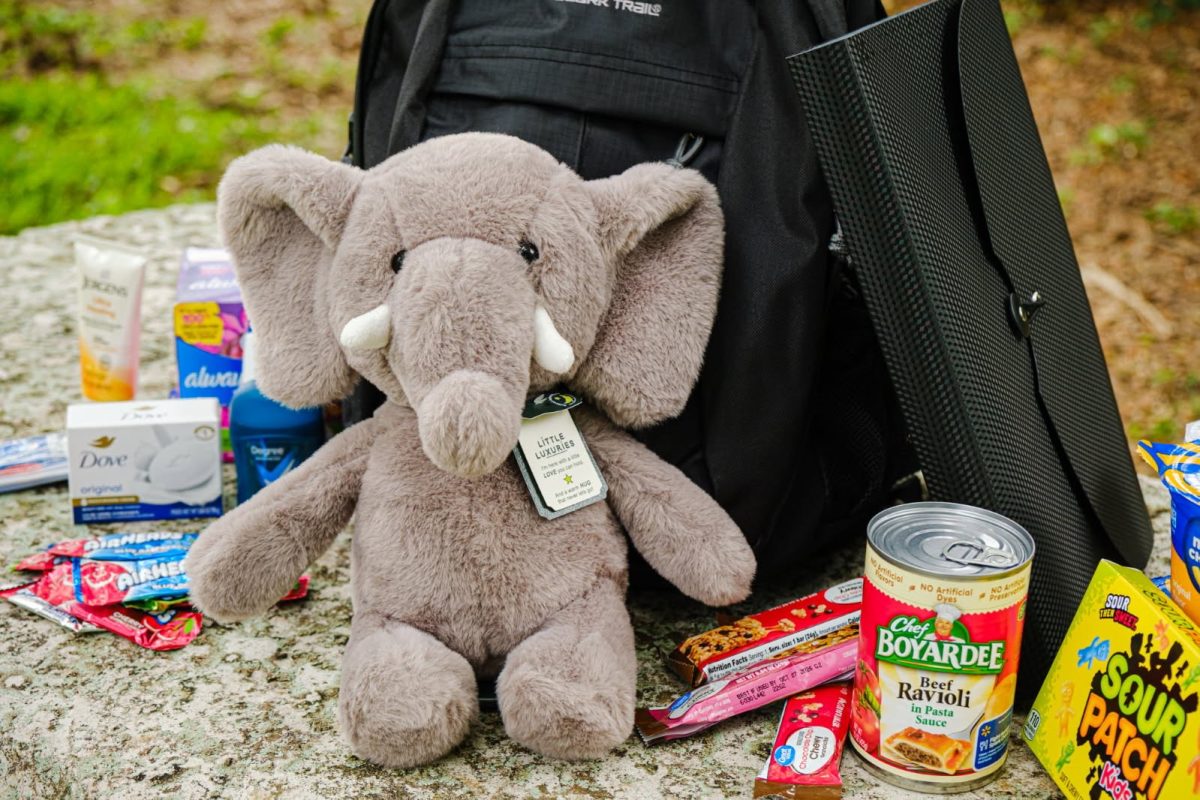
The backpacks include nonperishable foods, hygiene products, and a QR code for legal resources and food distribution. They also provide items to comfort a child in distress, such as a stuffed elephant or teddy bear, candy, and a sheet explaining techniques that might help disrupt a panic attack. And for the Christians packing the backpacks, the care kits aren’t complete without a note from the volunteer and a prayer for the child.
The Central Florida Micah Movement provides a detailed list of items for volunteers to complete each backpack, which costs between $40 to $50 dollars to put together.
An “emotional toolkit” created by the group is also included the backpacks. “I feel terrible! What can I do?” the toolkit says on the cover. The kit then encourages children to talk with somebody, get outside, snuggle with a stuffed animal, or use their senses to ground themselves. Most of all, the toolkit encourages children to talk about their feelings. “Saying it loud makes it feel better faster,” the toolkit advises.

A stuffed elephant and a note addressed to “A Child of God” is included with care kits for children whose parents have been detained or deported in Florida. (Photo courtesy of Central Florida Micah Movement)
At the launch event in May, Ortega said that for children “walking through trauma,” providing the backpacks also shares “a message from Christians and churches that we see them, we care about them and we love them.”
While many participants have been evangelical, United Methodists and a Catholic youth group have also gotten involved. Eight more churches are planning packing events, in addition to other small groups and Bible studies.
“It’s an approachable way for churches to get engaged with immigrants in a way that feels a little bit less politicized,” said Pastor Sócrates Pérez Jr., a catalyst, or organizer, for the group as part of a broader network called UNDIVIDED, which focuses on multiracial healing, solidarity and justice.
In the 2024 presidential election, 8 in 10 (81%) White evangelical Protestants and more than 6 in 10 (63%) of Hispanic Protestants voted for Donald Trump, according to Public Religion Research Institute, as he campaigned on the “largest deportation” in U.S. history. A May 2026 report by the think tank Brookings estimated that more than 200,000 children, including more than 145,000 U.S. citizen children, had seen a parent detained since the beginning of Trump’s second term. The estimate includes more than 35,000 children who have had all their parents detained.
Though support for Trump has since cratered among Latinos, more than half of White evangelicals (58%) approve of Trump’s job performance, according to Pew Research Center.
Because the backpack project feels more like a service initiative, “evangelical churches tend to get on board with that,” Pérez said. But it also ends up being an opportunity to expose those communities to the “complicated” stories of families facing separation, he said.
Micah Norwood, a 21-year-old resident at Discovery Church’s ministry school in Orlando, described her packing experience as “a wake-up call.” “This is actually affecting so many more people than we actually realize,” she said.
Among the 11 other residents preparing for careers in ministry at the 32,000-person megachurch who were helping pack with her, that feeling was collective, she said.
Ortega said she has seen all kinds of people feel tangibly connected to immigrant children through the program. She remembers a group of teenage boys who were visiting from another city for a week and attended a packing event.
“These 17-year-old boys were taking five minutes to write a card, where you wouldn’t normally think that a 17-year-old boy would care about writing a card to a stranger,” she said. At the end of the event, the boys stood in a circle with the backpacks on their fronts, like a baby carrier but with a stuffed animal sticking out the top instead, and wrapped their arms around the backpacks as they prayed for the children receiving the kits.
The care kit initiative fits into a broader effort by four organizations — UNDIVIDED, the Christian Community Development Association, World Relief and the National Latino Evangelical Coalition — to organize in cities across the U.S. “for the purpose of moving evangelical churches specifically towards justice and solidarity with immigrants,” Pérez said.
The Central Florida Micah Movement also provides support every other Monday for people waiting outside their Immigration and Customs Enforcement check-in appointments, offering coffee, printer services, storage for items that can’t come into the appointment, prayer and emotional support for children. They also hand out small clay butterflies “as a symbol that they’re not alone” that participants can carry into the appointments, Pérez said.

Backpack care kits for children whose parents have been detained or deported are loaded for delivery in the Orlando area. (Photo courtesy of Central Florida Micah Movement)
The group has advocated at Orange County Board of County Commissioners meetings, urging for less voluntary local government cooperation with ICE. In April, after that advocacy, the commissioners voted unanimously to reduce the time they would hold ICE detainees in jail. Now, the group is launching an advocacy campaign to push Florida U.S. senators to vote for a bill reinstating Temporary Protected Status for Haitians to live in the country legally.
Pérez, who grew up and was ordained in the Southern Baptist Convention, acknowledged that evangelicals can be distant from “justice work.” (He resigned from ministry at First Baptist Orlando’s Horizon West Campus earlier this year after being put on administrative leave for protesting a decision by senior pastors to host a tour stop of the conservative organization Turning Point USA.)
He hopes that at the end of the backpack events, participants “have a way to connect to a next step with the Micah Movement, whether that’s for advocacy meetings with lawmakers or to do accompaniment with us when we go to the ICE office every other week,” Pérez said.
Not everybody is ready to get involved in politics. Pérez described one woman who spent her time after the packing event “wrestling” with the conflict between her politics and her “desire to be compassionate as Jesus was.”
“One of the challenges is that people often get comfortable and stay stuck at the service phase and don’t engage in the ‘do justice’ part of Micah 6:8,” he said, adding that even those who don’t may start to ask good questions.
Norwood said she never really thought of doing advocacy, but she became inspired through the project to advocate for translators and other ways to make the gospel accessible not just in English.
Ultimately, Ortega said it’s the parable of the Good Samaritan that motivates her to stay involved.
“It was powerful then (in Jesus’ time) to say that a Samaritan was your neighbor, as it’s powerful today to say that somebody who is … getting deported or possibly undocumented, that’s our neighbor,” she said.
The RNS Love Thy Neighbor series is made possible by support from Faith in Public Life, Garrett-Evangelical Theological Seminary, the Center for Congregations, The Fetzer Institute, and readers like you. Support this work with a gift today.