NOTE: This piece was originally published at our newsletter A Public Witness.
For months, some MAGA figures and Republican politicians have argued that Immigration and Customs Enforcement agents should monitor polling places on Election Day. This rhetoric has persisted for months despite federal laws prohibiting federal officials from intimidating voters, interfering with elections, or even carrying weapons into a polling place. Several lawsuits have been filed to preemptively ensure ICE or other federal agents are not sent to monitor polling places. And several secretaries of state have updated their protocols for election workers to include what to do if ICE or other federal agents show up without authorization.
But one issue missing from the political and legal debates is that sending ICE or other agents in the Department of Homeland Security to polling places would often mean having them patrol a church. In recent elections, more than half of polling places in Arkansas and Oklahoma were churches. Between 40% and 50% of polling places were churches in another seven states (Florida, Georgia, Indiana, Kansas, Missouri, Ohio, and Utah). And 21 more states had churches serving as at least 30% of their polling places.
The high number of churches serving as polling places raises another issue about ICE showing up on Election Day. Currently, thousands of churches — including some that will open their doors to voters on Tuesday — are covered by federal injunctions blocking warrantless DHS immigration enforcement actions from occurring in or near their buildings. DHS has already been accused of violating one of the injunctions by repeatedly spying on a Baptist church in Minnesota. A large-scale ICE mobilization on Election Day could impact other protected congregations.
“We are prepared and know whom we need to call should there be something that happens tomorrow,” Rev. Stephen Cook, senior pastor of Second Baptist Church in Memphis, Tennessee, told me. “Our sincere hope is that this will not be an issue and that our neighbors will be able to come and enjoy the space and the place that we make available to them, and that everyone will be able to cast their ballots and to have their ballots counted fairly.”
A polling place for decades, Second Baptist is now covered along with other Cooperative Baptist Fellowship congregations by an injunction to prevent warrantless DHS actions there. In addition to being open on Election Day, they’ve been an early voting site for 17 days, so far without incident. But like election officials in various states, they’re prepared in case ICE does show up.
“We have a small group of people who have copies of the injunction that we are protected under and who are aware of what the limits of that injunction are as well as what the parameters of it are. And we have, as a staff, been spending the last couple of weeks just thinking through everything that we need to be prepared for in terms of lines and the operations of things [on Election Day]. We remain hopeful that we do not have any incidents.”
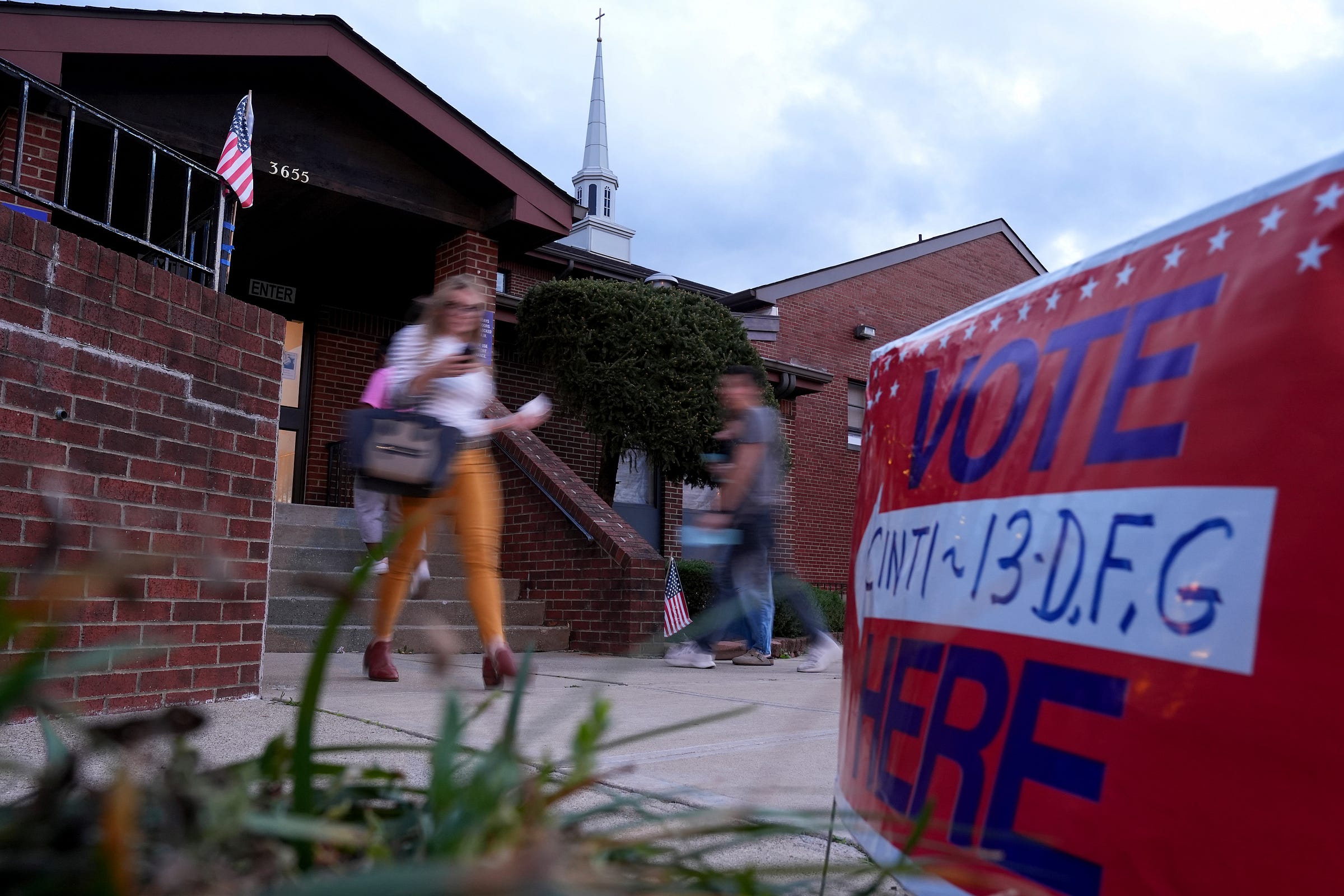
A voter walks out after voting at The New Hope Baptist Church in Cincinnati, Ohio, on Nov. 5, 2024. (Kareem Elgazzar/Associated Press)
Given the political rhetoric as well as the aggressive ways the Trump administration has deployed ICE this year, it’s important to pay attention to the threats and how this could impact churches. This issue of A Public Witness explores the threats of ICE monitoring polling sites and how some pastors are preparing to respond.
The Threat
MAGA pundit and longtime Trump ally Steve Bannon has for months been pushing for ICE agents to monitor polling places. He declared in February, “We’re going to have ICE surround the polls come November. We’re not going to sit here and allow you to steal the country again.” He added, “President Trump has to nationalize the election. You’ve got to put — not just, I think, ICE — you’ve got to call up the 82nd and 101st Airborne [Divisions] on the Insurrection Act.”
Despite the clear legal prohibitions against federal agents — especially armed ones — at polling sites, some GOP politicians have joined Bannon in arguing for ICE or other DHS agents to show up on Election Day. When asked about it, Trump refused to rule out sending ICE or the National Guard to voting locations. He instead said, “I’d do anything necessary to make sure we have honest elections. We have to have honest elections.”
DHS Secretary Markwayne Mullin also refused to rule out sending ICE to polling places during his confirmation hearing, though he insisted they would not be there “for intimidation.” He added, “I don’t understand what the concern is about enforcement of immigration at polling places anyways because honestly if you’re not a citizen you shouldn’t be voting anyways so technically there shouldn’t be illegals at the polling spot.”
In August, Maine Republican gubernatorial nominee Bobby Charles said he would ask White House border czar Tom Homan, who he called a “friend,” to send ICE agents and U.S. marshals to polling stations in the Pine Tree State. He said this was needed to stop “the illegals who are being paid money.” Charles is polling well behind his Democratic opponent. Maine Secretary of State Shenna Bellows, who is the public official overseeing elections, emphasized in response that federal law enforcement officials are “prohibited from being at the polls on Election Day.” Bellows, a Democrat, added, “Bobby Charles can call whoever he wants, but he can’t change the Constitution or the law.”
U.S. Rep. Mike Collins, the Republican nominee challenging U.S. Sen. Jon Ossoff in Georgia, said it was “fine with me” if Trump sent federal troops to polling places. Similarly, Minnesota state Rep. Bernie Perryman, a Republican running for a state Senate seat, was caught on leaked audio last month saying she thinks Trump should “send the National Guard in on Election Day” in the Land of 10,000 Lakes. She added it would be a “good” move, comparing it to ICE’s work during Metro Surge earlier this year — during which Renée Good and Alex Pretti were killed by federal agents. After controversy erupted about her comments, Perryman tried to walk them back by claiming she didn’t remember saying that and didn’t know she was being recorded.
In recent weeks, the Trump administration has said that despite the rhetoric they will not be deploying ICE agents to election sites. While the U.S. Department of Justice is planning to send 1,000 election monitors to various sites in all 50 states — a significant increase from past elections — the administration promised that none of the monitors will be ICE or FBI agents. Additionally, federal judges have blocked DHS from conducting election-related field operations in nine states. Documents in the case, quoted by a judge, assert that DHS “surveils, covertly infiltrates, and interrogates the staff of nonprofits and churches conducting voter engagement.” Although most of the targeted 165 organizations are not named, included in the documents are faith-based groups like ISAIAH and Faith in Minnesota (which helped lead clergy resistance to ICE in the Twin Cities).
Despite all of this, there have already been sightings of DHS agents and National Guard members near early voting sites or ballot drop boxes that sparked concerns from election officials and voters, including in California, Florida, Minnesota, and Washington, D.C. Additionally, numerous communities are reporting a surge in ICE activity in recent weeks.
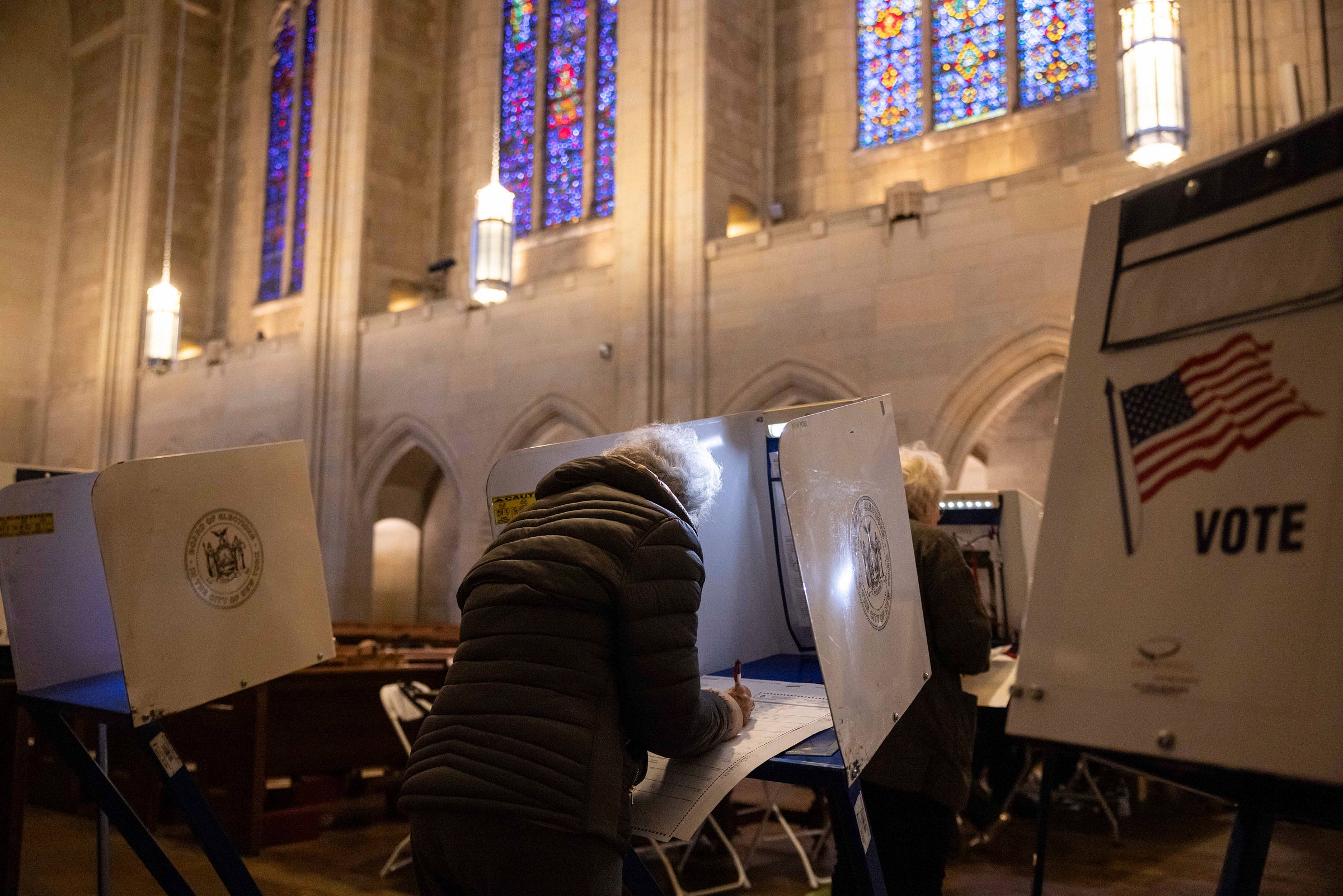
A voter casts a ballot at the Church of the Heavenly Rest in New York City on Nov. 5, 2024. (Yuki Iwamura/Associated Press)
If ICE agents do show up at or near a polling place on Tuesday, it might not just break federal law barring armed federal agents. In some cases, it could also represent a violation of a federal injunction blocking DHS agents from warrantless immigration enforcement actions at protected houses of worship.
After the Trump administration last year rescinded a policy barring operations by ICE or border agents in “sensitive” or “protected” places like houses of worship and schools, numerous religious denominations sued. In February 2025, a federal judge granted an injunction to protect congregations affiliated with the Cooperative Baptist Fellowship and several regional Quaker groups in addition to a Sikh Temple in California. That injunction was upheld in August by a federal appeals court. In February of this year, a different federal judge granted an injunction to similarly protect congregations in the American Baptist Churches USA, Alliance of Baptists, Metropolitan Community Churches, and several regional synods of the Evangelical Lutheran Church in America. That judge is considering whether to hold DHS in contempt for spying on a Baptist church covered by the injunction. Another suit with 27 mainline Protestant and Jewish groups as plaintiffs initially was ruled against by a judge, but last month a federal appeals court overturned that decision and revived the effort to get an injunction.
The two injunctions in place currently protect several thousand churches from warrantless DHS presence. Many of them will welcome voters in on Tuesday to cast ballots in the midterm elections. Because the churches see this as a way of living out their faith as they serve their communities.
“There is a deep strand of hospitality that’s kind of woven into our genetic code here,” Cook at Second Baptist in Memphis told me when asked about why they serve as a polling location. “So we have long been a site to play host to people for various and sundry things. For quite a while, we have understood that we have more people who come to our church Monday through Saturday than who come for church on Sundays. We want to be a church, a welcoming presence in the heart of our community.”
“Being a voting site, being a place where the community can come and know that this is a safe place and that this is a place where they can come and exercise their civic duties and responsibilities, is something that we take seriously,” he added.
Help sustain the journalism of Word&Way by subscribing to A Public Witness!
Poll Chaplains Stand Against Efforts to Bring Fear
Some churches covered by an injunction blocking warrantless DHS actions have even posted signs informing agents and visitors of that. Like St. John’s Baptist Church in Charlotte, North Carolina, where people will walk past those signs tomorrow to vote. A polling site for decades, Rev. Laura Heikes, the church’s senior minister, noted they see this as one way of serving their community.
“We are, at this church, passionate about folks in this community having access to vote. And to help make that easy and possible, we are happy to do that,” she told me.
Heikes noted that the church, which is part of the Cooperative Baptist Fellowship, is involved in the community in numerous ways, like with the “Fall Festival and Trunk or Treat” event they just held. Opening their building on Tuesday for people to vote is another way of helping their neighbors. Insisting that “everyone who is a citizen” should “have the ability to go without fear to their polling place,” she added that DHS agents showing up would only be about trying “to bring fear.”
Heikes told me she doesn’t expect that DHS will show up at their polling place given the “privilege” in the nearby neighborhoods. She added, “We feel deeply for our brothers and sisters on the east side of Charlotte who might have to grapple with that fear.” But if DHS does show up on Tuesday, she’ll spring into action.
“That’s the moment I get out my clergy collar and I just go be present at vulnerable places because I’m not a vulnerable individual,” she explained. “Being a pastor who is present and readily identifiable as a pastor can bring accountability, which I have done in the past when ICE was here.”
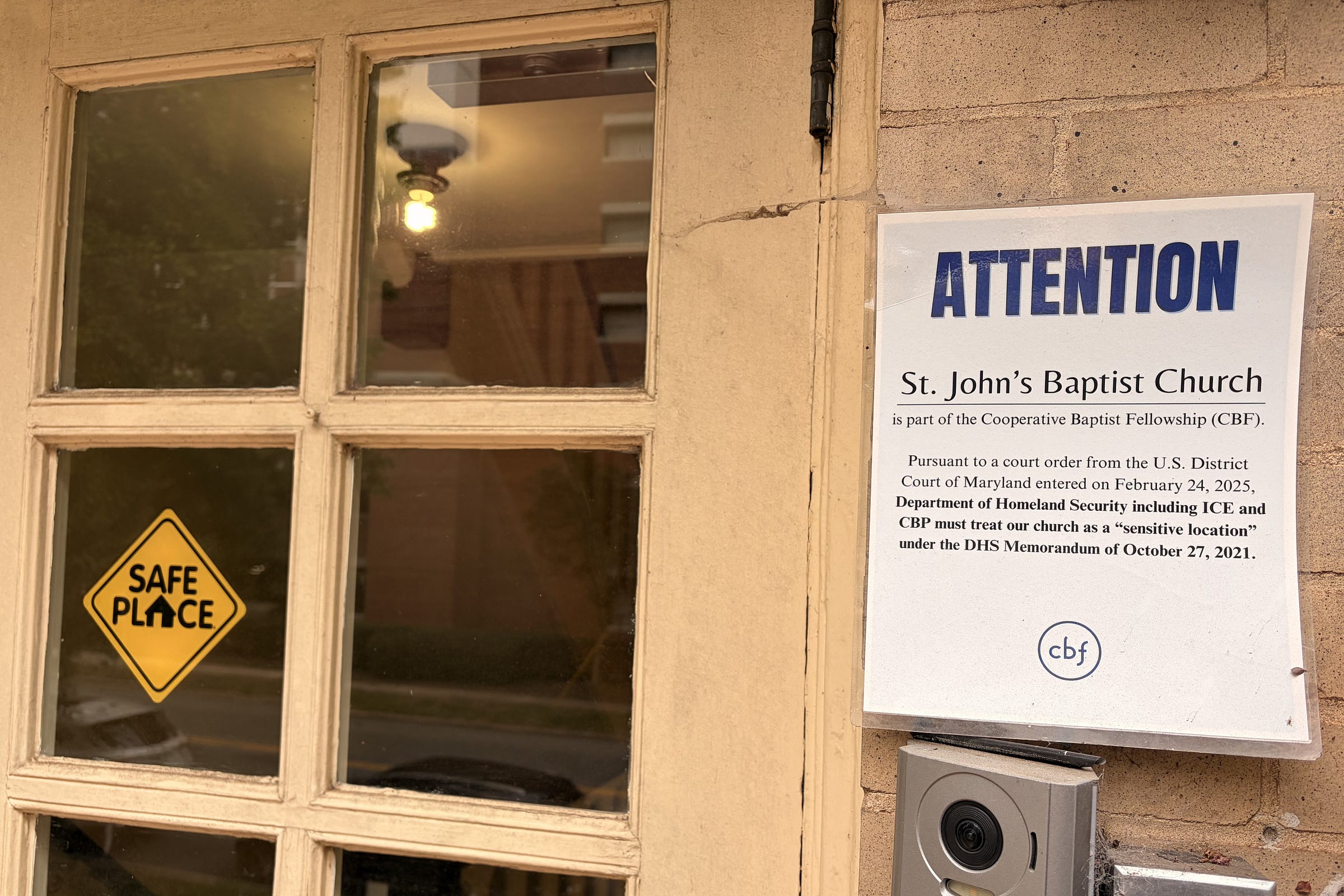
A sign outside St. John’s Baptist Church in Charlotte, North Carolina, reminding DHS agents that the church is covered by a federal injunction. (St. John’s Baptist Church)
Rev. Kheresa Harmon, minister for children and their families at St. John’s, added that in other precincts on Tuesday “across Charlotte, there will probably be clergy on site to provide a pastoral presence.” In North Carolina and other states, there has been an effort to train clergy to serve as “poll chaplains” at voting places.
The nonpartisan and interfaith effort Faiths United to Save Democracy has recruited more than 1,200 individuals this year to serve as poll chaplains, helping to train clergy to be a calming presence and a witness to anything that occurs. North Carolina is one of the nine states in which they have particularly focused on recruiting poll chaplains. Although clergy standing outside voting places as poll chaplains has occurred in previous elections, the possibility of ICE or other federal agents being present has raised the sense of urgency.
“You prepare people for danger,” explained Barbara Williams-Skinner, who leads Faiths United to Save Democracy along with Rev. Jim Wallis and Rev. Adam Taylor. “You hope for the best, but you have to prepare for the worst.”
In addition to some serving as poll chaplains, Harmon mentioned that clergy across Charlotte have been working together to counter ICE activity, so they will hear updates if there is a concern on Election Day. After the ICE surge in Minneapolis earlier this year, another surge targeted Charlotte. As in Minnesota and elsewhere, clergy joined the efforts to protest ICE’s actions. Harmon thinks that resistance means they’ll see fewer issues now, explaining that “enough pressure has been placed that I think the election will have a different feel to it than it would have if it had been last year.”
While the pastors at St. John’s in Charlotte and Second Baptist in Memphis don’t expect ICE to show up at their churches on Election Day, they are prepared to act to protect the voting rights of their neighbors.
“If ICE does show up here, then you know we know what we need to do,” Cook at Second Baptist said. “Hopefully, we don’t have to do it. That’s been part of my prayer life over these last few days for sure!”
As a public witness,
Brian Kaylor
A Public Witness is a reader-supported publication of Word&Way. To receive new posts and support our journalism ministry, subscribe today.