(RNS) — President Donald Trump announced Thursday (Oct. 15) that the Pentagon will not livestream the execution of the Fort Hood shooter, backing away from a proposal that triggered widespread pushback from prominent religious leaders.
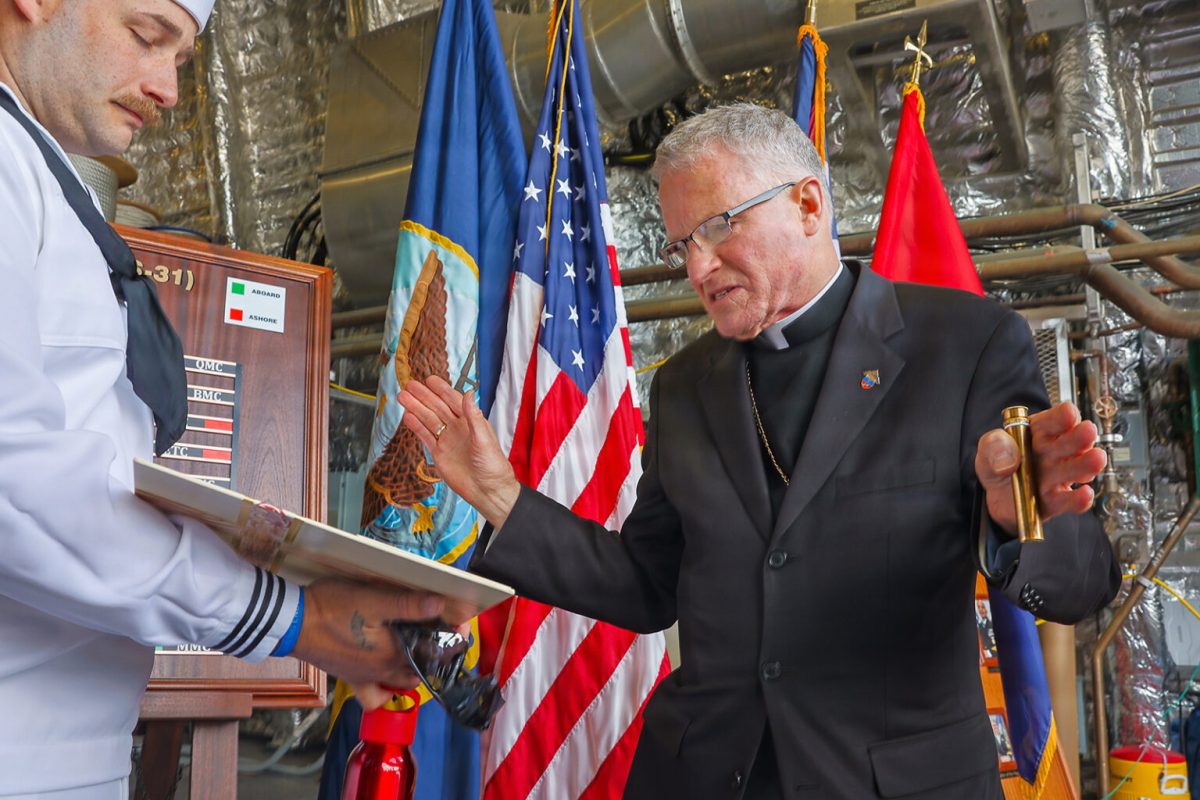
Archbishop Timothy P. Broglio, archbishop for the Military Services, USA, blesses the future USS Cleveland (LCS 31) aboard the ship in Cleveland, Ohio, May 11, 2026. (U.S. Navy photo by Mass Communication Specialist 1st Class Theoplis Stewart/DVIDS/Public Domain)
In a statement published to Truth Social, Trump said livestreaming the execution of Nidal Malik Hasan, an Army officer who killed 13 people and wounded 32 others when he opened fire at Fort Hood in 2009, would be a “strong deterrent for the World to witness how America deals with Terrorists.”
But the president concluded that “many very good and well-meaning people would rather not watch him die, through streaming or through any other visual device.”
Trump added: “He will die, as scheduled, by firing squad, but this event will not be streamed.”
The announcement comes after a week of controversy that erupted when Defense Secretary Pete Hegseth announced plans to livestream the execution of Hasan, who is slated to be killed by a firing squad in December.
“We’ll make sure that people are able to watch it,” Hegseth said last Thursday.
According to a Washington Post-ABC News-Ipsos poll published on Thursday, the plan has fared poorly with a broad range of religious groups since it was announced. The survey, which was conducted last week, found that strong majorities of Black Protestants (88%), Hispanic Catholics (80%), white mainline Protestants (81%), white Catholics (77%), and white evangelicals (74%) opposed livestreaming Hasan’s execution.
White evangelicals showed the most overt support for the idea, but only at 25%. Black Protestants were the least supportive at 11%.
The retreat follows a wave of statements from religious leaders and groups condemning the public execution plans. The morning after Hegseth announced the proposal, the U.S. Conference of Catholic Bishops issued a statement condemning the plans, calling the decision “a barbaric promotion of a culture of death.” Broadcasting the execution would only “further undermine the moral fabric” of the country, the statement said.
Walter Kim, president of the National Association of Evangelicals, which represents 45,000 churches, also said that though justice was needed for Hasan’s crimes, the “live-streamed execution by firing squad risks turning one of the state’s most solemn responsibilities into a public spectacle, promoting a culture of death, rather than a culture that upholds the dignity of every human being.”
Archbishop Timothy Broglio, who leads the Archdiocese of the Military Services, USA, asked that Catholics assigned to the firing squad be excused from this action “contrary to the teaching of the Church.” The Department of Defense declined to comment on whether Catholic service members would be excused from participating in the execution.
“The U.S. military generally enjoys a good reputation in the world. Is there really a value to throwing them in the same boat with terrorists by broadcasting the image of the execution of a man in a wheelchair to the whole world?” Broglio wrote in a statement.
Following Hegseth’s announcement, Pope Leo XIV repeated the Catholic Church’s opposition to the death penalty in a social media post published on Oct. 10, which was the World Day Against the Death Penalty.
Bishop Daniel E. Garcia of the Diocese of Austin, which includes Fort Hood, where the execution will be carried out, called on Catholics to pray for firing squad members and anyone who will witness the execution.
“True justice cannot be achieved through further violence or vengeance, and a public broadcast of this execution would make a spectacle of death,” the bishop wrote in a statement. “Carrying out this execution at Fort Hood, especially as a public broadcast, will only exacerbate that trauma.”
Leaders of the Episcopal Church and the Union for Reform Judaism also condemned the plans, as did the Council of United Methodist Church Bishops: In a statement, the group voiced concerns over how Hegseth’s framing of the execution could end up singling out Muslim Americans. The council called on faithful to pray for “our Muslim neighbors” and condemned the decision to livestream Hasan’s execution.
“Turning the death of a human being into a public broadcast does not honor the victims. It coarsens the conscience of a people and contradicts the gospel we proclaim,” wrote Bishop Ruben Saenz Jr., president of the council, before noting that the shooter “claimed to act in the name of Islam, and our Muslim neighbors must not bear the blame for one man’s crime.”
A few evangelical Christian leaders indicated support for the idea, most notably Texas Pastor Robert Jeffress, a longtime Trump supporter who leads First Baptist, a megachurch in Dallas.
“Life is so valuable, God said, that whoever takes a life should pay with his own life,” Jeffress told Religion News Service last week. “The more people that can see that truth illustrated through a public execution, the better.”
Jeffress later posted the statement to social media, and Trump promoted the pastor’s remarks on his Truth Social feed.
In addition, controversial Idaho pastor Doug Wilson, whose church Hegseth attends, signaled support for the idea in a statement to RNS last week. He said that so long as the Pentagon takes steps to keep the public execution from turning into a “circus” with a “ghoulish atmosphere,” then the livestreamed execution is a “welcome development.”
Asked about Trump’s decision not to livestream the event, Jeffress and Wilson told RNS they supported the move.
“I support President Trump’s decision completely,” Jeffress said in an email. “Although I’ve consistently said from the beginning that there is no biblical reason not to livestream an execution, I’ve also said there may be other reasons not to. I trust the president to weigh all the considerations and make the right decision.”
Wilson said in an email that he is “grateful for the decision.”
He explained he supports the change in plans “not because I object to public executions in principle, but rather because something that momentous would require a lot of careful preparation and instruction beforehand.” The level of preparation, Wilson said, is something “I don’t think we were ready for.”