(RNS) — Growing numbers of people in Britain are defining themselves as Christian Nationalists, according to a new survey — but the majority of them are not churchgoing Christians.

Photo by James Giddins on Unsplash
The report, “Beyond Christian Nationalism — Measuring Attitudes to Christianity and Britishness Today,” published by the reputable think tank Theos, surveyed 1,765 people. It shows that more than 10% of those surveyed identify as Christian Nationalists.
The movement is relatively new in Britain but has caused concern, including among bishops who have tried to disassociate the established Church of England from it following large demonstrations and some well-known far-right, anti-migrant activists saying that they have become Christians.
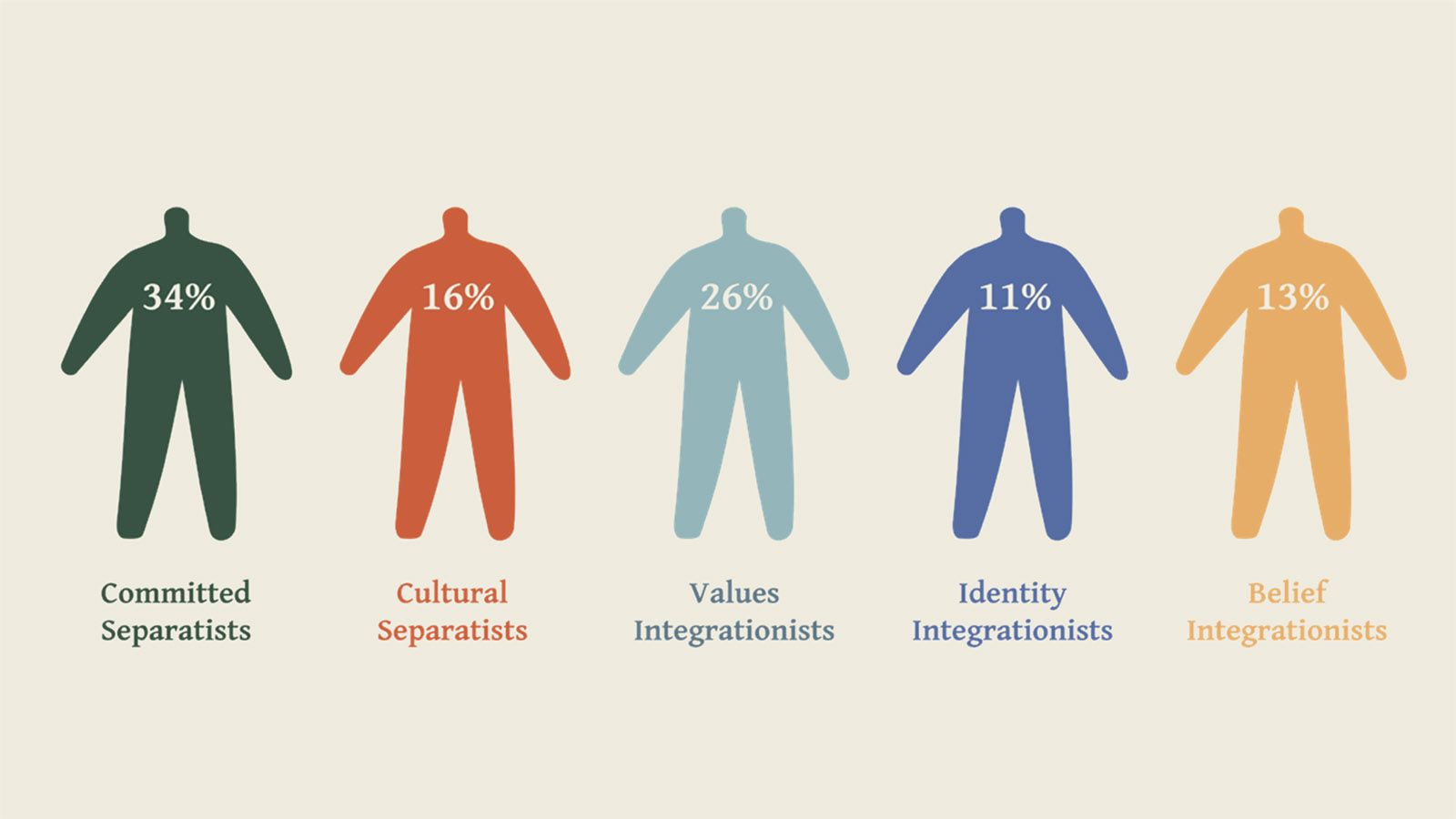
According to the Theos study, about 11% of those surveyed — more than 1 in 10 Britons — have views that resemble those of Christian Nationalists. These people embody an ideology that merges national identity with their idea of Christianity and believe that it should be central to British culture and given prominence over other faiths and secular views.
The 11%, termed “identity integrationists” by the study, had a strong identification with Christianity, yet just 13% reported attending church weekly, only slightly above the 11% average for church attendance across the whole survey. There was much more enthusiasm from them, however, for the Bible — just under half of them expressed an interest in it — and just under a third said they prayed every week.
This group showed hostility to Islam and were disinclined to follow church doctrine on welcoming the stranger: Only 19% agreed that Christianity requires supporting asylum seekers.
The five groups identified by Theos. (Image courtesy of Theos)
The report shows that their Christianity is cultural rather than doctrinal and that they are “deeply, indeed viscerally, culturally Christian.”
They are overwhelmingly white, and although not poor, they tend not to be highly skilled and more likely to live in rural areas.
Another group, termed “belief integrationists,” holds stronger religious beliefs in the nationalism-Christianity equation and are considerably less hostile to immigration. Almost half (48%) agreed that Christian values require welcoming and supporting asylum seekers. These “belief integrationists” made up 13% of those surveyed. Among this group, 31% attend church every week, 46% pray weekly, and 62% expressed an interest in the Bible.
They are more likely to be younger, male, poorer, urban, and non-white, with conservative moral values and traditional ideas about masculinity.
Despite being less hostile to asylum seekers, the report says that “a remarkable two-thirds of this group hold to the Great Replacement Theory (of white people being replaced by immigrants).”
Nick Spencer, a senior fellow at Theos and one of the report’s authors, said: “Until now there has been little research done in Britain on whether Christian Nationalists go to church. This shows that the keenest nationalists don’t go to church very often.
“When we asked these people about the white population being deliberately replaced, it’s off the scale among Christian Nationalists.”
In the past two years, demonstrations put on by the Unite the Kingdom organization have drawn thousands of people, with wooden crosses and the English flag (called the flag of St. George, with a red cross on a white background) being carried by the large crowds.
Tommy Robinson, one of Britain’s most well-known anti-Islam, anti-migrant activists, spoke at a Christmas concert last season after he converted to Christianity in prison. Robinson told concertgoers, “Something great is happening. I’ve seen it at each one of our Unite the Kingdom events as I saw the cross start being prevalent.”
Bishops in the Church of England have warned about the co-opting of Christian symbols and rhetoric to support anti-migrant views. In July a working group of the Church of England’s bishops urged its General Synod to focus on national unity. The group, led by the Bishop of Leicester, Martyn Snow, urged Christians to model a healthy sense of patriotism and reclaim symbols like the St. George’s flag as a sign of unity rather than division. The flag has traditionally been strongly associated with the Church of England as it flies from its churches’ towers.
The Theos report has been welcomed as one of the first major studies delving into Christian Nationalism in Britain. John Heathershaw, professor of international relations at the University of Exeter and research associate at the Centre for the Study of Bible and Violence, said that until now there has been little robust research into the topic.
“The survey is useful because Christian Nationalism is not a coherent ideology, and not a social and political movement but a cluster of attitudes,” he said.
Heathershaw called “belief integrationists” the most interesting group identified by the survey.
In a recent Substack, he wrote:
“My guess is that many of them are charismatic evangelicals, the largest growing group in the UK and across much of the world. Forgive the caricature, but one typical belief integrationist may be a Nigerian Pentecostal man in his 30s or 40s. While they may be a small minority nationally, they are an increasingly significant part of the Christian faith. Although 54% of this group say they are proud that Britain “is predominantly white” (p.118), they are by far the least white group of all five identified by Theos. Of course, racialized views are not exclusively held by the racial majority.”
The most worrying aspect found by the survey, Heathershaw told RNS, is the sizable number of people who believe that there is a concerted effort to replace Britain’s population with another group.
“It shows right across the survey that 37% of people support the Great Replacement Theory. That is remarkable and troubling,” he said.
The report also highlights how divided Britain is over the role of Christianity. Sizable numbers of people want it to have no public role — despite the nation having an established church, with 26 Church of England bishops sitting in the Parliament’s second chamber, the House of Lords. About half the population wants to keep Christianity out of politics, with 34% of those surveyed saying that they want politics free from faith — people Theos calls “committed separatists.” It describes another 16% as “cultural separatists,” who are similarly opposed to religion being involved in politics but are more strongly nationalist.
Although these people tend to have secularist views, these groups also include people who are Christian who believe there should be no connection between church and state and are found in what in Britain are called free churches, such as traditional Baptist ones.
The final sector defined by Theos is another integrationist group — people who believe there should be some integration between Christianity and Britishness. The “values integrationists” make up 26% of those surveyed and want Britain defended from external threats. While they have a strong sense of Christian values as part of Britain’s heritage, they do not feel threatened by what is happening today.
Tim Wyatt, a leading commentator on Christianity in Britain and author of The Critical Friend Substack, said the Theos report offers useful insight into what is happening in Britain today, but that there is a risk in paying too much attention to its findings.
“It would be too easy for mainstream Christians to hold their noses and see Christian Nationalists as bigots, to write them off as irredeemable racists.”
Instead, said Wyatt, their interest in Christianity should be seen as an opportunity. “Mainstream Christians should be willing to talk to them, to sit down and talk about who they think Jesus is and what he teaches.”
Wyatt said that for many Christian Nationalists who do not attend church — the group Theos calls “identities integrationists” — their ideas “are based on nostalgia, wanting to reach back and conjure an England of their imaginations,” of a kind portrayed in television dramas such as Agatha Christie’s “Miss Marple,” with the entirely white population of a village turning out en masse for Sunday service.
“The irony is,” said Wyatt, “that in larger towns and cities the survival of churches is propped up by ethnic groups. As the face of British Christianity changes, these people are harking back to what they think it used to be.”