I wrote my dissertation on the tensions between conservative religious teachings on gender and sexuality and LGBTQ+ experiences in Catholic schools — with implications that extend to policy and law. My work was, in part, motivated by my own former opposition to LGBTQ+ rights.

Jonathon E. Sawyer, Ph.D.
Before reconciling with my own sense of LGBTQ+ personhood (well into my adulthood), I was immersed in various forms of conservative religion. From the teachings of eternal marriage in Mormonism to the “homosexual deliverance prayers” of Pentecostalism to the “total depravity” doctrine of Calvinism, all these groups (at least at the time) equated “gay” with sin. For many years, I thus opposed same-sex marriage and other forms of LGBTQ+ visibility (including my own).
On Nov. 3, the U.S. Supreme Court heard oral arguments in St. Mary Catholic Parish v. Roy. The case continues to elevate a familiar, unnecessary, and harmful choice: civil rights for LGBTQ+ people or religious freedom for believers.
In 2022, Colorado enacted a program that provides public money to families sending their children to private preschools, including religious ones. The Colorado statute requires that a religious school benefiting from that money must not discriminate against LGBTQ+ families. St. Mary Catholic Parish — represented by The Becket Fund for Religious Liberty — asserts that they are the true victims of discrimination, that their religious freedom rights are in jeopardy. It seems likely that the conservative majority on the U.S. Supreme Court will agree.
Oh, how I long for the day when I do not feel compelled to write about how the Court pits religious freedom and LGBTQ+ people against one another. Yet, because the conservative majority on the Court appears dissatisfied with the many monumental wins for religious freedom in recent years, here we are. LGBTQ+ students are once again caught in the crossfire.
In part, it took brave and compassionate Christians (including Catholics) — messengers who breathed affirming words into my life — to break the “religious freedom v. LGBTQ+” spell that once dominated my heart. Indeed, a change of heart at the highest court in the land can end this war.
The Religion v. LGBTQ+ Myth
The troubling, uncompromising “religious freedom v. LGBTQ+ people” position evidently commands the views of certain members of the U.S. Supreme Court.
At the oral arguments, Justice Samuel Alito (a conservative Catholic) lamented a series of cases surrounding LGBTQ+ people and conservative Christians in Colorado, pointedly and suspiciously asking: “What should we make of all this?” Justice Alito’s not-so-subtle subtext is that conservative Christians in Colorado (and hence the larger U.S.) are under the threat of persecution by the state.
For the powerful who perpetuate this narrative — like Justice Alito and groups that have historically opposed same-sex marriage, reject transgender experiences, and prefer the invisibility of LGBTQ+ people in public life — the religious freedom v. LGBTQ+ culture war may seem justified and even necessary. Yet such a view departs from one of the very purposes of the judiciary: to place a check on the discriminatory norms that harm citizens in a democratic system.
One need not abandon conservative religious beliefs on gender and sexuality to stand up for the vulnerable. In fact, religious freedom in the United States is stronger than ever. On LGBTQ+ matters in recent years, conservative Christians have won at the U.S. Supreme Court in almost every major case. But LGBTQ+ people, insidiously scapegoated as anti-Christian, remain the focus of conservative judicial ire.
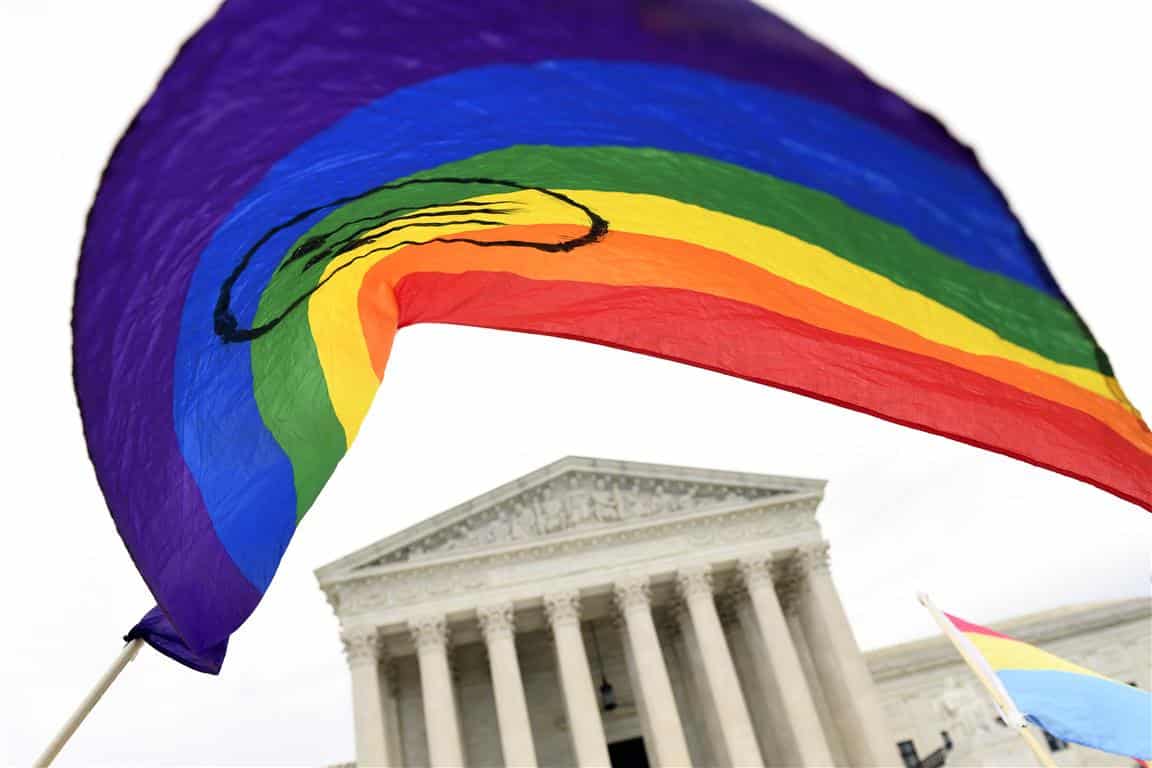
FILE: In this Oct. 8, 2019, photo, people gather outside the Supreme Court in Washington. (AP Photo/Susan Walsh)
Repeating Patterns of Discrimination
The worst outcome of the St. Mary case would be a decision that affirms the idea that taxpayer-funded exclusion of LGBTQ+ students and families in schools is acceptable — because after all, (conservative) religious freedom reigns over every other democratic concern. Such a decision would only perpetuate the false “religion v. LGBTQ+” narrative.
We’ve been down this road before: many in the nation once held the view that religious freedom should protect racial segregation in schools. In Bob Jones University v. United States (1982), the U.S. Supreme Court weighed in and rightly recognized that there is no compelling governmental interest in maintaining and advancing state-sanctioned racial discrimination.
Will today’s Court reach a similar conclusion on behalf of LGBTQ+ students and families? I wish I were optimistic.
If the Catholic school in Colorado prevails, any substantial burden on the religious freedom to exclude LGBTQ+ people in private religious schools receiving public money might trigger what is called “strict scrutiny” in the law. Such heightened constitutional scrutiny would undoubtedly favor sincerely held religious belief on gender and sexuality over the real experiences of LGBTQ+ students and families, many of whom themselves are also sincere believers.
The duplicitous logic of “religious freedom v. LGBTQ+ people” continues at the U.S. Supreme Court. For the sake of human dignity, lay down your arms.
A Better Way
Not all on the Supreme Court are complicit in advancing the myth of religious freedom v. LGBTQ+ people.
Justice Sonia Sotomayor, herself a Catholic, responded powerfully in the oral arguments:
“What you’re basically saying is [that] we can exclude [LGBTQ+] people merely because of exposure to them. … We can exclude children of same-sex marriage. We can exclude children who are trans — who might have transgender feelings or beliefs because exposing other children to them creates a problem.”
While these potent words were necessary, they don’t have to be the end of the story. There is a better way.
Like the New Testament’s Paul of Tarsus, who rebuked divided first-century Christians for lacking love while speaking in the tongues of angels, I experienced a profound change of heart. From a fierce opponent of LGBTQ+ rights to an advocate, I was struck on my own path by something (even someone) deeper: a recognition of the image of God in myself, my neighbor, and the stranger.
In their quiet chambers, in pursuit of equal justice under the law, I pray today’s conservative members of the U.S. Supreme Court experience a similar change of heart.
Jonathon E. Sawyer is visiting assistant professor at the University of Alabama beginning in 2027 and a former postdoctoral researcher at the National Education Policy Center at the University of Colorado Boulder.