(RNS) — Days before the midterm election, Texas Gov. Greg Abbott went on Fox News and warned that his Democratic opponent, Gina Hinojosa, a practicing Catholic, “supports Shariah law.” He vowed to ban “Shariah law, Shariah cities.”
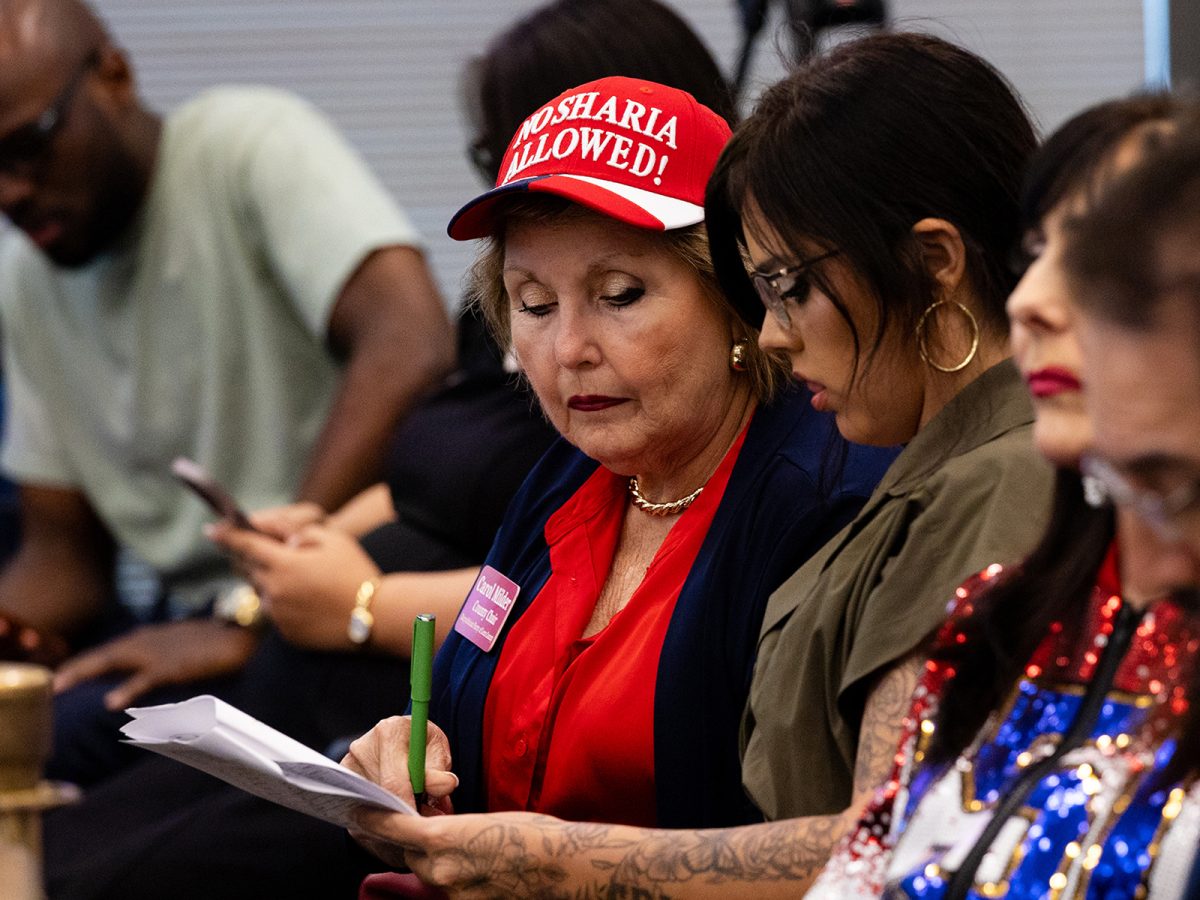
Carol Milder, chair of the Leon County Republican Party, wears a hat reading “No Sharia Allowed!” while attending a Texas State Board of Education hearing at the Barbara Jordan State Office Building in Austin, TX on Monday, June 22, 2026. (RNS photo/Angela Wang)
On Election Day, Hinojosa beat Abbott, a three-term governor, by more than seven points, becoming the first Democrat elected governor of Texas since 1990.
Abbott was one of several Republicans who campaigned on anti-Shariah messaging and lost. Shariah, Arabic for “path,” refers to Islamic guidance covering worship and everyday life. Texas, where GOP candidates embraced anti-Muslim rhetoric, was the state where it failed most visibly, but it wasn’t the only place.
In Georgia, Republican state Sen. Greg Dolezal, running for lieutenant governor, released an AI-generated ad showing schoolgirls wearing hijabs followed by depictions of terrorists breaking into houses. “Keep Georgia Sharia Free” was the ending message. He lost to Democrat Josh McLaurin. In Michigan’s Senate race, Republican Mike Rogers called his Democratic opponent, Dr. Abdul El-Sayed, “the most radical extreme candidate,” adding he was “pretty close” to the Muslim Brotherhood, which the U.S. designated a terrorist organization. President Donald Trump also called him a “jihadist,” a claim made without evidence.
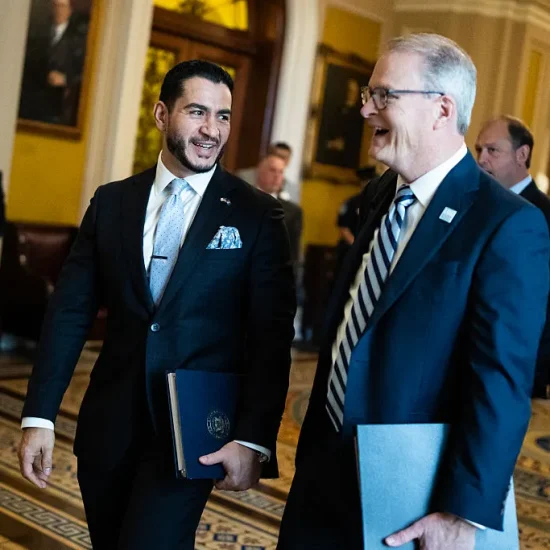
El-Sayed became the first Muslim elected to the U.S. Senate. Another seven Muslims were elected to the House of Representatives, a record. And in Texas, Democrats flipped every statewide seat on the ballot on Nov. 3.
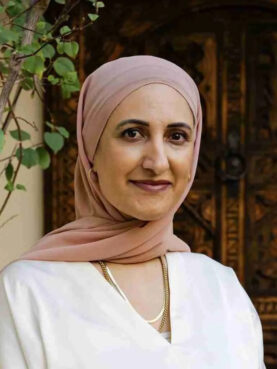
Nabila Mansoor. (Photo courtesy of ATJ Action Fund)
“This was a real repudiation of the GOP strategy that they could build an entire political future on hate,” said Nabila Mansoor, executive director of Asian Texans for Justice, a nonprofit devoted to organizing Asian Americans and Pacific Islanders in Texas. “It wasn’t enough, and our voters told them that.”
In 2024, Republicans had made inroads with some Muslim voters: Angered by the Biden administration’s handling of Israel and the Gaza war, 10% of Muslims who voted for Biden in 2020 said they voted for Trump in 2024, according to the Institute for Social Policy and Understanding, an organization that studies American Muslims.
But indications are that the backlash in 2026 may have erased those gains. In an exit poll commissioned by the Council on American-Islamic Relations, a Muslim civil rights group, 93% of 522 Muslim registered voters nationwide said they voted in the general election. Eighty percent said they backed Democrats and 6% Republicans, with 70% saying Islamophobia motivated them to vote. In 2024, 86.2% of surveyed Muslims said they voted in the general election, according to CAIR’s exit poll. In Dearborn, Michigan, a majority Arab-American city, voters turned out in record numbers, the city’s Mayor Abdullah Hammoud said.
For Democrats, the anti-Muslim campaign was “a winning strategy,” said Basim Elkarra, executive director of CAIR-Action, a PAC, and senior adviser to the Unity and Justice Fund, a super PAC that backed Democratic candidates in Texas and Michigan, among other states.
“We thank Trump and (Mike) Rogers and the Republican establishment for using Islamophobia because it turned out our people all around the country, from Kansas to Ohio, Texas, Michigan.”
The Republican Party of Texas did not respond to a request for comment.
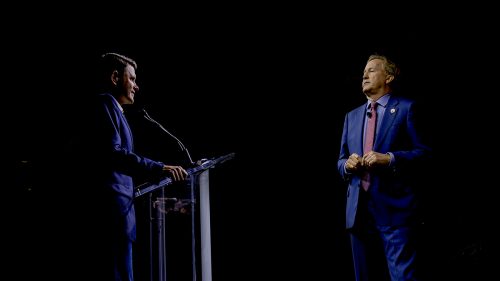
Photo illustration with James Talarico and Ken Paxton, Democratic and Republican nominees for U.S. Senate, at their respective state conventions in June. (Source photos by Eddie Gaspar/the Texas Tribune)
In a Nov. 4 lecture to his congregation at the East Plano Islamic Center, Yasir Qadhi, a prominent Islamic scholar, said the Texas Muslim community should feel validated by Abbott’s loss. “How can we not take a personal joy and a personal vindication?” he said.
“The governor thought that by banning Shariah, that is what Texans wanted, and he only finds out that voters decided to ban him instead.”
With the Republican Attorney General Ken Paxton, Abbott led an anti-Shariah campaign in Texas. His first target was EPIC City, a proposed Muslim-focused development centered around EPIC (Qadhi’s mosque). Abbott launched investigations into EPIC City, signed a law banning what he called “Shariah compounds,” and designated CAIR a terrorist organization. CAIR, which has denied links to terrorism, is challenging the designation in court. Meanwhile, a judge ruled the EPIC development project could proceed.
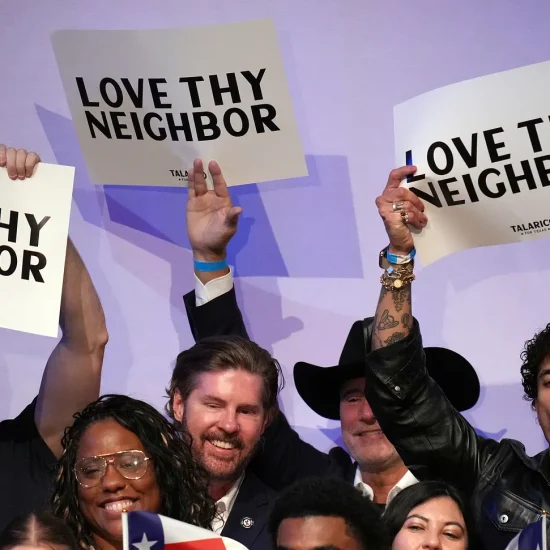
Paxton, who ran for Senate, lost to Democrat James Talarico.
It’s difficult to measure just how much anti-Muslim and anti immigrant rhetoric hurt Republican candidates in Texas, but Garrett Fulce, a Texas Republican consultant and host of Seeing Red, a conservative politics podcast, is among those who believe it did.
He notes in Fort Bend, a county southwest of Houston, Republicans had previously tried to court the suburb’s growing number of Muslim and Hindu voters. With the pervasive anti-Muslim rhetoric from Republican candidates — which he called “pretty disgusting” — Fort Bend swung toward Democrats. The rhetoric was “driven towards turning out voters who just don’t like the idea of being in communities with peoples of other faiths,” he said.
Residents in the state’s most reliable red counties either stayed home or voted Democrat, according to a Texas Tribune analysis.
That’s largely because Republican candidates did not address economic issues, such as high grocery and gas prices, said Calvin Jillson, a political science professor at Southern Methodist University in Dallas.
“The Republican Party says, ‘we know you’re having trouble affording food, but these Muslims are trying to take over, and they’re going to implement Shariah law,’” Jillson said. “It’s just a non sequitur to people’s real concerns and interests.”
One of the clearest examples of anti-Muslim and anti-semitic messaging came from Republican Bo French, who, in a now-deleted X post, asked if Jews or Muslims posed a “bigger threat to America.” French faced widespread backlash, including from his own party, and lost his bid for a seat on the Texas Railroad Commission. Democrat Jon Rosenthal defeated French, making him the first Democrat elected to the powerful state regulatory agency in decades. French did not respond to a request for comment.
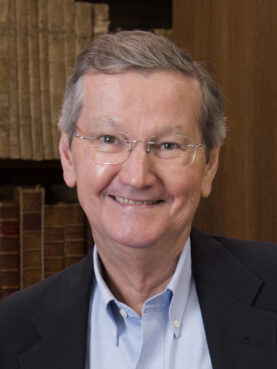
Calvin Jillson. (Photo © SMU)
Another factor for Republicans’ sweeping loss in Texas is that they became “so used to winning” and assuming their nominees will prevail in the general election, said Jillson. “(Candidates) feel as if they can just let it rip and say outrageous stuff without consequence — and I think we’ve just seen the consequences.”
For many Muslims, the results also pointed to the value of their organizing.
Sania Rahim, a physician in Houston, mobilized fellow Muslim doctors through WhatsApp chats to support candidates and vote in the primaries and midterms. She said unprecedented Islamophobia in Texas and the war in Gaza motivated her and other Muslim Texans to become politically engaged for the first time.
“We have been granted a reprieve by God,” Rahim said. “We have the chance to breathe and to figure out our strategy to move forward because Islamophobia is over for now, but the actors who promote it are still there.”
Not every Republican who leaned on the rhetoric paid a price. Dozens of Republican lawmakers who are part of the Congressional Sharia-Free America Caucus won reelection, including Keith Self of Texas’ 3rd Congressional District and House minority whip Tom Emmer of Minnesota’s 6th Congressional District. Rep. Randy Fine of Florida, who posted in February that the “choice between dogs and Muslims is not a difficult one,” also easily won re-election in his solidly Republican district
It’s still an open question whether the Republican Party, in Texas and nationally, will change its tone toward Muslims. The Republican National Committee did not respond to a request for comment.
Elkarra said he believes that Republicans may change course and attempt to court Muslim voters in battleground states and swing districts come 2028.
Sameeha Rizvi, government affairs and legislative manager with CAIR-Action, said now is the time to keep Muslim communities engaged in political organizing.
CAIR-Action, CAIR’s PAC, endorsed several Democrats in Texas, including Hinojosa and U.S. Senator-elect Talarico. The group also hosted voter registration at local mosques and digital advertising targeting Muslim voters in Texas.
“We can’t get too comfortable,” Rizvi said. “I think the moment we take our foot off the gas pedal is when that hate will start to come back, and it’ll fester again, and it’s gonna rebuild.”