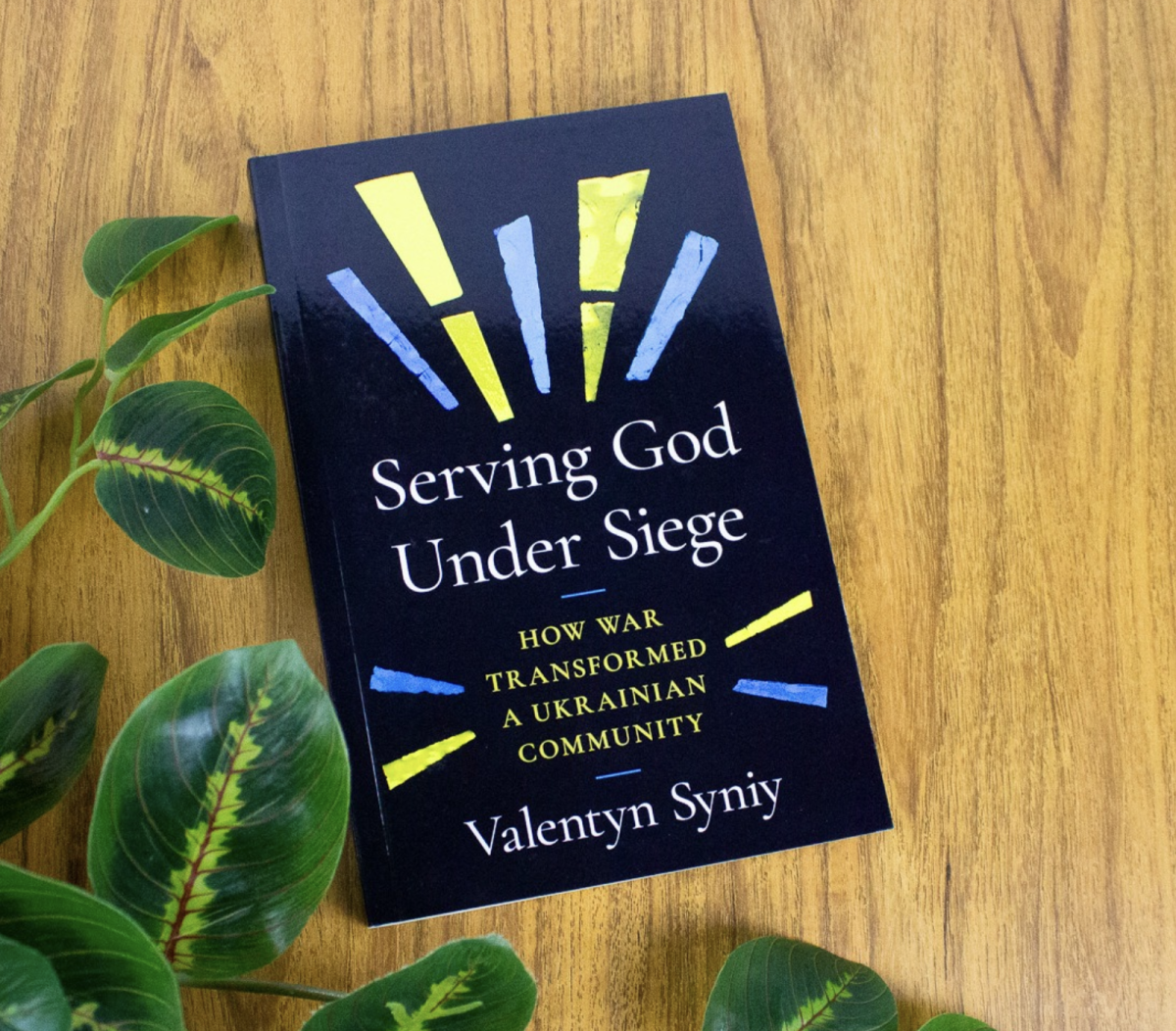
SERVING GOD UNDER SIEGE: How War Transformed a Ukrainian Community. By Valentyn Syniy. Grand Rapids, MI: Wm. B. Eerdmans Publishing Company, 2025. Ix + 253 pages.
When Russia invaded Ukraine in February 2022, I was serving in an interim capacity at a local church. We placed a Ukrainian flag on the digital sign with the words “Praying for Ukraine,” as a sign of solidarity. Initially, it seemed as though the more powerful Russian Army would reach Kyiv in just a few days, perhaps incorporating Ukraine into a new Russian Empire. It’s been nearly four years since the Russian invasion, but the Ukrainians continue to fight back, keeping the Russian Army at bay, despite constant bombardment from drones and missiles that seem to be directed at civilian targets. Here in the United States, the plight of the Ukrainian people has taken a backseat as we address other pressing matters, even as the current administration at times seems to back Russian goals. The longer wars go on, the easier it is to abandon alliances and devote one’s energy elsewhere. Nevertheless, we should not forget the Ukrainian people who have resisted their powerful neighbor at the cost of many lives. With that in mind, it is helpful to hear from voices from the front lines to better understand what is truly happening.
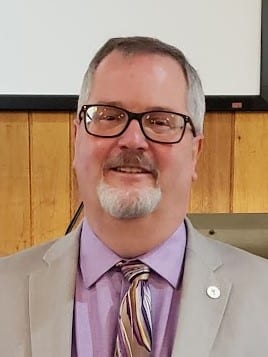
Robert D. Cornwall
In Serving God Under Siege: How War Transformed a Ukrainian Community, Valentyn Syniy, president of Tavriski Christian Institute, an evangelical seminary in Kherson, Ukraine, offers a firsthand account of the devastation brought upon the Ukrainian people. I had an opportunity to meet and hear from Valentyn Syniy at the recent 2025 AARSBL meeting in Boston. Therefore, I was able to hear firsthand about the challenges facing the Ukrainian people, including Christian communities like his. Syniy, his family, and the community of which he is part live in Kherson, which lies in the southern part of Ukraine, near Crimea. While the Russians illegally occupied Crimea in 2014, they seek to occupy the entire Kherson region. The city of Kherson, which the Russians occupied but eventually lost, when the Ukrainian Army reclaimed the city, lies close to the border and was an early target of the Russian invasion.
In Serving God Under Siege, Syniy takes us on a journey that begins with the February 2022 invasion that led to the evacuation of the seminary, much of his family (his father, who is a Baptist pastor in Kherson, remained in the city), along with thousands of Ukrainians who live in Kherson. Although they had begun preparing for the possibility of an invasion, the Russian attack came quickly, forcing a quick departure as the Russian army approached the city. As he tells the story of the invasion and evacuation, we get a sense of the true realities of the war, especially as it affects civilians.
As we read Serving God Under Siege, we follow Syniy, his family, and members of his community of evangelicals, as they flee to the western part of Ukraine, along with thousands of others, trying to stay ahead of the Russian advance. He tells of the challenges of finding vehicles as well as gas to carry the people to safety, along with the challenge of finding places to stay along the way. Because so many people were evacuating, progress toward safety was slow. Needing additional transportation as they departed the city, they purchased a Mercedes van, that had flat tires when they purchased it, as they left the city. While they got the tires inflated and the van started, they faced numerous mechanical problems. The book, at times, reads as if it were an adventure story, only that this is not an adventure; it is a life-and-death struggle for survival. As the story continues, Syniy and his community reach the western Ukrainian city of Ivano-Frankivsk, where TCI had made arrangements with Baptist churches for housing (they were not the only refugees streaming toward that city). They would make that city in the foothills of the Carpathian Mountains their home until Kherson was liberated.
The good news is that the people in the city of Ivano-Frankivsk welcomed the refugees. However, there were cultural differences that proved challenging for the refugees from southern Ukraine. As for TCI itself, the seminary’s ability to provide education for pastors in training was curtailed. Instead of focusing on education, Syniy and others in his community began organizing efforts to provide support to the refugees from the frontline areas. They also began making trips into Kherson to bring people stranded in the city to safety. Syniy also considered joining the army, but he recognized that he could be more effective in leading relief efforts. Even as he and his community committed themselves to the relief effort, they began to hear reports from Kherson about what was happening at the seminary property, which Russian soldiers had occupied. The soldiers looted the buildings, taking expensive equipment and resources, while laying waste to the library. Syniy shares very matter-of-factly the challenges of gaining support for their efforts from outside the region. While he had developed a strong set of connections in Western Europe and the United States for the educational and missional efforts, sometimes these outside supporters were less interested in supporting the relief efforts. Nevertheless, they persisted in the work.
There is good news to share amidst the devastation. We hear stories of how the communities came together to support each other. This includes other seminaries that helped support TCI, especially once they returned to Kherson and began rebuilding their seminary. But even before they returned to Kherson, TCI set up a makeshift educational center in Ivano-Frankivsk, in part with the help of other schools. While they lacked all the resources of the school that had been built up over the twenty-five years of the seminary’s existence, they were determined to continue with their calling to raise up pastors and leaders for the churches. They even found time to celebrate the twenty-fifth anniversary of the founding of the seminary. Syniy also addresses the need for prophetic voices in the face of the challenges posed by the Russian invasion, even though they failed to raise the consciousness of Russian Christians, considering the atrocities committed against the Ukrainian people by Russian soldiers.
As we progress through time, we watch as the people connected to TCI long to return home in Kherson, even while settling into their exile in their adopted homes. Syniy offers a strong defense of self-sufficiency while recognizing the need for assistance from outside. Throughout the book, Syniy raises theological questions, reminding us that a situation like this one can challenge a person’s and a community’s theology in ways that are very different from situations that are much less dire. He acknowledges that the war did serve as a blow to the faith of many Ukrainian Christians. Many left their churches and stopped believing in God. He offers a chapter titled “Theology After Bucha,” which wrestles with the Russian massacre of the people of the village of Bucha, a massacre that demonstrated that the Russian purpose was to annihilate the Ukrainians. The situation in Ukraine raises important questions about how Christians should involve themselves in politics and matters of state. Should they stay neutral as their nation is being invaded? But as we see here, that is not possible.
There is good news in the end. Kherson is liberated, and the people have begun returning home (at least for now). Unfortunately, the TCI property, which had been built up over twenty-five years of existence, had been devastated. But they could return home. That is the good news. Of course, the war is not over. The tide could again turn (Vladimir Putin desires to control the Kherson region). However, a book like this can help those of us living at a distance from the war gain a close-up view of the situation that seemingly doesn’t affect our lives. As one who has tried to stand in support of the Ukrainian struggle, I am grateful that Valentyn Syniy wrote Serving God Under Siege so that we in places like the United States, where support for the Ukrainian effort is tenuous at best. I hope the book will gain a wide readership so that others, especially those who are skeptical of the Ukrainian cause, can get a better sense of what is happening in Ukraine. Having the opportunity to not only read this firsthand account of a community’s struggle to survive in the face of a war, but also to meet the author in person, has helped me gain a better understanding of what is at stake in this war, especially when it comes to the church in Ukraine.
This review originally appeared on BobCornwall.com.
Robert D. Cornwall is an ordained minister in the Christian Church (Disciples of Christ). Now retired from his ministry at Central Woodward Christian Church (Disciples of Christ) of Troy, Michigan, he serves as Minister-at-Large in Troy. He holds a Ph.D. in Historical Theology from Fuller Theological Seminary and is the author of numerous books, including “Eating With Jesus: Reflections on Divine Encounters at the Open Eucharistic Table” and “Second Thoughts About Hell: Understanding What We Believe” coauthored with Ronald J. Allen. His blog Ponderings on a Faith Journey can be found here.