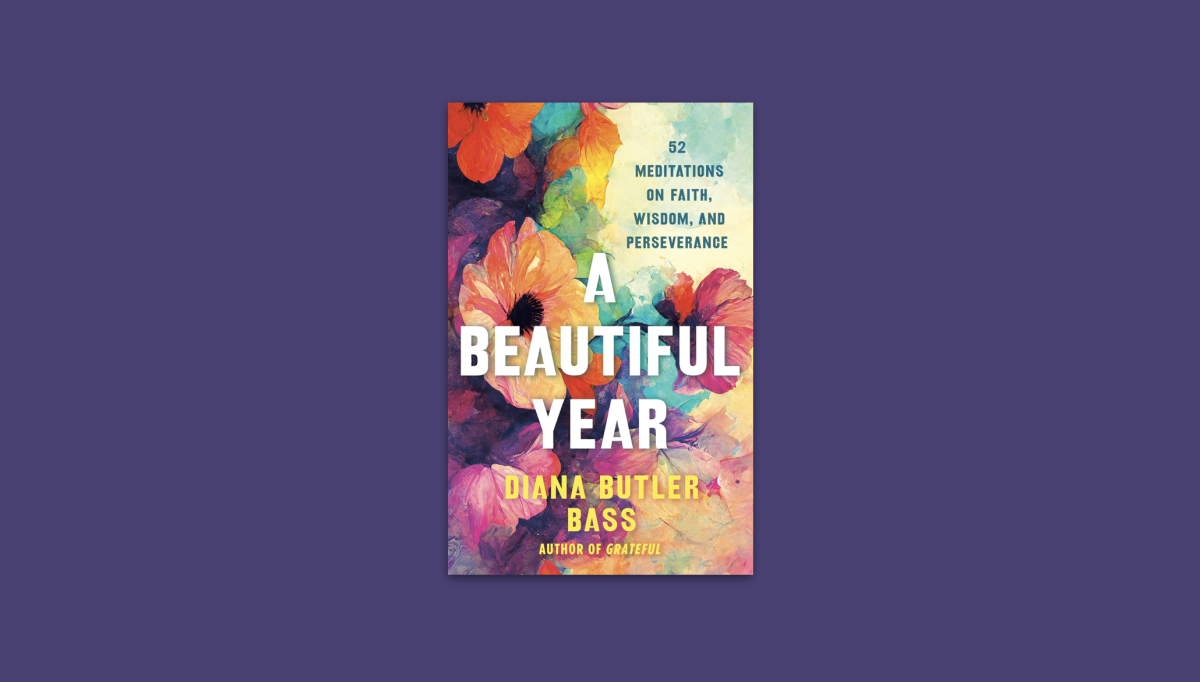
A BEAUTIFUL YEAR: 52 Meditations on Faith, Wisdom, and Perseverance. By Diana Butler Bass. New York: St. Martin’s Essentials, 2025. 323 pages.
We live in challenging times. There are wars aplenty, turns toward authoritarianism in what have been stable democracies, and a growing coarseness in our social conversations (not just in our political ones). For Christians with a progressive perspective, there is a need for spiritual resources that provide wisdom and foster perseverance. Fortunately, those resources are available. Some of these resources are deeply rooted in tradition, including the liturgical year that runs from Advent through Pentecost, ending on Christ the King Sunday. Who better to lead us through the year than Diana Butler Bass?

Robert D. Cornwall
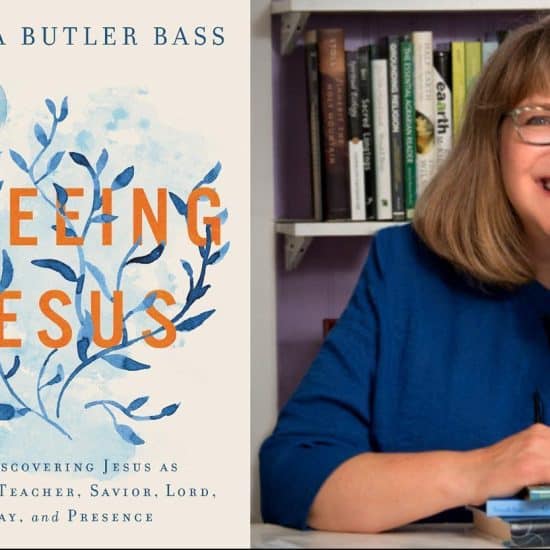
Diana Butler Bass is one of the better-known Christian authors and scholars of our day. Her books include studies of Church History (A People’s History of Christianity), church life (Christianity for the Rest of Us and Christianity after Religion), theology (Freeing Jesus), and spirituality (Grateful and Grounded), along with a few more. Like many of us, she has been on a spiritual journey that started in mainline churches, moved into evangelicalism, and then post-evangelicalism. As she has taken that journey, she has gathered wisdom, which she has shared with readers and those who have heard her speak. Because she has spent much of her career in the public sphere, she has persevered. Her faith and her wisdom are on full display in her latest book, A Beautiful Year: 52 Meditations onFaith, Wisdom, and Perseverance.
I often review books written by authors I do not know personally. Many of them are people whom I’ve not encountered before receiving the review copy. Therefore, I can be a bit more objective. There are others, Diana being one, with whom I’ve had a long-standing relationship. So, I approach a book like this from a more personal perspective. In other words, I know much of the backstory to what she shares in her books. In our conversations over the years, I have discovered that our spiritual journeys have paralleled each other (we are essentially the same age, and had she gone to Fuller rather than Gordon-Conwell for seminary, we would have been seminary colleagues). So, I find it difficult to refer to her by her last name. So, in this review, I will speak of Diana, not Bass.
Diana has been speaking for more than two decades about the intersection of faith and contemporary life. She brings her training as a church historian (she holds a Ph.D. in American Church History from Duke University) together with lifelong experience in the church, along with great communicative skills that allow her to speak words of wisdom that resonate with many contemporary Christians. I appreciate her willingness to explore and speak to the concerns on the hearts of many inside and outside the church. She often does so, by drawing not only on her skills as a scholar, but personal experience in the church and in the world beyond. Now, in A Beautiful Year, she does something different, offering readers a year-long devotional that follows the liturgical year. She shares in the introduction a word about calendars, which she says “tell stories.” They tell stories about “who we honor, what we treasure, what we aspire to. They are teaching devices — doing their work through cycles of repetition and ritual” (p. 1). While our “secular calendar” is largely an inheritance from the Roman Empire, the liturgical calendar offers us a different vantage point to mark time, one that tells a different story.
Readers of A Beautiful Year are invited to inhabit that different story that takes us deeper into our faith as Christians. If we follow this calendar, marking it by picking up this series of meditations each week, we discover, as Diana points out, that “the Christian year is a cycle of stories and rituals based on the life and teachings of Jesus” (p. 5). That is a key point that needs to be embraced by contemporary Christians who often lose sight of Jesus, as we merge Christianity and nationalism. Now, A Beautiful Year is not a daily devotional. Rather, it contains fifty-two meditations, enough to pick up one a week. Most of the meditations are based on essays posted on her Substack page, The Cottage.
Being an Episcopalian, Diana knows the rhythms that the lectionary provides as one moves through the liturgical year. This spiritually defined year begins with Advent, which generally begins the last Sunday of November or the first Sunday of December, and flows on for fifty-two Sundays until the church reaches Christ the King Sunday, which is not her favorite Sunday. Like many, the word king is problematic, because “it is wedded to social privilege and pyramids of wealth and power and invested with centuries of inequities and fairy-tale fantasies” (p. 310). Nevertheless, it is part of the year, so we must deal with it. So, she suggests we deconstruct the concept of monarchy, which is a worthwhile project. So, as we follow the liturgical calendar, we move through the year, picking up each of the major seasons — Christmas, Epiphany, Lent, Easter, Pentecost, and Ordinary Time (also known as the Sundays after Pentecost).
Along the way, she devotes more meditations to some seasons than to others. Thus, there are seven meditations for Advent (including Christmas Eve), along with six meditations for the season of Christmas, but only nineteen for Pentecost, which covers half the year. Fortunately, Diana gives readers permission to pick and choose meditations that speak to them, no matter the time of year. So, if you want to read her meditation on “The Greatest Christmas Special Ever Aired” in July, you may do so. Since we both grew up in the 1960s and 1970s as late Baby Boomers, she mentions three — Rudolph the Red-nosed Reindeer (1964), Charlie Brown Christmas (1965), and How the Grinch Stole Christmas (1966)—but I’ll let you discover which is her favorite of the three. The key here is that all three carry quite well the message of the season that God loves everyone. I picked that one because it resonated with me.
Because Diana has drawn her meditations from her Substack blog, each reflection picks up on insights that have come to her at a particular moment. While particular moments spark the conversation, they are not so time-defined that they won’t transcend the particular moment that sparked them. What makes this particular set of meditations different from many is that it speaks theologically to concerns that many progressive Christians have about the world we live in. She speaks to people like me who have been part of the church our entire lives, never thinking about abandoning our faith, while also speaking to those who struggle, especially those who, like Diana (and me), find themselves in a post-evangelical world. As the subtitle reminds us, this is a set of meditations that speaks of “faith, wisdom, and perseverance.” For many, that last word is an important one. How do you persevere as a believer when the world seems out of control? Where might God be present in all of this? Having a book like this, one that emerges out of Diana’s own journey as a public theologian who has faced significant pushback, especially since she is a woman who is speaking into spaces that many conservative Christians believe belong to men.
She writes in her conclusion to this set of meditations, after having walked with us through the liturgical year, picking up on its various messages, while addressing difficult texts and topics, that “Christianity isn’t linear time. Rather, time wends through rituals and readings to be experienced all over again” (p. 314). That is quite true because once one reaches Christ the King Sunday in late November, the next Sunday is the First Sunday of Advent. With the first Sunday of Advent, everything starts over again with the call to prepare ourselves for the coming of God’s realm. While the liturgical calendar doesn’t really change (yes, three cycles follow the story lines offered by Matthew, Mark, and Luke — with John sprinkled through each of the three cycles), she acknowledges that we change as time passes. Thus, “some years, the stories speak with urgency; other years, they may bore with their repetition.” So, we may experience some things that are familiar to us, and then we’ll be surprised as we encounter something new. Thus, she writes that “The Christian year isn’t a line. It isn’t a circle. It is a spiral of spiritual wisdom from Jesus through the millennia to us” (p. 315).
Those people who have read Diana’s earlier books know that she is a gifted communicator and writer. They will not be disappointed by this book, even though it is different from earlier books. Even if she draws from her Substack page for meditations, they may speak to readers differently here than on that site. So, as one works through A Beautiful Year, they will gain the benefit of the wisdom that Diana Butler Bass accumulated during her years of walking through the liturgical year, wisdom shared here in the form of fifty-two beautifully written meditations.
This review originally appeared on BobCornwall.com.
Robert D. Cornwall is an ordained minister in the Christian Church (Disciples of Christ). Now retired from his ministry at Central Woodward Christian Church (Disciples of Christ) of Troy, Michigan, he serves as Minister-at-Large in Troy. He holds a Ph.D. in Historical Theology from Fuller Theological Seminary and is the author of numerous books, including “Eating With Jesus: Reflections on Divine Encounters at the Open Eucharistic Table” and “Second Thoughts About Hell: Understanding What We Believe” coauthored with Ronald J. Allen. His blog Ponderings on a Faith Journey can be found here.