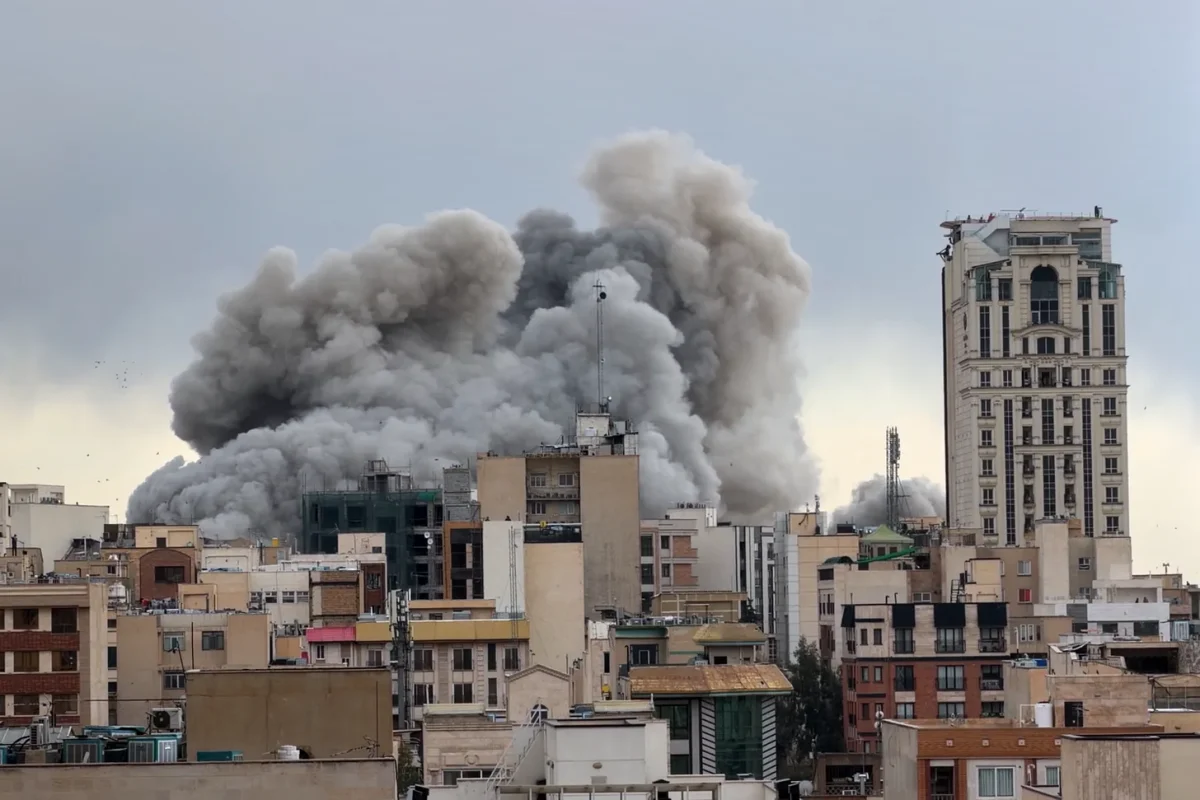
(RNS) — In the hours before President Donald Trump announced a two-week ceasefire in the war with Iran, religious leaders across faith traditions responded with alarm after the president’s message Tuesday morning (April 7) warning that “a whole civilization will die tonight.”
FILE: A plume of smoke rises after a strike in Tehran, Iran, on March 2, 2026. (Mohsen Ganji/Associated Press)
“A whole civilization will die tonight, never to be brought back again. I don’t want that to happen, but it probably will,” Trump wrote on his Truth Social account.
In response, X and other social media platforms were flooded with reactions from lawmakers, clergy and faith leaders.
The deadline, originally set for 8 p.m. Eastern Daylight Time, was being described by the Trump administration as a last chance for Iran to agree to U.S. demands tied to reopening the Strait of Hormuz, a vital shipping lane for the world’s oil and gas. If Iran did not comply, Trump warned the U.S. could carry out military strikes on major infrastructure targets.
Pope Leo XIV, who has made speaking up for peace a cornerstone of his early, sometimes soft-spoken papacy, called Trump’s threat targeting “all the people” of Iran “truly unacceptable,” as he was leaving Castel Gandolfo, his country house in Italy.
“I would invite the citizens of all the countries involved,” Leo said, “to contact the authorities — political leaders, congressmen — to ask them, to tell them, to work for peace and to reject war and violence.”
Advocacy groups and religious leaders in the U.S. were also quick to denounce Trump’s comments, criticizing his threats to attack civilian infrastructure.
Several U.S. Catholic bishops echoed Leo’s comments on social media. The president of the U.S. Conference of Catholic Bishops, Oklahoma City Archbishop Paul Coakley, also used unusually strong rhetoric in responding. Coakley said in a statement that “the threat of destroying a whole civilization and the intentional targeting of civilian infrastructure cannot be morally justified.”
“There are other ways to resolve conflict between peoples,” the archbishop wrote. “I call on President Trump to step back from the precipice of war and negotiate a just settlement for the sake of peace and before more lives are lost.”
The USCCB has often avoided directly naming Trump in its criticism of his policies, including in special messages opposing indiscriminate mass deportation, which makes Coakley’s choice to call on Trump directly stand out.
Coakley was the first Catholic bishops’ president to meet with a U.S. president in nearly a decade. A January meeting between him and Trump, which produced smiling photos of the two together, seemingly paved the way for the administration to announce religious visa changes sought by the conference.
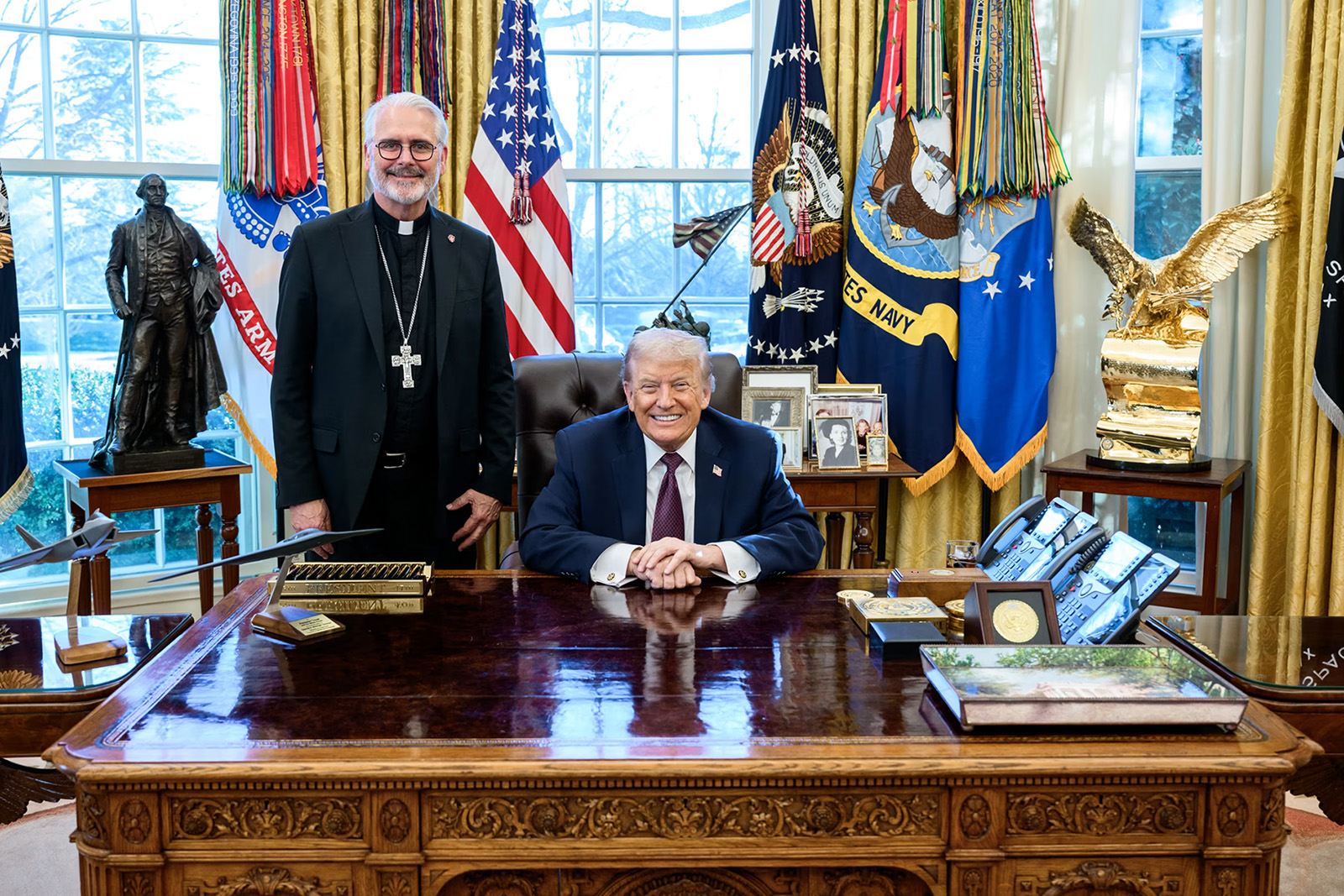
Archbishop Paul Coakley of Oklahoma City, president of the U.S. Conference of Catholic Bishops, meets with President Donald Trump at the White House on Jan. 12, 2026. (Official White House Photo)
In his statement, Coakley invited U.S. Catholics to join Pope Leo XIV’s prayer vigil for peace on Saturday in their parishes, virtually or in individual prayer.
Since the U.S.-Israeli war with Iran began at the end of February, more than 1,900 people have been killed in Iran, and more than 1,500 people have been killed in Lebanon, The Associated Press reported. Eleven Israeli soldiers have died in Lebanon, 23 people have been reported dead in Israel, and 13 U.S. military members have been killed.
The Council on American-Islamic Relations, the nation’s largest Muslim advocacy organization, condemned Trump’s rhetoric as “unhinged, racist and genocidal.” The group called on Congress to reconvene and vote to end the war on Iran.
Imam Steve Elturk, co-chair of the Imams Council of Michigan, condemned Trump’s Sunday social media comment, which Elturk said seemed to mock the sacred religious expression “Praise be to Allah.”
“(Trump’s) statement, which includes threats of devastation against Iran and the use of vulgar and inflammatory language, represents a dangerous escalation that undermines both international stability and the moral fabric of public discourse,” Elturk said at a press conference organized by the council in Dearborn on Monday. He was joined by nine other religious and community leaders.
The National Iranian American Council, a lobby and advocacy group, said the president’s rhetoric on the war “has reached an unprecedented and deeply alarming level.”
“This language represents a dangerous shift into genocidal rhetoric, where the destruction of civilian life is an explicit goal,” the group wrote in a blog post Tuesday. “This is a direct threat to a civilization of more than 92 million Iranians, whose survival depends on electricity, transportation, water, and public services.”
A survey of 508 Iranian Americans by NIAC and Zogby Analytics last month found 66% opposed the war, while 33% supported it (1% didn’t answer).
Robert P. Jones, president of the Public Religion Research Institute and a leading scholar on Christian nationalism, said Trump’s comments diverge from long-standing Christian moral teachings on war.
“For an administration that has been using religious language to justify the war, it’s remarkable that they have completely avoided engaging Christian moral theology on this point,” Jones said.
Even in cases where war is considered justified, Jones said, moral theology places limits on conduct in war, including on proportionality and protecting civilians from harm.
“The kind of thing that President Trump is talking about doing is not only a war crime in international law, but it runs afoul of the most plain teaching of the Christian just war tradition,” he said.
The Rev. Jacqueline Lewis, senior pastor of Middle Church, an inclusive Protestant congregation in Manhattan, echoed Jones’ assessment, saying Trump’s comments have shocked her and members of her church community. “This is a war crime,” Lewis said. “This is an intent to commit genocide.”
Trump has made comments online and at public appearances throughout Easter weekend threatening large-scale strikes on infrastructure such as bridges and power plants in Iran. Jones said his recent rhetoric can also be understood through the lens of Christian Nationalism, which often depicts geopolitical conflict as a struggle between good and evil.
“This vision of a clash of civilizations is absolutely at the heart of a Christian Nationalist worldview,” Jones said. “If you cast a political conflict as a cosmic war between good and evil, it lends itself to an unlimited war with unlimited means.”
Bishop John Stowe of Lexington, Kentucky, who is bishop president of the Catholic peace group Pax Christi USA, told RNS in a text message that Trump is “every day” surpassing “his previous outrageous statements.” Stowe said, “I never thought I would hear a US President publicly threaten to annihilate a civilization.

Bishop John Stowe, right, speaks during a prayer vigil outside the White House, May 3, 2024, in Washington. (RNS photo/Jack Jenkins)
“Someone in government needs to restrain him before he does more irreparable damage. The US cannot exempt itself from restrictions on war crimes,” he wrote.
Art Laffin, a Catholic Worker and peace and nuclear disarmament activist, also condemned Trump’s remarks, calling them “an affront to God and a crime against humanity,” and he urged faith leaders to speak out against the threat of military action.
In a statement, quoted Pope Leo’s Palm Sunday homily, calling for nonviolence. “Lay down your weapons! Remember that you are brothers and sisters!” he wrote.
Some Democrats, as well as former U.S. Rep. Marjorie Taylor Greene, a Republican, have called for Trump’s Cabinet to invoke the 25th Amendment to the Constitution, which would remove a president unfit for office. Others, including some lawmakers, have publicly speculated Trump may intend to use nuclear weapons.
Santa Fe, New Mexico, Archbishop John Wester, known for his outspoken advocacy against nuclear weapons, told RNS that he did not interpret Trump’s comment as being about nuclear weapons. However, he said he was not surprised that some people were concerned about nuclear weapons use, calling those concerns “one of the many reasons we have to get rid of them because they’re always a threat.”
But criticism of Trump’s comments is also coming from the Catholic right. Catholics for Catholics, a group that has historically supported Trump, tweeted that “threatening to eliminate an entire civilization should make us all pause today to pray for peace in the world.”
Russell Moore, a prominent evangelical theologian, editor-at-large of Christianity Today and an ardent critic of Trump since 2016, wrote on X: “That one can excuse or ignore this while claiming to be ‘pro-life’ is a sign of a seared conscience. God have mercy on us all.”
Still, some evangelical Christians, who make up a crucial base of Trump’s supporters, commended his rhetoric. Joel C. Rosenberg, an American-Israeli evangelical writer, posted on X that although Trump’s language may be “vulgar,” he was “deeply impressed with the President’s decisiveness and resolve,” adding that Trump is “sending a clear and strong message to Tehran” and “has not backed down.”
The liberal Jewish Zionist lobby group J Street said it was “appalled” by the president’s remarks. “This language — a threat to carry out war crimes — is a searing violation of Jewish and American values, certainly will not lead to the de-escalation we desperately need, and is a terrifying example of the senseless violence that has characterized Trump’s leadership,” it said in a Tuesday statement.
And for refugee aid organizations, the consequences of such rhetoric could extend far beyond politics with real-world implications for civilians already affected by the conflict, said Myal Greene, president and CEO of World Relief, a prominent Christian humanitarian organization.
“Rhetorically dangling the fate of an entire people group as leverage is incredibly troubling,” Greene wrote in a statement. “We are already serving families who have had to flee their homes in the Middle East related to this conflict … we are deeply concerned we will face a massive displacement crisis for which the region and world is not prepared.”