NOTE: This piece was originally published at our newsletter A Public Witness.
“I’ve come to view Jesus the way I’ve come to view Elvis. I love the guy, but a lot of his fan clubs terrify me.”
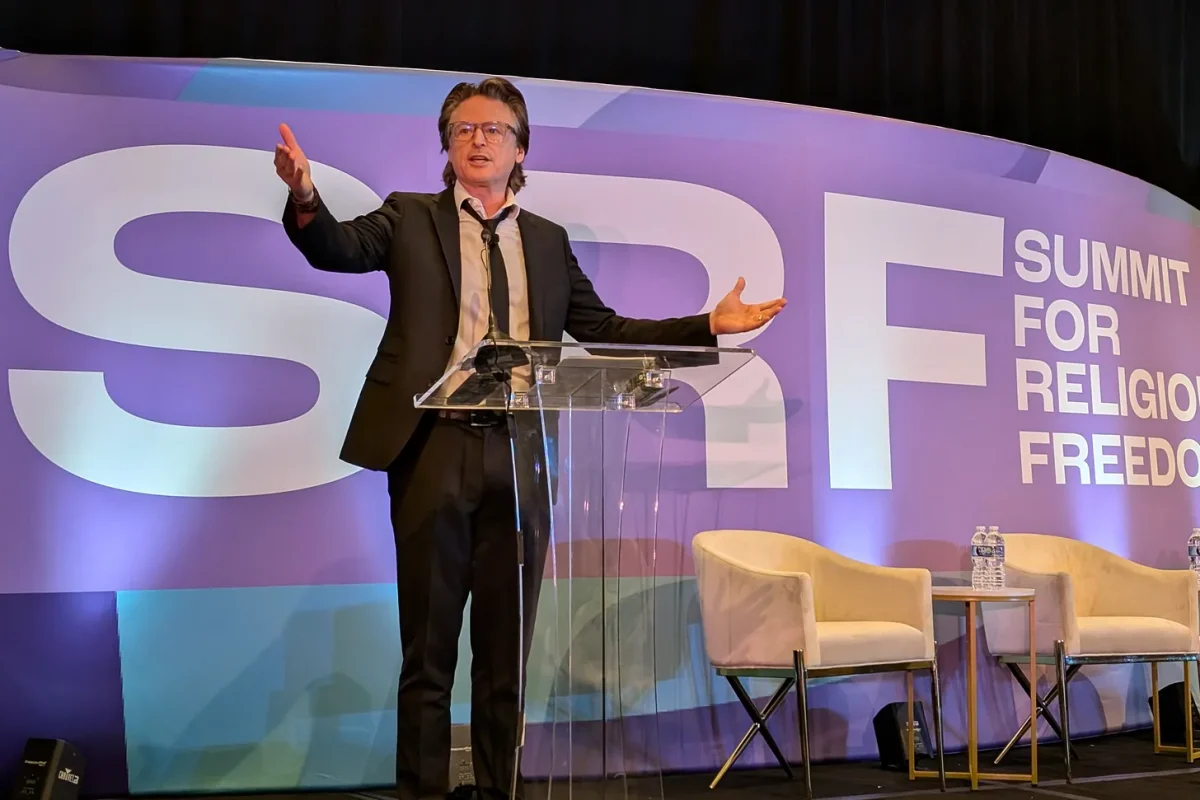
That’s how comedian and actor John Fugelsang joked about the problem of Christian Nationalism during his remarks at the Summit for Religious Freedom in the Washington, D.C., area this week. The summit was organized by Americans United for Separation of Church and State (where I serve as vice chair on the national board of trustees).
Fugelsang mentioned his personal faith — “I aspire to be Christian” — and his upbringing in the Catholic Church, as well as being the child of a former Carmelite nun and a former Franciscan friar: “My father, the brother, met my mother, the sister.” He then tore into the politicization of Christianity. His talk echoed themes in his new book, Separation of Church and Hate: A Sane Person’s Guide to Taking Back the Bible from Fundamentalists, Fascists, and Flock-Fleecing Frauds.
“They’re trying to eliminate the wall between church and state to realize their dream of turning America into a second-rate theocracy, like Iran but with Kid Rock music. And the Ten Commandments are being required in classrooms by Christians who are blindly obedient to a man who’s broken all 10,” Fugelsang said. “The only way you can follow both Donald Trump and Jesus, friends, is if you’ve never read either of their books. Because the only thing Donald Trump has in common with Jesus is they both spent a lot of time around prostitutes and they both used ghostwriters.”
Recalling the recent AI image Trump shared of himself appearing like Jesus, Fugelsang again stressed the contrast: “A man who sells gold sneakers playing a man who told the rich to give everything away. A man obsessed with power playing a man who rejected it. Satan offered Jesus the world, and he said ‘no.’ After the miracle of the loaves and fishes, they tried to make him king and he goes by himself to a mountain to be alone. Jesus was ‘No Kings’ before that was trendy.”
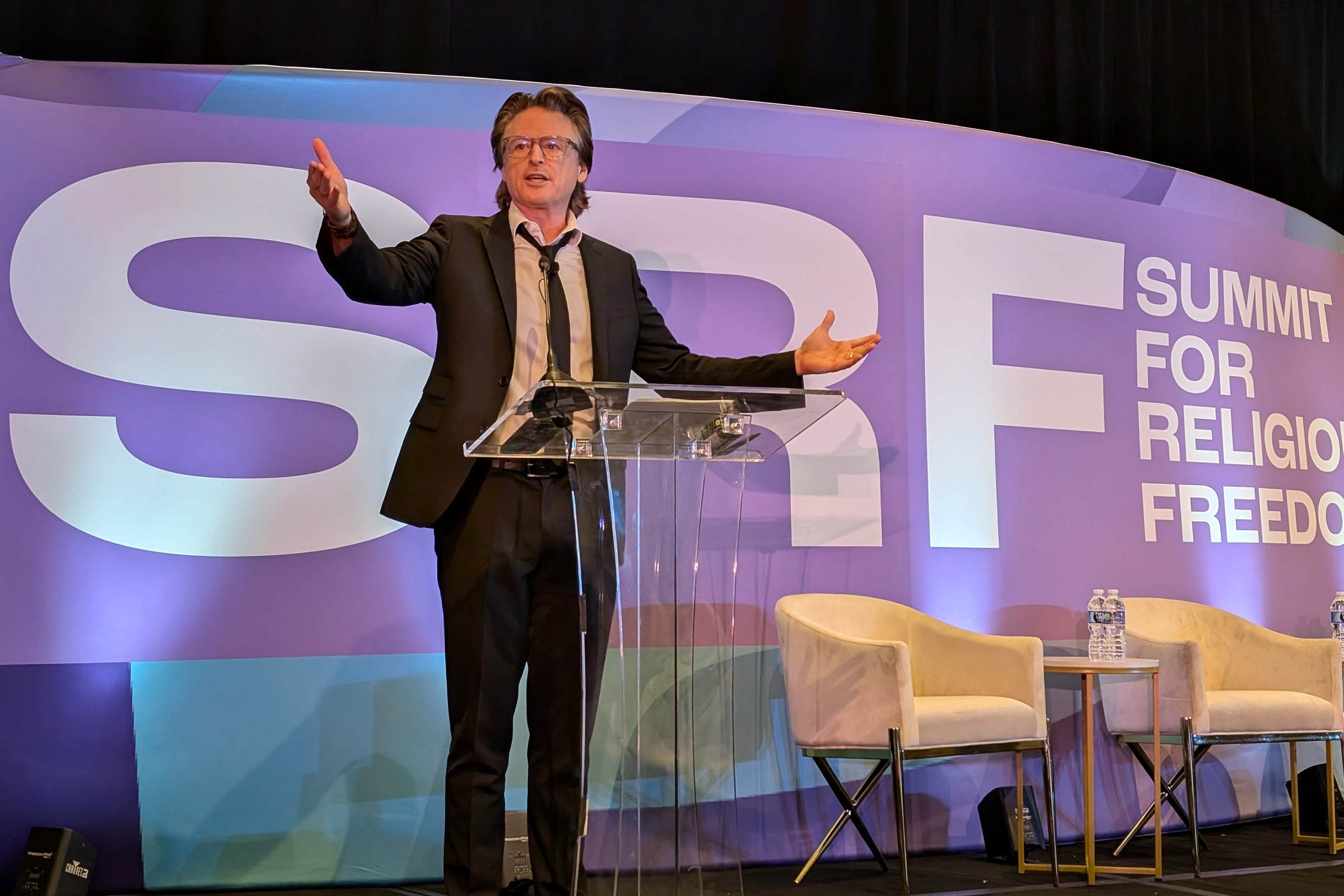
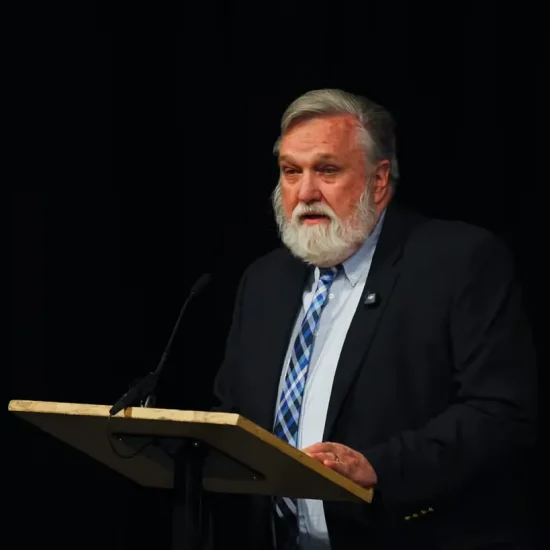
John Fugelsang speaks at the Summit for Religious Freedom in Alexandria, Virginia, on April 26, 2026. (Brian Kaylor/Word&Way)
Fugelsang also directed his comedic zingers at others in the Trump administration for invoking religion to justify hurting people.
“The speaker of the House, Mike Johnson — America’s creepiest youth pastor — says we were founded to be a Christian nation,” Fugelsang said. “Now, you’ve got a secretary of defense — or the secretary of Jägermeister — brazenly, petulantly pontificating on government property to a spiritually diverse volunteer army about his fervent devotion to this gun-toting-alpha-crow Christ, who does not exist in the actual Jesus parts of the Bible. And while these pious posers pontificate, as we all know, they are blowing up schools full of children in Iran [and] they are blowing up people in Venezuelan fishing boats.”
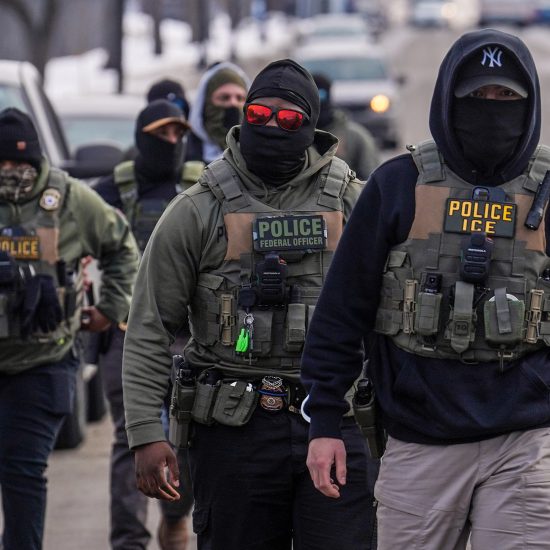
“They’re cutting services to the poorest of the poor. They are protecting wealthy abusers of children. They’re cutting taxes and regulations for the wealthy. And masked cowards with badges are chasing brown kids around church picnics,” he added. “Millions of us were raised to think it’s a religion about peace and love and empathy, and we grew up to find it’s been hijacked by this mean, White supremacist, tax-free click.”
In contrast, Fugelsang praised Pope Leo XIV for pushing back against Trump, Johnson, Hegseth, and Vice President J.D. Vance on the war in Iran by quoting Jesus and other parts of the Bible.
“To delegitimize and expose these frauds, he’s making them fight Jesus. Because he shows up to a microphone and all he does is the greatest hits of Jesus’s teachings: Blessed are the peacemakers, love your enemies. It’s basic stuff. It’s like, wash your hands, don’t eat the silicone gel. It’s not rocket science.”
From Fugelsang’s perspective, the pope’s critiques help show how Christian Nationalism isn’t about Jesus or Christianity but about power.
“Step one, they used Jesus, his name, his movement to gain power. Step two, once they have that power, they do the opposite of everything the character of Jesus says in the book. And step three, when someone points this out, scream that you’re persecuted. That’s been the play,” he explained. “A country founded by deists who didn’t want a king and a religion inspired by a rabbi who commanded us to love our enemies have both been hijacked by these power-hungry frauds.”
The politicians using Christianity for power and the preachers helping them are, for Fugelsang, “fake Christians.” Those pushing such “authoritarian Christianity,” he added, must be challenged like when some Christians and others challenged the powerful Christian leaders who led the Crusades, the genocide of Native Americans, slavery, and the Nazi regime.
“If we don’t label them ‘fake Christians,’ then we’re letting them put MLK in the same basket as the KKK. Same religion on paper, completely different moral universe and practice,” he explained. “If Christianity is defined by the teachings and example of Jesus, then these two things cannot be morally equal expressions of the same thing. One activity aligns with the core ethic, the other one gives it the finger.”
“You can’t hate them, but we have to beat them,” he added. “Most of these mean fundamentalists or Christian Nationalists don’t know the Bible all that well. But they’re counting on the rest of us not knowing the Bible all that well either.”
An Organized Movement
It’s not just a comedian warning about the danger of Christian Nationalism. Scholars, activists, and clergy at the summit also talked about the policy shifts chipping away at the wall separating church and state, sounding the alarm and urging people to push back against this movement.
Guthrie Graves-Fitzsimmons, vice president of programs and strategy at Interfaith Alliance, explained during a panel conversation about the weaponizing of faith against public education that those in power are “rewriting the relationship between church and state” and “actively dismantling the infrastructure meant to protect students.” As an example, he noted there were nearly 23,000 book bans since 2021 in school districts across the nation. And the bans are overwhelmingly coming from activist groups and government officials, not parents.
“This is a coordinated political campaign dressed up as a grassroots movement,” he said. “The organized minority is winning right now, not because they have the support of the American people, but because they have a strategy.”
Beyond book bans, he highlighted other ways Christian Nationalists are attacking religious freedom in public schools. He called it “a cruel joke that the Department of Education” has so-called “patriotic education” that’s “undermining a core American value of religious freedom for all.” He also blasted the idea of posting a highly edited version of the Ten Commandments in classrooms, which is not only religiously coercive but is “also devaluing the Ten Commandments as a religious text.”
“Do you want the government teaching about religion or do you want the government religiously indoctrinating your children?” he asked. “As much as we complain about the weaponization of faith and religious freedom, we need to be 10 times louder, all of us in this room, advocating for true religious freedom.”
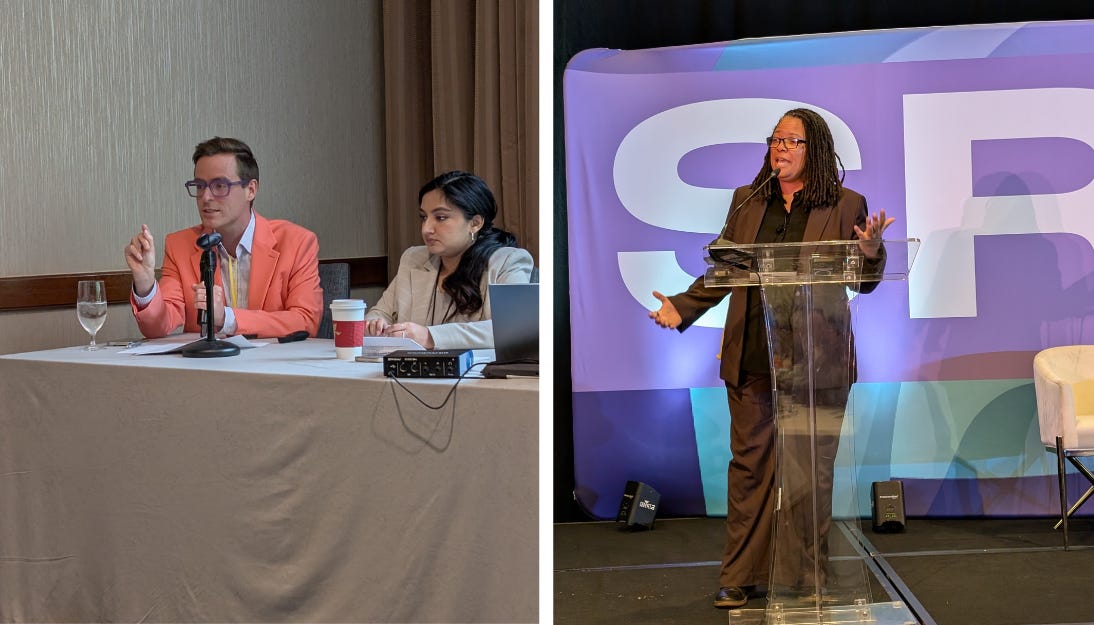
Guthrie Graves-Fitzsimmons (left) speaks on a breakout panel with Mannirmal Kaur of the Sikh Coalition and Naden Smith (right) speaks during the Summit for Religious Freedom in Alexandria, Virginia, on April 26, 2026. (Brian Kaylor/Word&Way)
Nadine Smith, president and CEO of Color of Change (a group working for social justice), also noted that we’re watching “the playbook and the role of White Christian Nationalism” in the United States today and that those who value religious freedom need to offer a strong alternative. She explained that Project 2025 is “simply the reverse engineering of everything that has brought us progress.”
“We are not dealing with an incompetent government. We are dealing with people executing precisely what they arrived to execute. The corruption, this plunder economy, and White Christian Nationalism are the same project,” she said. “It’s about control. It is why they don’t want democracy.”
As an example of how religion is being “weaponized” for power, she highlighted the fact that Trump isn’t religious or moral, but he’s “an avatar for an overall belief system” of nationalism. Trump, she added, “uses” religion “as a spray tan of sorts over the horrible things.”
Yet, through it all, Smith holds out hope of MAGA individuals walking away from supporting what’s happening in the nation. Building “something out of the rubble of this plunder economy” will require efforts of “reconciliation.” With that, she argued, also comes the need to “actually have a vision of what our country should be that includes us all. Because we can’t simply be against things, we have to be for things.”
“We are going to have to shape the architecture of true freedom in this country, and it’s going to mean that we have to push for policies that undo the forced religious ideas that are baked into so much of what our laws currently are,” Smith added. “We are having grander ideas of what the world and what our neighborhoods, our cities, our states, and our nation can actually be. And we cannot get there if we continue to allow White Christian Nationalism, the racism that is baked into it, the sexism that is baked into it, the hatred of stranger that is baked into it guide our political life.”
Help sustain the journalism of Word&Way by subscribing to A Public Witness!
From Oy to Joy
Rachel Laser, president and CEO of AU, also recognizes the attacks on the constitutional principle of church-state separation. She even listed many of them in quick succession during her remarks to open AU’s summit. She noted, for instance, the government worship services at the Pentagon and the Department of Labor, states trying to force a highly edited version of the Ten Commandments in public schools, the “crusade” to create sectarian public schools, and efforts to put spiritual “chaplains” in public schools. But she also mentioned she’s trying to embrace a new mantra she’s heard: “Less oy, more joy.”
“This is not about denial. It’s not about forced cheerfulness or pretending that the danger isn’t real. It’s important to face the reality. It’s important to ring the alarm bells. That sense of threat motivates us to take action. It’s important to clarify the record and state the real facts. The ‘oy’ part is important, and that’s why I began where I did,” explained Laser, who’s Jewish. “But the point here is that ‘oy’ alone isn’t good for a people or a movement. In the Jewish context, ‘less oy, more joy’ means refusing to let antisemitism define the entirety of Jewish life. Yes, Jews must fight antisemitism, but they must also strengthen and celebrate Jewish life.”
Such joy among advocates can be a form of resistance, she added, because it shows those trying to tear people down that they are unable to fully break you. So she noted that even as she names and challenges the threats to church-state separation, she celebrates the nation’s promise and the radical experiment instituted by the U.S. founders. And she celebrates with “joyful resistance” how diverse communities across religious, political, geographical, and other demographic divides are uniting to protect religious freedom for everyone.
“Talk, write, and teach about church-state separation. Preach about church-state separation. And not just with pain — even though some pain is understandable — also with joy about the promise itself. People deserve to know the truth about our country’s founding ideals,” Laser added.
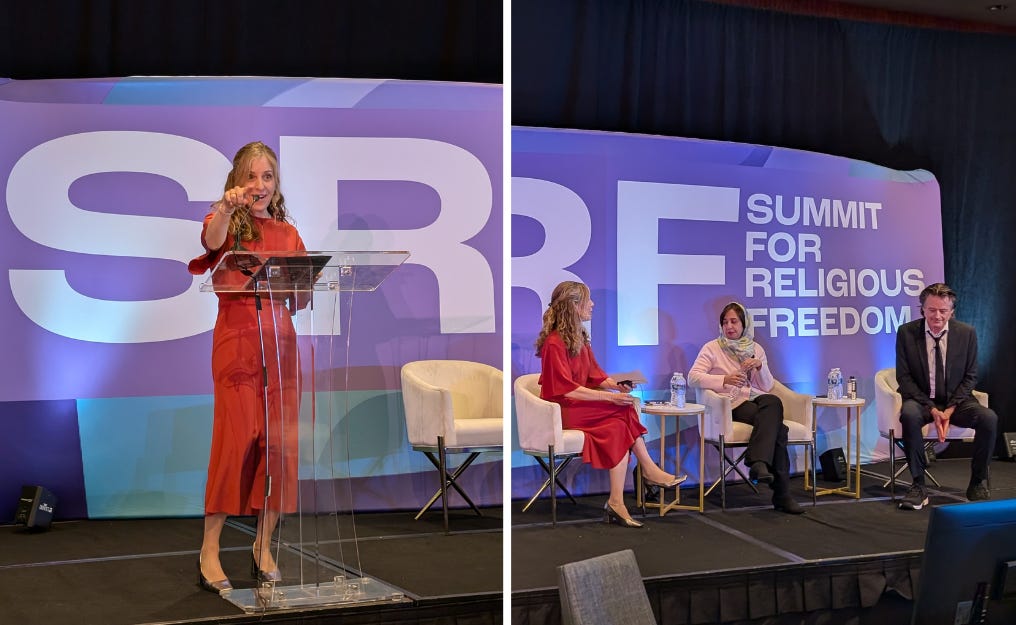
Rachel Laser (left) speaks and joins a panel conversation (right) with Maggie Siddiqi of Interfaith Alliance and John Fugelsang during the Summit for Religious Freedom in Alexandria, Virginia, on April 26, 2026. (Brian Kaylor/Word&Way)
Similarly, John Fugelsang added that he remains optimistic because of the significant improvements he’s seen during his life and because of the examples of successful anti-authoritarian movements in the past.
“There’s always been an amazing tradition of Christian activism, and it has always manifested itself in resistance to Christian authoritarianism. The real Christians prove the fake Christians are fake,” he said. “And it’s going to take coalitions to expose them. The most effective opposition to authoritarian Christianity has always been plural: churches and synagogues and mosques and secular and civic actors together.”
So he encouraged those at the summit to work together regardless of religious beliefs, bringing together those who believe in no gods and those who take seriously the command to “love thy neighbor” because “the own-thy-neighbor folks have gotten too powerful and too insane.” And, unsurprisingly given the summit’s focus, he pointed to the U.S. history of church-state separation as critically important.
“No matter what your belief system is, Christian Nationalism guarantees that we are all going to have to work together,” Fugelsang said. “Separation of church and state isn’t just a single rule, it’s a framework that connects everything. It is baked into our system, like caffeine is baked into coffee beans — and thank God for that.”
As a public witness,
Brian Kaylor
A Public Witness is a reader-supported publication of Word&Way. To receive new posts and support our journalism ministry, subscribe today.