NOTE: This piece was originally published at our newsletter A Public Witness.
Earlier this month, the Southern Baptist Convention met in Orlando, Florida, and again voted against women in ministry. The next week, some Baptists met a couple hours north in Jacksonville for their own annual gathering. And you don’t have to look very hard to see a different vision of being Baptist and Christian. Like when the highest-elected officer of the denomination stepped to the podium.
“Women in ministry has also been a part of the DNA of our fellowship for as long as we’ve been around,” declared Rev. Tanya Parks, a pastor in Louisiana who has served the past year as moderator of the Cooperative Baptist Fellowship.
The longtime denominational home of the late Jimmy Carter, CBF’s general assembly featured not just a woman presiding over the business of the denomination but also women preaching and serving in other ministry roles. And in the current Christian Nationalist context where the nation’s largest Protestant denomination is attacking women while supporting an administration that’s stripping away civil rights for women, Black people, LGBTQ individuals, and others, we shouldn’t ignore Christian denominations offering a different kind of witness.
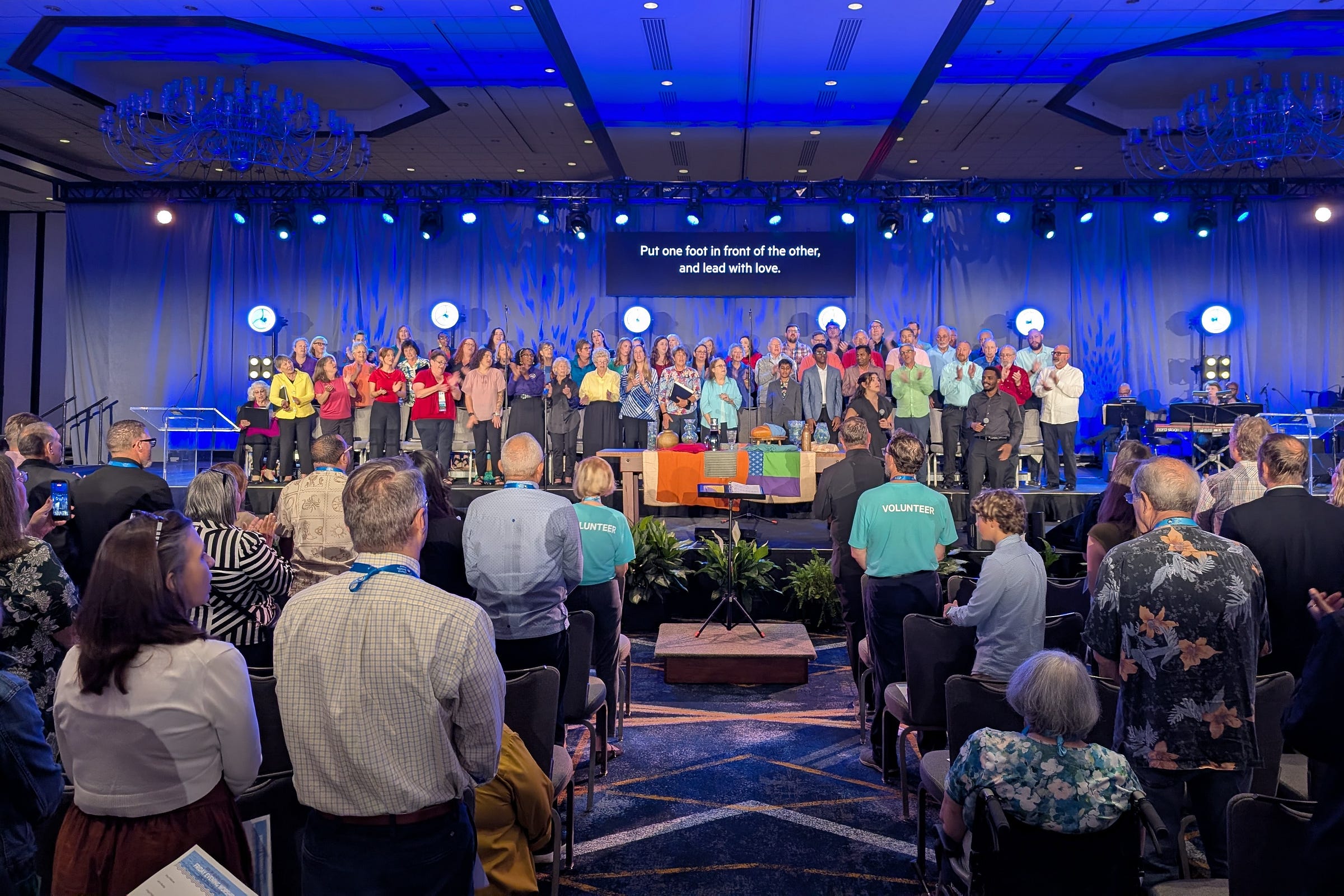
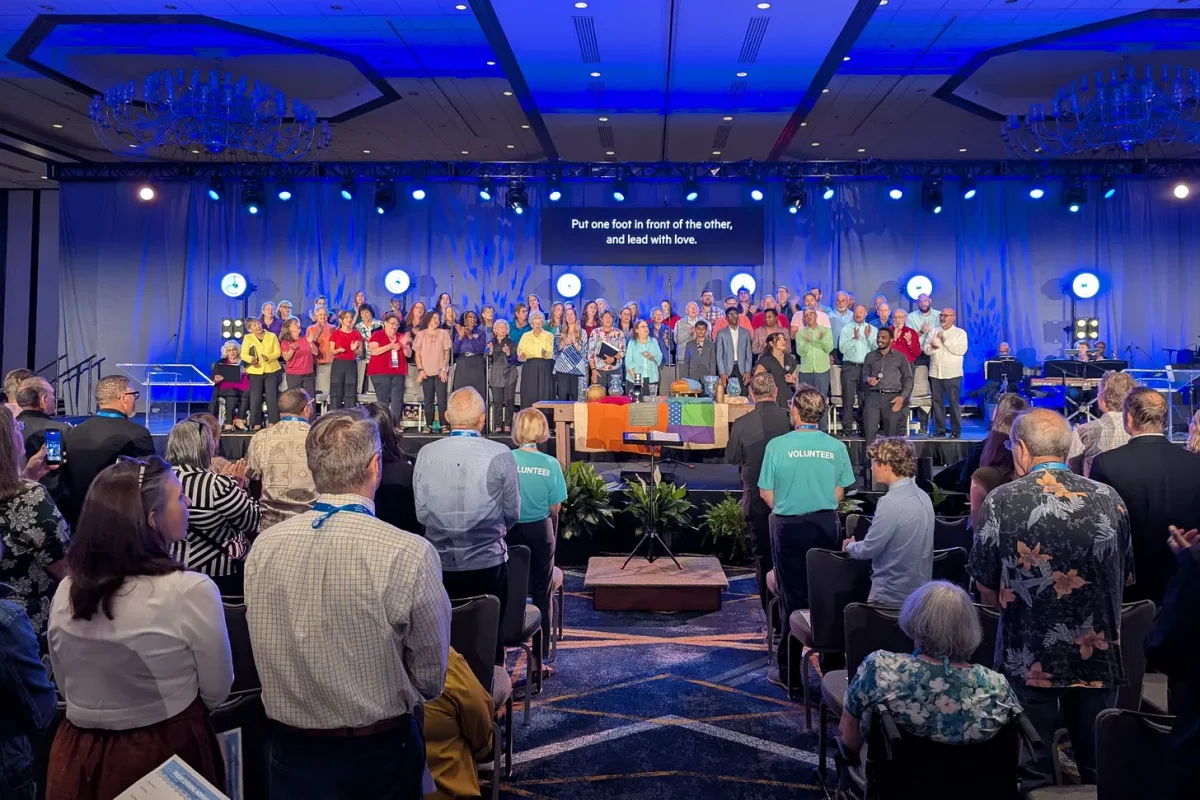
People sing during a worship session at the Cooperative Baptist Fellowship’s general assembly in Jacksonville, Florida, on June 19, 2026. (Brian Kaylor/Word&Way)
Yolanda Pierce, dean of the Vanderbilt Divinity School and author of The Wounds Are the Witness: Black Faith Weaving Memory into Justice and Healing, preached during the CBF assembly about the importance of learning, remembering, and telling stories of resistance, including those of women who have often been left out of church histories and honors.
“It’s almost hard for us to grapple with the subversive nature of the gospel: its embedded belief in a messiah who came to turn the world upside down, one who came to dismantle systems and powers and principalities,” she explained during a dinner sponsored by Baptist Women in Ministry. “These memories are dangerous, and they should be kept alive. They were kept alive by the first-century Church through the oral tradition. Long before anyone wrote anything down, they would tell the stories of this Jesus, they would tell the stories of this resurrection. Long before anyone thought to compile it into a canon and call it sacred Scripture, they would tell the stories of this dangerous memory of someone who death could not defeat.”
“Long before they wrote it down, in the time between Mary in the empty tomb and her telling others about the good news, the dangerous, dangerous memory they want us to forget is that for a brief moment the entire gospel was contained in the memory of one woman,” Pierce added. “For those who suggest that women dare not preach the gospel, there is no gospel unless the woman at the well and the women at the tomb and the women at the cross had told the truth about a risen savior. That is the dangerous story that we have to keep telling.”
And so this issue of A Public Witness treks to Jacksonville to recall more dangerous stories that were told during the CBF general assembly, as those gathered were urged to resist Christian Nationalism and advocate for the rights of their neighbors.
Challenging ‘Rotten Religion’
Rev. Howard-John Wesley, senior pastor of Alfred Street Baptist Church in Alexandria, Virginia, knows what it means to lead a church in publicly standing against injustices. The historic Black congregation that sits just across the Potomac River from Washington, D.C., traces its history to 1806 as enslaved Black Baptists worshiped under the eye of White Baptists until receiving independence in 1850. Last year, he led the church to be one of the first groups to pull its programming from the Kennedy Center shortly after President Donald Trump started taking it over (and even before Trump’s name was illegally added to the building). The megachurch moved its massive Christmas program to another venue in protest of the administration’s policies.
At CBF, Wesley challenged those present to stand up, especially against those who misuse Christianity to justify violence toward others.
“There’s a lot that claims the name Jesus Christ, but the closer you get to it, it does not live like, look like, or love like our Lord and Savior,” he said. “And don’t get me wrong. It wears a cross around its neck. It carries a Bible and quotes Scripture. It has a steeple on top of its roof. But when you get close to it, it really doesn’t look like Jesus Christ.”
Preaching about what’s often called “The Parable of the Good Samaritan,” Wesley particularly criticized those who misuse Christianity to justify ungodly behavior toward their neighbors. Warning about those who have “weaponized the Bible,” he insisted that just because someone is quoting Scripture, that doesn’t mean they’re acting Christlike.
“One of the very first signs of rotten religion is that it quotes a whole lot of Scripture, but very little of it is in red. It knows law, but it can’t quote grace. It’s heavy in Moses and in Paul, but it is light in Matthew, Mark, Luke, and John. It is good in the laws of who’s going to hell, but it does not embrace the teachings of grace that encourage us all to live right in the eyes of God. It is heavy in Scripture that’s light on Jesus,” he argued. “This is one sign of rotten religion in America: when Scripture has been weaponized to hurt and not to help, to deport and not to deliver, as a bullet and not a balm. There is something wrong when you only use Scripture to justify who you hate.”
“Our foremothers and forefathers of my people understood this. They were skeptical of ‘slaves, obey your master’ because there was no Jesus in it,” he added. “Be careful of folk that use words like ‘reprobate’ and ‘abomination’ but don’t have any Jesus attached to it. Watch out for folk who say that women ought have no authority over men in the church when they’ve got no Jesus attached to it. Be careful of folk that tell you that every elected official is God-ordained and then you have to obey them without question and challenge when there’s no Jesus attached to it.”
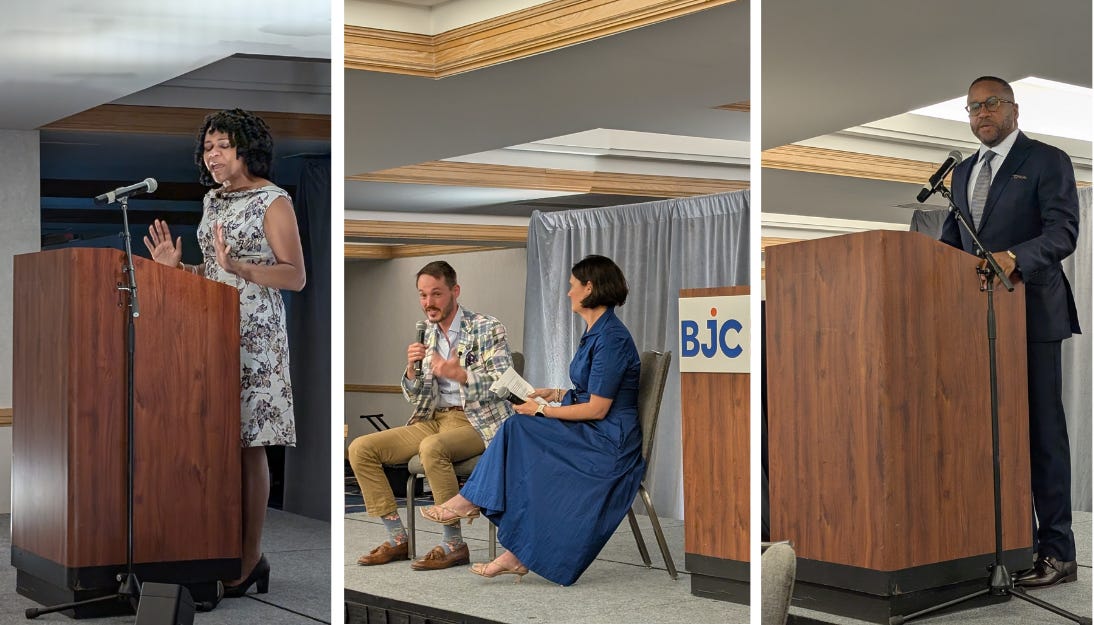
From left: Yolanda Pierce, Michael Woolf and Amanda Tyler, and Howard-John Wesley speak during the Cooperative Baptist Fellowship’s general assembly in Jacksonville, Florida. (Brian Kaylor/Word&Way)
Amanda Tyler, executive director of the Baptist Joint Committee for Religious Liberty, similarly emphasized the need to challenge Christian Nationalism and work for the freedom of everyone.
“The 250th celebrations already have, and will continue to perpetuate the myth of the United States as a Christian Nation. A glorified and fictional account that sanctifies the founders and sacralizes the founding documents,” explained Tyler, author of How to End Christian Nationalism. “We have to tell the truth about who we are. This takes vulnerability, bravery, and openness on everyone’s part. It takes a culture that is willing to complicate a narrative that has been propped up by divine sanction to justify all kinds of evil in God’s name. … And it requires all of us to call out the ‘Christian nation’ myth for what it is: a lie that perpetuates White supremacy and bigotry.”
“This honest history instructs us that no document — not the Declaration of Independence, not the U.S. Constitution, not the Bill of Rights, not the Emancipation Proclamation, not the Voting Rights Act — guarantees freedom. Freedom depends on the commitment of all of us to freedom,” she added. “And in the words of Baptist freedom fighter Fannie Lou Hamer, ‘Nobody’s free until everybody’s free.’”
Help sustain the journalism of Word&Way by subscribing to A Public Witness!
‘Gasping for Air’
A key issue throughout the general assembly was how to push back against ICE as it threatens houses of worship and targets our immigrant neighbors. Rev. Michael Woolf, senior minister of Lake Street Church in Evanston, Illinois, shared his story of getting body-slammed and arrested while peacefully protesting outside an ICE detention center in the Chicago area. He urged those present tp do something, even if their advocacy might look different than his.
“Paul has this metaphor, this mystical idea of the body of Christ. We each have things that we can do. I wouldn’t actually recommend going to get slammed on the ground. Not that fun,” said Woolf, coauthor of Confronting Islamophobia in the Church. “There’s something for everybody to do. And I think it’s really important this time as we struggle with fascism, as we really look at our Republic — and I don’t know what the future’s going to hold — I think it’s really important that we do our best and to live out our faith in the world and find some way to bring our values into the public square as Christians.”
Similarly, Democracy Forward President and CEO Skye Perryman talked about the importance of faith leaders standing up against ICE and on other issues. Democracy Forward is representing CBF in a lawsuit against the Trump administration to block ICE actions on the property of houses of worship (and Democracy Forward is also representing several other mainline Protestant groups in a similar suit filed later). She praised CBF for being one of the first faith groups to stand up against the administration on this issue.
Speaking on Juneteenth in the city where the hymn “Lift Every Voice and Sing” was written and first performed, she connected that historical struggle for freedom with the need now to push back against fresh efforts to curtail civil rights.
“Democracy is now gasping for air,” she warned. “This nation has always been struggling to achieve true democracy for all people. We’re kidding ourselves if we think that we somehow had finally achieved it. Juneteenth reminds us we are in the midst of an old fight in a new time.”
Perryman particularly argued that in this moment, Christians must follow the command to love our neighbors as ourselves.
“There is a major role for people of faith, and there is a major role for this community of faith,” she said. “We have to remember who we are, and as followers of Christ we know that loving the neighbor is the way.”
“I’m a very skilled lawyer, and I promise you that I can do mental gymnastics with the best of people. But there is just no way to square this circle. It’s love your neighbor. There’s no exceptions,” she added. “As followers of Christ, we know that no powerful person, no institution, no cultural movement can get us out of that command. We have to love our neighbors. And we can’t sit by while children are torn from their families, while hate is used as a political tool to stir up controversy and try to make us think that we are more different than we are the same.”
One way she encouraged those present to do this is by helping people be able to vote. She emphasized that churches shouldn’t tell people how to vote, “but we do need to make sure that everyone is afforded the basic dignity of being able to vote.”
CBF is working to live out Perryman’s call by using the general assembly to roll out a new effort to assist churches in helping people get registered to vote and turn out to the polls. Calling it “Love Your Neighbor to the Voting Booth,” the nonpartisan initiative will include resources for churches to use in assisting people to get registered and overcoming barriers to voting.
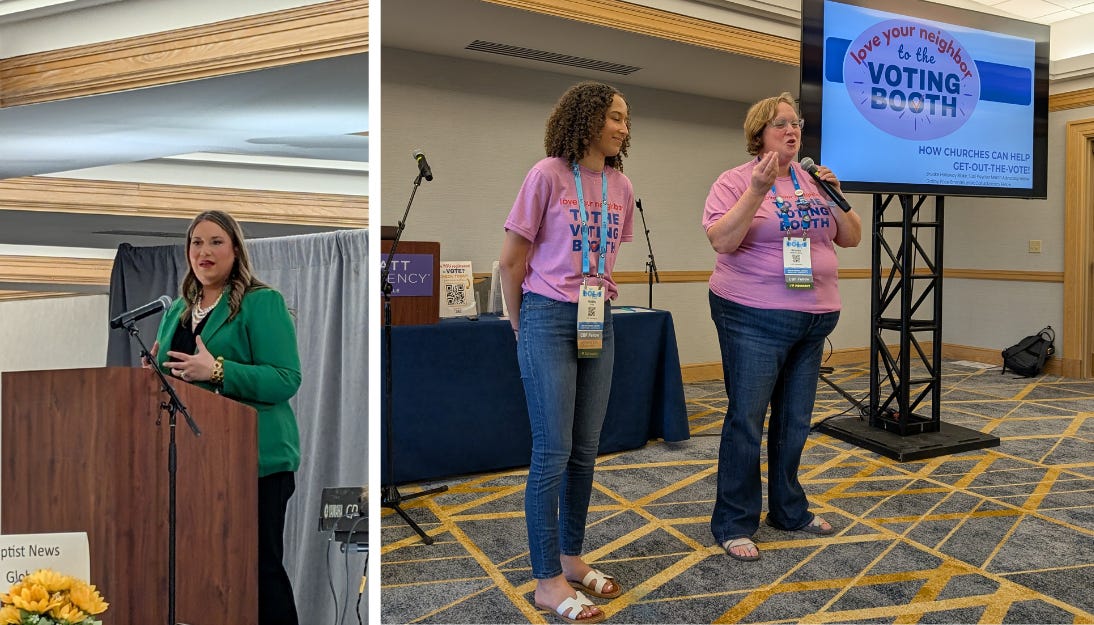
Skye Perryman (left) speaks and Gabby Price and Brooke Holloway Blake (right) introduce the “Love Your Neighbor to the Voting Booth” initiative at the Cooperative Baptist Fellowship’s general assembly in Jacksonville, Florida, on June 19, 2026. (Brian Kaylor/Word&Way)
Bacardi Jackson, executive director of the ACLU of Florida, also encouraged advocacy efforts at the state and national level. Calling Florida a “model” for much of what is now being implemented in Washington, D.C., she argued that faith communities must be part of the work of pushing back. After recounting efforts — including by her parents — during the civil rights movement to expand voting rights, education access, and more, Jackson lamented that those issues are being litigated again.
“While I am proud to be here to stand on their legacy, I am devastated that instead of expanding their work, I must fight the exact same battles,” she said. “Each new restriction demands a response. Each unconstitutional law requires legal action. … Each assault requires that we educate our community, that we organize, and that we engage.”
“I also want to tell you that I’m not living here in grim despair. I actually have a lot of hope,” Jackson added after telling stories about slavery, lynchings, segregation, and the current moves in Florida and nationally to strip away civil rights and democratic freedoms. “This climate we are living in is not new. People in this nation have experienced and survived it more than once. So the operative question is not how can we survive this, but how will each one of us each one of us choose to show up? If we are our ancestors’ wildest dreams, who will our descendants be to us? The survivors of our silence? The victims of our complicity? The inheritors of status and wealth without civil rights? Or, will we seize this moment to make our descendants proud?”
As a public witness,
Brian Kaylor
A Public Witness is a reader-supported publication of Word&Way. To receive new posts and support our journalism ministry, subscribe today.