OBERURSEL, Germany (RNS) — Tobias Riemenschneider’s congregation meets on the top floor of a repurposed train station outside Frankfurt am Main. A narrow spiral staircase leads to a converted dance studio, encircled by mirrors and chandeliers, decorated in pink and sparkles.
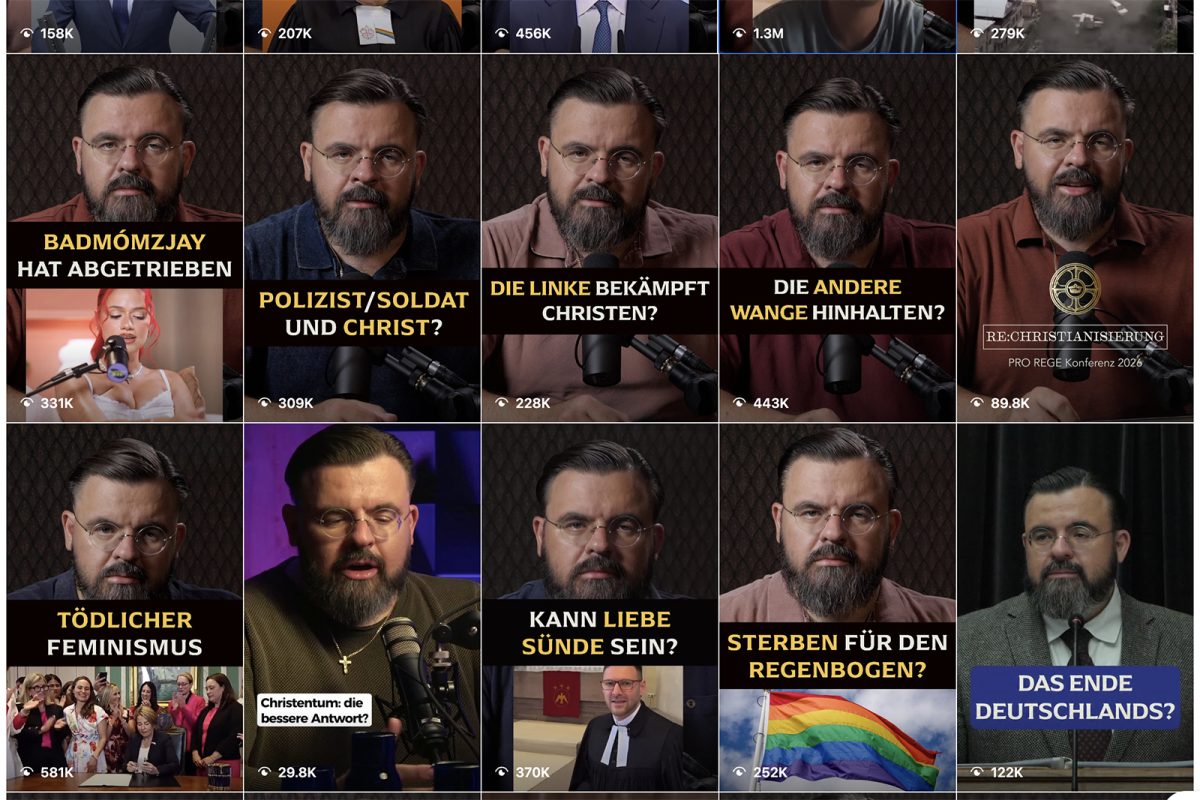
Recent Instagram posts by pastor Tobias Riemenschneider. (Screen grab)
In the center, a camera rig focuses on a wobbly old wooden pulpit with a coaster stabilizing its foot. Just out of frame, Riemenschneider’s brother-in-law and co-pastor, Paul Sayers, occasionally dashes over to a keyboard to play synthy organ tunes.
The small congregation of about 50 people often hears about the plight of godly masculinity and the rising threats of LGBTQ+ rights activists and an influx of Muslim immigrants.
The women cover their hair with veils.
“I don’t care necessarily what the man believes as much as I know that he’s convicted that what he tells is biblically based,” parishioner Chris Hutchinson, originally from Kentucky, said. “There are not a lot of sources for this sort of biblical teaching here in Germany anymore. Even though this is the land of the Reformation.”
This scrappy operation on Sundays is a stark contrast to Riemenschneider’s other hustle as a German “Christfluencer,” where his social media posts about politics have garnered 150,000 followers on Instagram and YouTube.

Parishioners attend Christuskirche Frankfurt, Sunday, August 23, 2026, in Frankfurt, Germany. Christuskirche Frankfurt is a breakaway congregation that formed in the wake of a schism at another church that controversial Pastor Tobias Riemenschneider co-founded. (RNS photo/Liam Adams)
Earlier this year, a church Riemenschneider co-founded ousted him, largely due to conflict over his growing public support for the far-right Alternative für Deutschland (AfD) party. He spoke to federal AfD leaders in October 2025 and to state party organizers in Saxony-Anhalt at a Christmas gala in December 2025 — organizers now celebrated as the heroes of a historic victory for the German far right in a September 6 election.
Though the church-state relations and the religious right’s prowess in Germany differs greatly from the U.S., Riemenschneider and a wave of right-wing Christian influencers, or “Christfluencers,” are bridging that gap. Their content strategy mirrors that of popular conservative influencers like Allie Beth Stuckey or the late Charlie Kirk, and they have formed networks across the Atlantic.
This alliance gained attention when Leonard Jäger, known by his channel name “Ketzer der Neuzeit,” meaning “Heretic of the Modern Age,” met Donald Trump at Mar-a-Lago in November 2024. This was right before Jäger’s interview with AfD leader Alice Weidel, a lesbian whose partner is a Sri Lankan-born woman with whom she is raising children.
Jäger has risen to the top of the charts in this Christfluencer sphere for his provocative anti-LGBTQ+ content and contemptuousness toward women’s empowerment. But his interview with Weidel, who told Jäger she and her wife are raising their children “as Christians,” has since garnered 1.2 million views.
Travis Wussow, a former public policy executive within the Southern Baptist Convention, said conservative pastors like Riemenschneider have learned from religious right activists in the U.S.
“I would expect AfD to learn that lesson from the U.S. and try to run the same play,” Wussow said in an interview. “That is to network with pastors, church leaders, or commentators who are speaking to faith and politics who are little bit dissident, a little bit edgy, a little outside of the mainstream. And use those connections to validate their message.”
Wussow was interviewed for the 2023 book, “The Godless Crusade: Religion, Populism and Right-Wing Identity Politics in the West,” which compares religion and right-wing populism in Germany and in the U.S.
The book chronicles how the AfD never adopted a strong commitment to conservative Christianity in the same way as the Republican Party, despite early attempts.

Recent Tiktok posts by Maximilian Krah. (Screen grab)
There are some exceptions. One is Maximilian Krah, a member of the German Parliament who became popular through TikTok. A staunchly traditionalist Catholic, Krah previously worked as a high-profile attorney for the Society of St. Pius X — an ultraconservative group that Pope Leo XIV recently excommunicated over charges against four bishops’ “schismatic acts.”
But many others in the AfD are secular, while some are even flirting with paganism.
As his loyalty to the far-right party deepens, Riemenschneider said in an interview, “I can live with inconsistencies.”
He was similarly blasé about criticism of antisemitism in the AfD party, including certain AfD politicians using Nazi slogans or salutes.
“I am sure there are antisemites, maybe Nazis, in the AfD. But I do not believe they have a strong influence,” he said.

Pastor Tobias Riemenschneider in Frankfurt, Germany. (RNS photo/Liam Adams)
Riemenschneider received attention in U.S. evangelical circles for teaming up with Doug Wilson, a self-avowed Christian nationalist and founding pastor of the denomination to which U.S. Defense Secretary Pete Hegseth belongs, to denounce “theobro” podcaster Joel Webbon for past antisemitic comments.
Riemenschneider had collaborated with U.S. pastors before, when he drafted the so-called Frankfurt Declaration in 2022 to condemn COVID-19 public health restrictions on church gatherings.
Madlen Geidel, an expert on Christfluencers, said the pandemic was an early turning point for several influencers and that the next major one was the assassination of Charlie Kirk. This fueled narratives of victimhood, Geidel said.
“They use it to prove that you’re in danger if you’re a Christian in Germany,” said Geidel, a research associate in the media ethics and digital theology department at Friedrich-Alexander-Universität Erlangen-Nürnberg.
That idea accelerated after Green Party members of the German Parliament submitted a formal inquiry in May requesting information from various intelligence services about ties between the AfD and Christfluencers, specifically naming Riemenschneider. Other Christfluencers took offense at references to “Christian evangelical” fundamentalism in a manifesto by Die Linke, or “The Left” in English, which outlines the progressive party’s policy proposals and political concerns.
Another important Christfluencer who called out Die Linke’s program was Jasmin Friesen. Friesen manages an Instagram account called “liebezurbibel,” meaning “Love for the Bible,” which promotes conservative views similar to Riemenschneider or Jäger, but with homier aesthetics.
“Friesen reads Die Linke’s commitment to taking action against religious fundamentalism across religions as being directed against Christian evangelicals,” Geidel said. “While many commenters agree with her, others explicitly point out that evangelical Christianity and fundamentalism should not be treated as the same thing.”
Friesen is credited with converting Jäger, once a sports influencer, anti-vax activist and non-believer, to Christianity. Jäger more recently said he’s not affiliated with a particular party, though he recently hosted Austrian far-right activist Martin Sellner and an AfD politician on his podcast. Sellner coined the term “remigration,” an anti-immigrant philosophy that is also being used by the AfD in Saxony-Anhalt.
Jäger’s more popular content nowadays includes a guerilla-style interview at a “Grandmas Against the Right” meeting during a major Protestant church gathering.
“These are highly moralized issues that reliably generate disagreement across audiences. It doesn’t matter if you are a fan of him or if you hate him, but you will watch him and you will share it with your friends,” Geidel said.
But the winds of endangerment that these Christfluencers say they face is, according to them, starting to shift. That began on September 6, when the AfD in Saxony-Anhalt scored a historic victory.
In an Instagram video, Riemenschneider rebuked German Chancellor Friedrich Merz and praised the AfD’s lead candidate in Saxony-Anhalt, Ulrich Siegmund, whom Riemenschneider told RNS he had met at that Christmas gala in December.
“They (voters) feel betrayed by you because you promised a conservative shift but failed to deliver,” Riemenschneider said in the Instagram video, according to a translation. “They want the Germany that Ulrich Siegmund promises — the Germany where people still knew what a woman was, the Germany as it was before the left-wing project radically transformed it.”