(RNS) — One of the nation’s most prestigious divinity schools has been placed in receivership, leading to speculation that the school might close or change drastically.
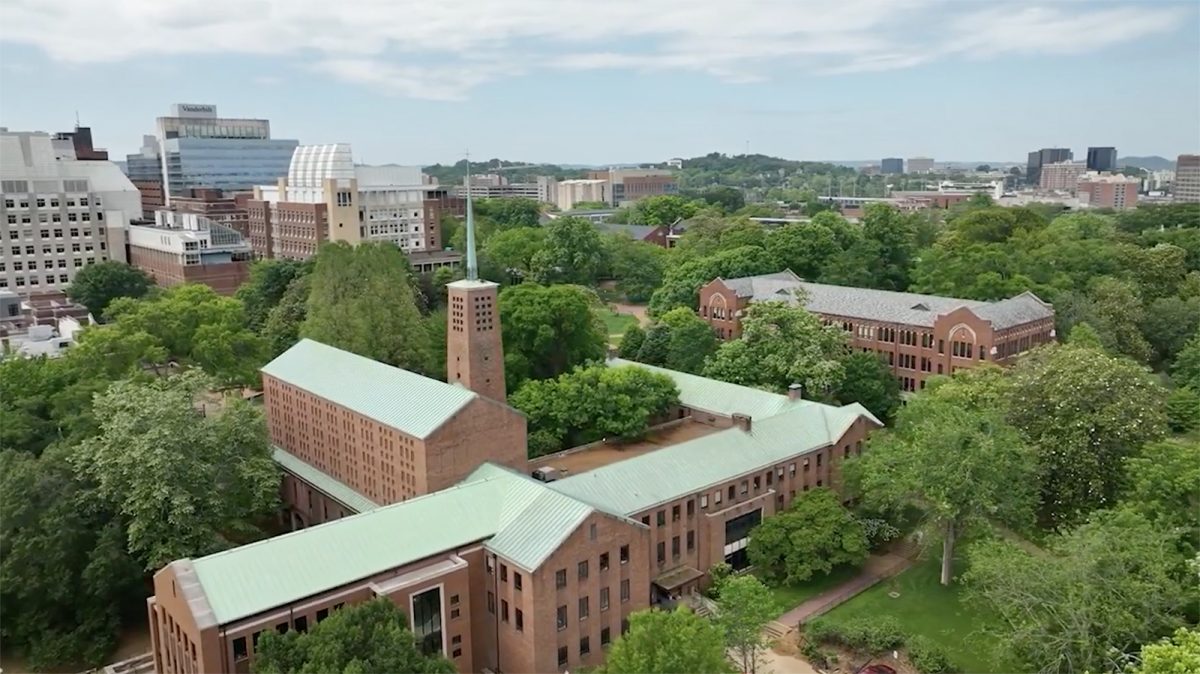
Vanderbilt Divinity School on the Vanderbilt University campus in Nashville, Tenn. (Video screen grab)
“After careful consideration, including an independent review, we have placed our Divinity School in receivership as a mechanism for renewal,” a spokesperson for Vanderbilt University told RNS in an email. “Over the next two years we will work to position the school for long-term success, investment and growth.”
Details about the receivership have been hard to come by. There has been no public announcement and little comment from the university’s leadership outside of news reports, leading to speculation among alumni that the school would close.
But alumni, faculty, and others close to the school were quick to address what they called a lack of transparency about the move, with some saying they suspect it’s related to well-publicized political pressure exerted by the Trump administration on American universities.
“The provost’s office appears to have underestimated how much reputational harm the word ‘receivership’ would do,” said Peter Capretto, a Vanderbilt Divinity graduate and associate professor of psychology, culture and religion at Phillips Theological Seminary in Tulsa, Oklahoma.
“There’s been a major communications misstep here.”
Phillis Sheppard, professor of religion, psychology and culture and chair of the faculty at the Nashville-based divinity school, said that news of the receivership caught the community by surprise and caused confusion and anxiety.
“There are some who combine those two with a sort of bated hope that something creative can come out of this,” she said. “But the overwhelming effect is anxiety about the unknown and about why this is occurring.”
Sheppard said that some faculty and students feel cut out of the conversation about the school’s future. “It suggests that folks not in theological education either know more about theological education than those who have been doing it for many years,” she said, “or that those in theological education cannot think practically about the workings of higher education.”
She said that some of her students have questions that have not been answered yet. A letter to students from Dean Yolanda Pierce and Deputy Provost Tracey George dated Sept. 22 gave few details.
“We know this news may raise questions and concerns,” they wrote. “Please be assured that your education and your progress toward your degree remain our priorities.”
The word receivership also feels ominous, as if it implies the school will be shut down — in part because that term is also used to describe what happens when a company goes bankrupt. At Vanderbilt, the term has a different meaning, a university spokesperson told RNS in an email.

Peter Capretto. (Photo courtesy of Phillips Theological Seminary)
“At Vanderbilt University, receivership is a mechanism for temporarily returning delegated operations to central management,” according to the email. “It is a way to stabilize the school and restore it to full health before returning operational management to the school. The goal is a sustainable and successful future for the Divinity School.”
Capretto, a self-described theological education nerd, said there is no sign that the divinity school’s enrollment has dropped or that the school faces financial trouble. The divinity school has one of the largest endowments — about $258 million — in the Association of Theological Schools, according to annual data reports from ATS.
The receivership news comes a few months after Vanderbilt’s Board of Trust published a “Declaration of First Principles,” which argues that universities must remain neutral when it comes to politics and social issues.
If academic units of Vanderbilt allow political and social agendas to overshadow their core purpose, according to the declaration, then they may be shut down or placed in receivership.
Capretto said it’s hard not to see a connection between that declaration and the divinity school being placed into receivership, especially when there has been little communication about that decision.
“This did not come out of nowhere,” he said.
Vanderbilt did not respond to questions about the divinity school’s finances or about how the principle of institutional neutrality is being applied to the school. The divinity school’s website makes no mention of receivership. A university spokesperson told RNS receivership does not interfere with what happens in the classroom.
“Receivership is not a pretext for closing the school,” the spokesperson told RNS in an email. “Receivership does not alter academic freedom.”
The declaration of principles comes as a challenge to the divinity school faculty, whose job it is to help students apply religious beliefs and texts to the world around them. That, said Sheppard, includes talking about politics.
“We’re training them to be engaged citizens with a mission for a world that’s more just. I would say more just, more compassionate and more welcoming,” she said. “That means we would be talking about things that some people would label political; others might label religious or spiritual.”
Originally founded by Methodists in the 1870s, the school cut its denominational ties in 1914. The school has a long history of involvement in social justice issues as well as deep ties to Nashville churches. In 1960, the school expelled James Lawson, then a student, for taking part in protests against segregated lunch counters in downtown Nashville. The university later apologized and, in the 1990s, named him a distinguished alum. Lawson, a scholar of nonviolent resistance, would go on to teach at Vanderbilt in the early 2000s.
Sheppard, former executive director of a center named for Lawson, said he was expelled because school leaders were too entwined with broader cultural racial discrimination and segregation in the South. She sees some parallel with the current debate over politics at universities. “We can ask the question now: What are we intertwined with now that leads to potentially silencing voices that would speak out against what’s happening in the world today?” she said.
Author and religious scholar Anthea Butler, a Vanderbilt alum, argues that the university is trying to cozy up to the Trump administration at a time when academics are under political pressure.
President Trump has clashed with leaders at Harvard and other major universities, claiming they have become too liberal, accusing them of antisemitism and withholding federal funding. Some have signed settlements with the Trump administration to restore funding, while Harvard has opposed Trump’s attempt to revoke the school’s tax-exempt status.
Butler said that by invoking institutional neutrality and placing the divinity school in receivership, leaders at Vanderbilt are trying to get on the Trump administration’s good side.
“You are doing all this because you want to be on his radar as a good school,” said Butler, an emeritus professor in American social thought at the University of Pennsylvania who is currently teaching at Oxford.
Butler said she sees a direct connection between the Board of Trust’s declaration and the decision to place the divinity school under receivership. She also sees parallels between the current receivership and debate over politics at Vanderbilt and the conflict with James Lawson in 1960.
“This is shades of when they kicked Jim Lawson out in the 1960s,” she said. “Now they’re coming to finish the job.”
She first heard about the school being placed in receivership from alumni posting about it on social media in September, weeks before there were any news reports. So far, she said, few details have been made public or shared with alumni.
Butler said that the divinity school has a unique role to play in theological education. It’s in the buckle of the Bible Belt and welcomes people with differing views to study theology. “It’s been a place where both conservative and liberal Christianity have learned how to live together,” she said.
If there is an attempt to close the school, Butler said, she does not expect faculty, alumni or students to go quietly. She said a friend at the school put it this way: “I don’t think we can save it, but we can sure as hell raise hell about it before it ends.”