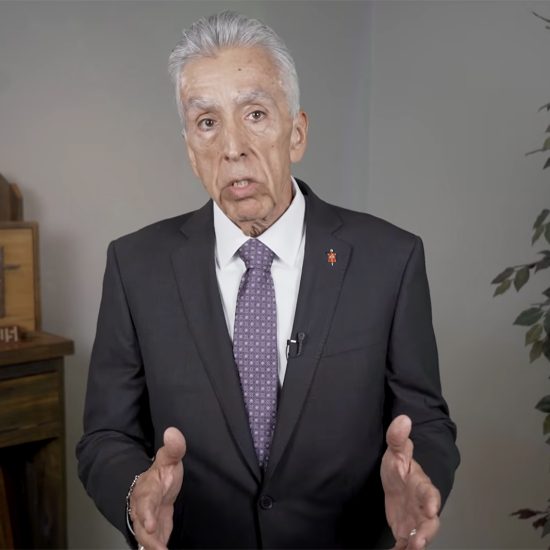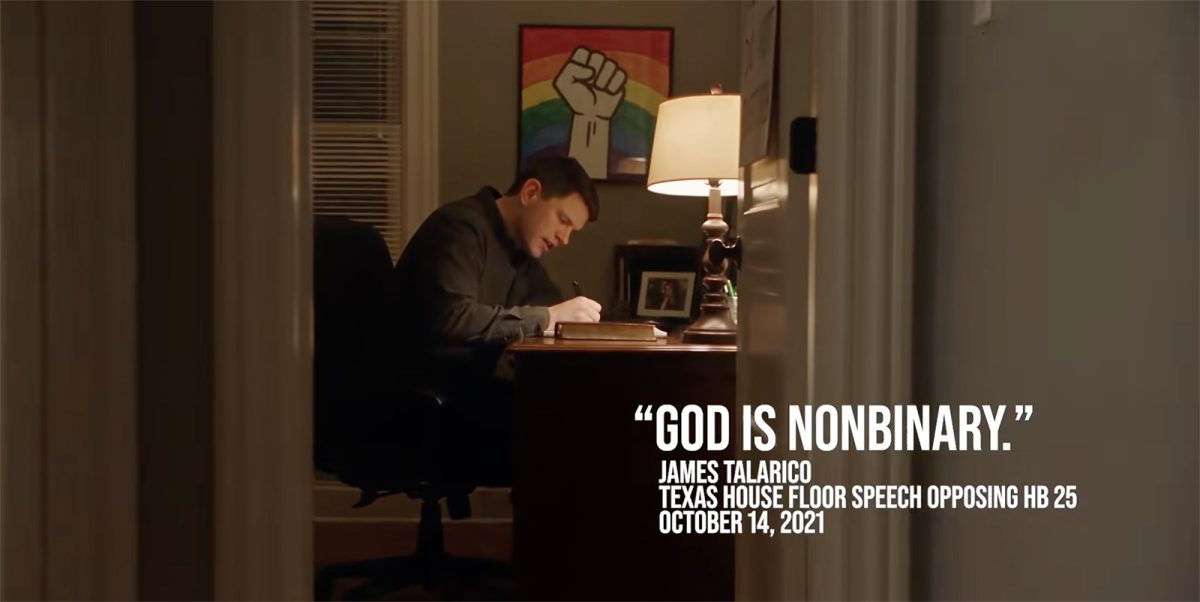
An AI-generated campaign ad produced by Texas U.S. Republican candidate Ken Paxton depicting Democratic candidate James Talarico. (Video screen grab)
Ads produced by his Republican opponent, Texas Attorney General Ken Paxton, have harped on Talarico’s 2021 reference to God as “nonbinary,” with one ad depicting an AI-generated version of Talarico reciting the line while writing in a “King James Talarico Bible.” President Donald Trump, while campaigning for Paxton, has begun falsely claiming that Talarico instead referred to God as transgender. Vice President JD Vance has insinuated, derogatorily, that Talarico is attracted to men.
And Elon Musk — a Texas resident, Paxton supporter, and the world’s first trillionaire — has funded many of the anti-LGBTQ attack ads against Talarico and promoted them on X, a social media platform he owns.
“Talarico will vote to take away your children and transition them,” Musk wrote on X on Monday (Oct. 26th).
The GOP attacks on Talarico — an outspoken Christian who has long interwoven his political rhetoric with religious language — often zero in on remarks he delivered in religious spaces, and some of the critics insist Talarico’s comments are evidence he is not a Christian.
“Progressivism will hollow out your religion and wear it like a skin suit,” North Texas pastor Josh Howerton said on Instagram earlier this year. “In the biblical category, this guy is a false prophet and a false teacher that just so happens to also be in politics.”
Experts say that attack is part of a wider GOP effort to use the progressive faith of Democratic pastors and seminarians running for Congress — particularly their embrace of LGBTQ-affirming theology common in their religious traditions — against them.
Republicans are “getting a lot of mileage” out of the attack, said Kristin Kobes Du Mez, a historian at Calvin University who studies evangelicalism. Evangelicals tend to view trans rights as “against God’s order,” she added.
And while it remains an open question whether the GOP attacks, which include a deluge of ads focused on transgender people, will be effective, some LGBTQ Christians are concerned the combined effort is pushing Democratic candidates to distance themselves from past support for trans people. In Iowa, the Rev. Lindsay James and the Rev. Sarah Trone Garriott, both Democrats running for Congress, have put out ads that some activists see as efforts to distance themselves from LGBTQ-related positions targeted by their Republican opponents.
“The ‘moderate’ position leaves trans people in the cold,” said the Rev. Andi Woodworth, a transgender United Methodist pastor.
The dynamic appears to emerge out of a mix of factors both old and new. Of the nine pastors and seminarians running for Congress as Democrats this year, six are mainline Protestants — including four running in closely watched races. Mainline denominations, such as the Presbyterian Church (U.S.A.) and the United Methodist Church, are liberal compared to their evangelical Christian counterparts, a tilt that began in the early 1900s when “fundamentalists,” who later embraced the term evangelicals, broke from what were called “modernist” Christians. By at least the 1980s, mainline denominations were already debating LGBTQ inclusion, and by 2015, when same-sex marriage became legal nationwide, many had already made at least some room for pastors to officiate same-sex weddings and for the ordination of LGBTQ clergy.
Meanwhile, evangelicals and conservative Catholics aligned with the Republican Party, and “anti-LGBTQ, anti-queer, earlier anti-gay attacks became central to the Republican Party platform” from the mid-1970s on, according to scholar William Stell.
This election cycle’s onslaught of anti-LGBTQ ads, focusing on “an even smaller and more marginalized and vulnerable group, trans folks,” is especially painful for Woodworth, who leads Reconciling Ministries Network, an organization that advocates for LGBTQ people within the UMC. In an interview, Woodworth, who uses she and they pronouns, said that while she is encouraged by the surge in liberal pastors and seminarians running for Congress this year, the sheer volume of attacks targeting trans people — the focus of $183 million in ad buys, according to the Associated Press — has been difficult.

(Photo by Lucas van Oort/Unsplash/Creative Commons)
She pointed to examples in races across the country. In July, Republican congressional candidate Joe Mitchell, who has attended evangelical churches, claimed his Democratic opponent, the Rev. Lindsay James, an Iowa state representative and PCUSA pastor, was “a pastor in name only” because she supports things such as allowing “men in women’s sports” — a reference to support for trans athletes.
Nearby, Iowa Republican Rep. Zach Nunn has run ads attacking the Rev. Sarah Trone Garriott, a Democratic state senator and ELCA pastor also running against him, accusing her of backing policies such as gender affirming care. The onetime hospital chaplain, he argued, is “extreme and radical.”
The story is similar in Kansas, where the Rev. Adam Hamilton, a UMC megachurch pastor, has emerged as an unexpectedly competitive candidate for U.S. Senate. During a recent campaign rally for Hamilton’s GOP opponent, Sen. Roger Marshall, Vice President JD Vance pointed out that Hamilton’s church, Resurrection UMC, sponsors a local pride festival. Noting the event included participation from a drag group controversial in conservative Christian circles, Vance, a Catholic, accused Hamilton of wearing the “skin suit of our religion.”
In Texas, Paxton has blamed Talarico’s views on the influence of “liberal theology,” but the Rev. Brian Ellison, who runs the Covenant Network of Presbyterians, which advocates for LGBTQ people in the PCUSA, argued Talarico is likely just reflecting his religious tradition. When Talarico made the remark about God being nonbinary on the floor of the Texas legislature, he pointed to the existence of masculine and feminine references to God in scripture — a fact widely accepted among biblical scholars across theological lines. And Ellison also noted the PCUSA’s governing body voted in 2018 to affirm a statement calling on denominational leaders to “actively work for the protection of human and civil rights” of “people facing discrimination on the basis of sexual orientation or gender identity.”
“I think attacking Presbyterians for essentially being affirming of the dignity and humanity of transgender people is something that is very disappointing,” Ellison said.
But even as Ellison and Woodworth defended Talarico and other religious Democrats, both acknowledged it is often paired with some disappointment. James and Garriott have both put out ads distancing themselves from positions attacked by their opponents. Hamilton said in a recent debate that “there are two genders, male and female,” and he voiced opposition to trans boys competing in girls sports. Talarico made headlines for making a similar argument to Fox News, which he insists is in line with he past positions, although it is widely perceived as a shift.
Woodworth attributed such shifts to the influence of a “consultant crowd,” saying, “sometimes Methodists who are running for public office end up in that position because of the consultants, not because of their faith.”
But Woodworth noted Hamilton has shifted his stance on LGBTQ people over the years, becoming more accepting over time. She noted that just a few days after his debate remarks, Hamilton garnered attention from LGBTQ rights advocates for speaking out against anti-trans bullying, saying, “Jesus told me I was to love my neighbors.”
“Our friend is on a journey,” Woodworth said, referring to Hamilton.
In addition, while Talarico initially dismissed his past comment about God being nonbinary as “cringey,” he recently said during a recent CNN Town Hall that the remark was “provocative” but “not controversial theologically.”
Still, while Woodworth noted some in her circles assess Hamilton using a form of political pragmatism, others have told her the pastor is “throwing us under the bus just like everyone does.” She acknowledged trans advocates are used to disappointment — “trans people show up with scars,” she said — and some candidates may be a bridge too far.
“I know folks who are like, ‘We appreciate that we as a country need for the U.S. Senate to change hands — we need that,’” Woodworth said. “It is not without cost in the hearts and minds and lives of trans people.”
The answer may be that some trans Christians simply won’t vote for some Democrats on Election Day, including ones that center their faith. Woodworth said that shouldn’t worry Democrats for the same reason she and others find it so offensive that Republicans and their allies have dedicated so much energy to anti-trans messaging this cycle.
“There are not that many of us,” she said.
In the meantime, Woodworth said, she hopes all the attention paid to LGBTQ-affirming theology will inspire more Christians.
“It is not hard to affirm trans people — it is, in fact, easy the more that you understand Scripture,” she said.