In September, the White House launched a new “America Prays” initiative to encourage Americans to gather together “with at least 10 people” and devote “one hour per week to praying for our country and our people.” They inaccurately claimed the Southern Baptist Convention endorsed the effort and haven’t really made any edits to the site since President Donald Trump announced it during a meeting of his “Religious Liberty Commission” at the Museum of the Bible. Except to change the main picture for the initiative.
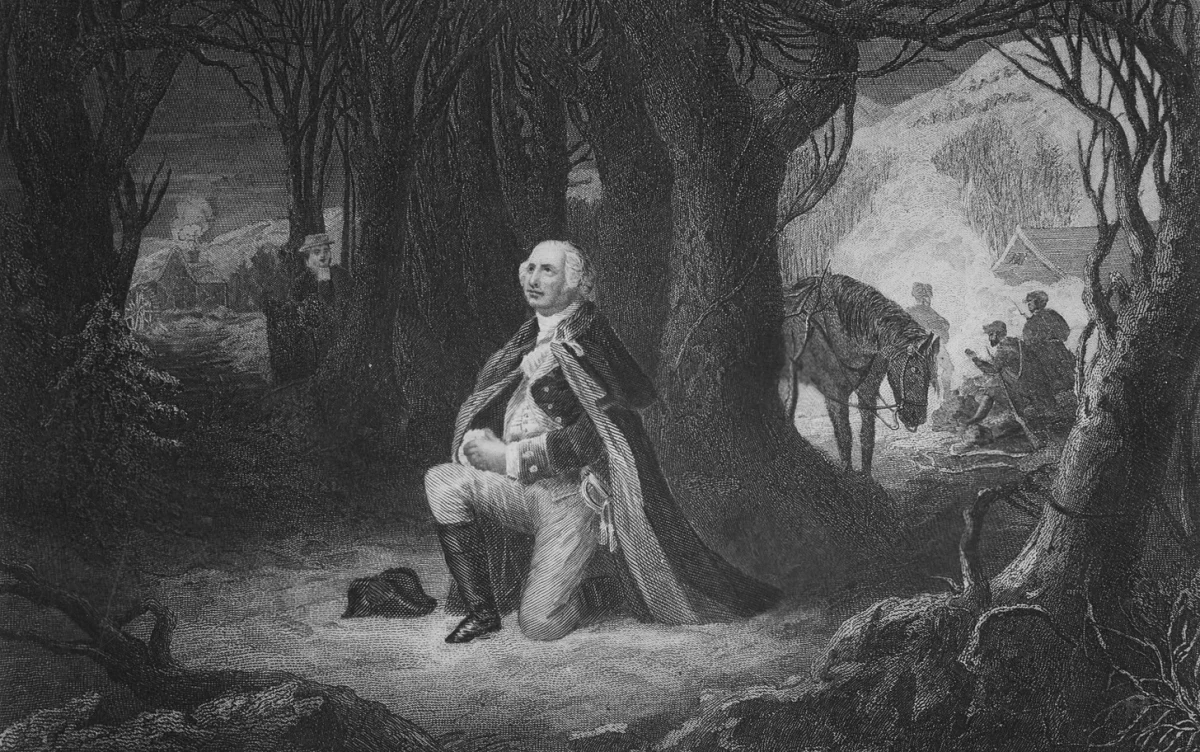
At the top of the White House site, it says the effort is to rededicate “the United States as one nation under God.” And then they posted an image of George Washington praying on bended knee in the snow next to a horse while in Valley Forge during the Revolutionary War. At first, they posted an ugly, apparently AI-generated version. By the day after Trump’s announcement, the site had been updated to feature the same scene but a more famous version by artist Arnold Friberg. He painted “The Prayer at Valley Forge” 50 years ago for the U.S. Bicentennial celebration.

The original image of George Washington praying (left) on the White House’s “America Prays” site, and a cropped section of Arnold Friberg’s “The Prayer at Valley Forge” (right) now on the site.
The Trump administration likes Friberg’s image as they push Christianity as part of the celebrations of the 250th anniversary of the Declaration of Independence next July. The Department of War posted the painting on social media on Nov. 16 along with the caption, “For 250 years, America’s military has appealed to Heaven.” The Department of Labor shared it on social media on Sunday morning, adding, “May God bless our nation and her people.” And Secretary of War Pete Hegseth referred to the story of Washington praying during his remarks at a Christmas tree lighting at the Pentagon yesterday (echoing similar remarks about Washington praying that he made during first of the monthly prayer services he’s been leading at the Pentagon).
There’s a bit of a problem with all of the uses of Friberg’s painting or other renditions of Washington praying at Valley Forge (whether created by AI or not): It’s based on a myth.
There’s no evidence the moment ever happened, and the original story included inaccurate details from someone known to have made up stories about Washington. Yet, this false story is held up now as “evidence” that America was built on prayer and is “one nation under God” (even though God wasn’t actually added to the Pledge until 1954, which is long after Washington was at Valley Forge).
Despite that, as these few recent moments show, we’re likely to see the painting and hear the story a lot in the coming months as we near the Semiquincentennial on the Fourth of July. It’ll be repeatedly used as “proof” the U.S. should be a “Christian nation.” So this issue of A Public Witness looks at the truth behind this Christian Nationalist fable.
Unreliable Narrator
Episcopal minister Mason Weems preached some at the church where George Washington attended prior to the Revolutionary War. But in his later retellings, Weems gave himself a stronger Washington tie, calling himself the “rector of Mount-Vernon parish.” He used that exaggerated connection to promote his book, A History of the Life and Death, Virtues and Exploits of General George Washington. First published in 1800 — the year after Washington’s death — it was a popular book that he repeatedly expanded with many editions as he added new stories.
The problem is the book is often more hagiography than biography. And Weems was less concerned with getting things accurate than advancing moral lessons with his stories. As historian François Furstenberg explained in his book, In the Name of the Father: Washington’s Legacy, Slavery, and the Making of a Nation, “Weems would use Washington to teach virtue to America’s youth.” So some of the stories in the book are believed by historians to be made up.
Like the one about little George chopping down the cherry tree.
Yes, that’s right, a story we teach to children to highlight the importance of telling the truth is itself a lie. Perhaps that’s why it wasn’t even originally in the book.
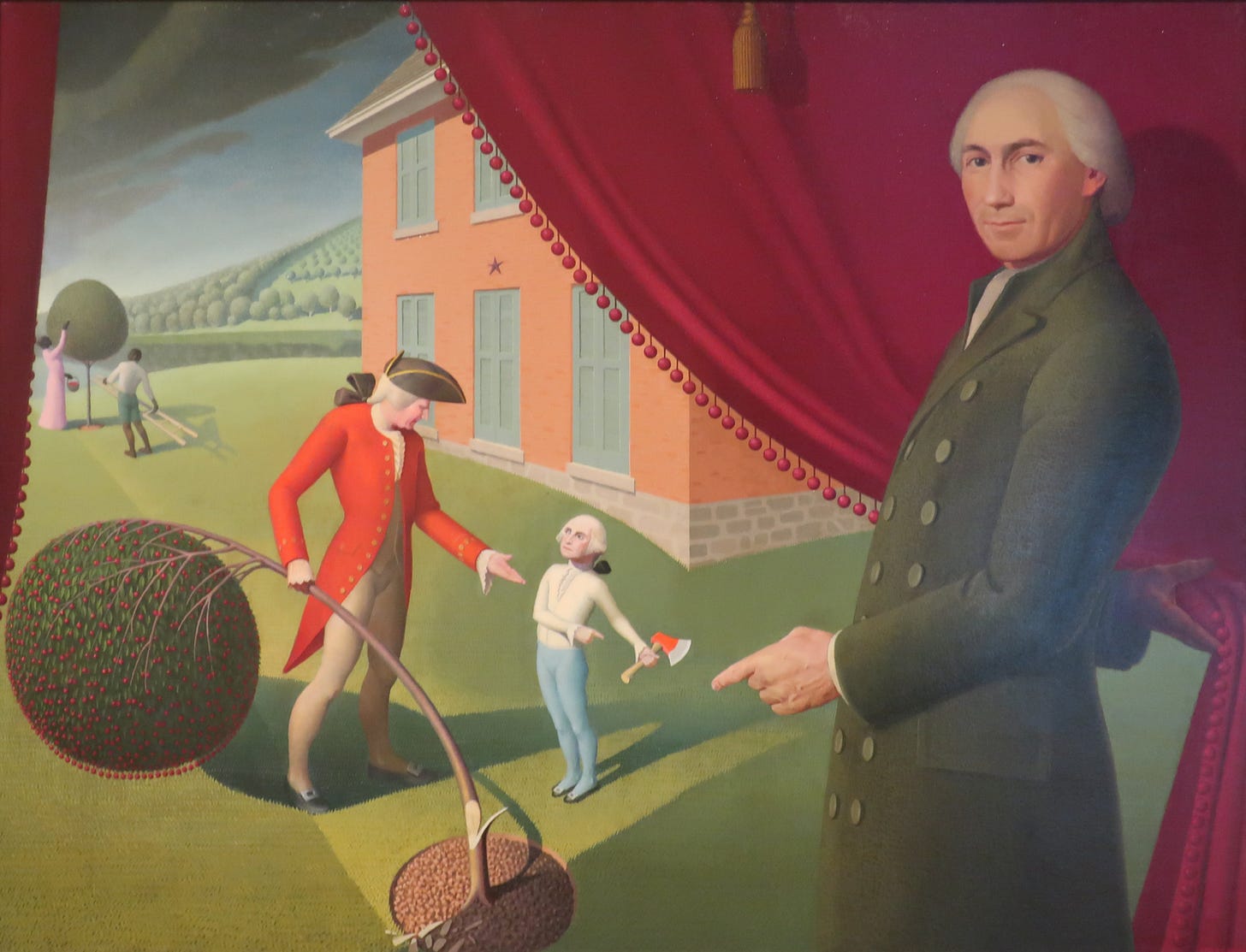
Grant Wood’s 1939 painting “Parson Weems’ Fable” depicts the story of young George Washington and the cherry tree while also highlighting it was made up by Mason Weems, who is seen standing in the foreground as if directing a play. (Public Domain)
As Weems’s stories were popular and he kept printing new versions, he added the cherry tree story to a new edition a few years later. He also added a story about Washington’s praying at Valley Forge during the Revolutionary War. And it too is a myth.
The rest of this piece is only available to paid subscribers of the Word&Way newsletter A Public Witness. Subscribe today to read this essay and all previous issues and receive future ones in your inbox.