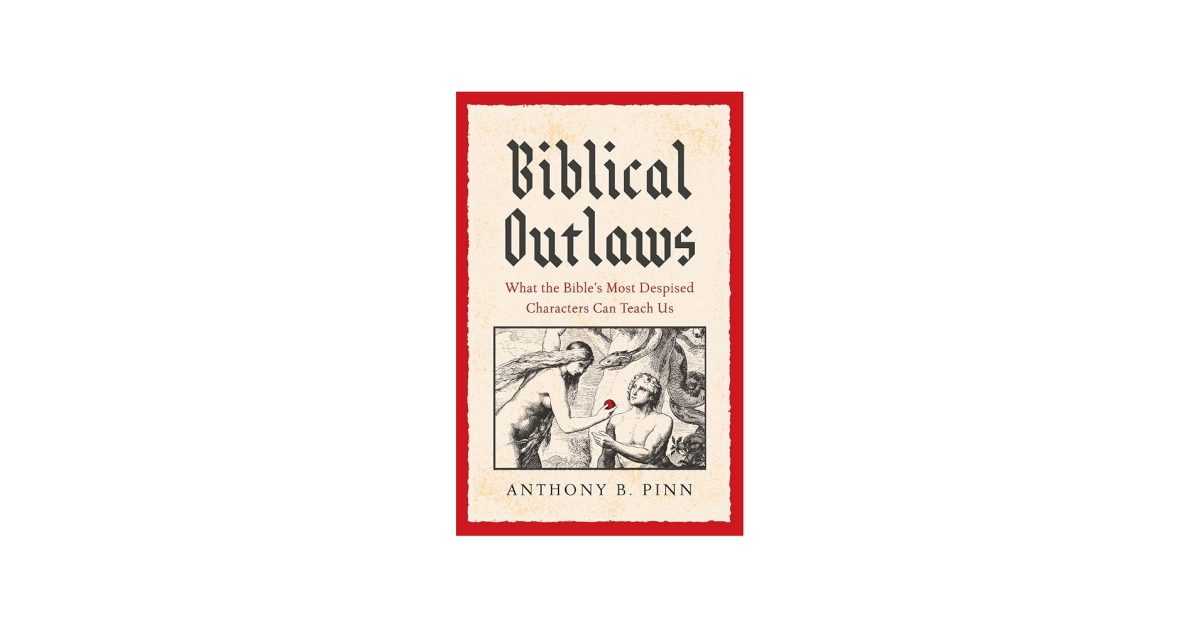
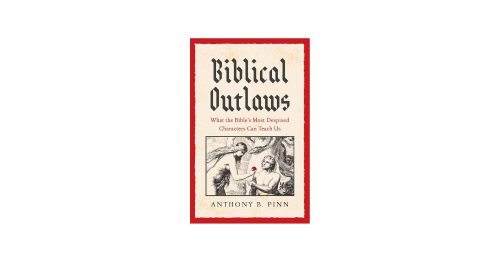
BIBLICAL OUTLAWS: What the Bible’s Most Despised Characters Can Teach Us. By Anthony B. Pinn. New Haven, CT: Yale University Press, 2026. X + 179 pages.
I have a strong love for the biblical story, which one would expect from an ordained minister. At the same time, I understand that we cannot read it flatly, believing everything is equally valid, authoritative, and true. There are depictions of God and human relationships, along with actions allegedly authorized by God, that simply cannot stand unchallenged. Therefore, there are times and places we simply must read against scripture. Often, that means reading scripture against scripture. There also are characters in the Bible that get overlooked or mislabeled. Consequently, if we wish to get a full sense of the biblical story, we need to attend to the stories that get overlooked or misinterpreted. We might think here of a person such as Hagar, whom Paul casts in a negative light, while the Genesis narrative suggests that God honored her even as Abraham sent her off into the wilderness. Neither Abraham nor Sarah comes off well in the story of Hagar and her son Ishmael. Then there is the matter of the people who interpret the Bible. Might we benefit from readings offered by less-than-devout interpreters, even if they are atheists? I will confess that I am open to such perspectives, especially if they open up new possible interpretations.

Robert D. Cornwall
When I received word from a representative of Yale University Press about a book with the title Biblical Outlaws, I knew I had to read and review it. I wanted to know What the Bible’s Most Despised Characters Can Teach Us (the subtitle of “Biblical Outlaws). I wasn’t disappointed. Biblical Outlaws: What the Bible’s Most Despised Characters Can Teach Us was written by Anthony B. Pinn, the Agnes Cullen Arnold Distinguished Professor of Humanities at Rice University. He teaches and writes in the area of religious studies and is, by confession, an atheist. Perhaps it is his social location as an atheist who studies the Bible that attracted him to the Bible’s despised characters. With that in mind, Pinn offers us his take on five biblical characters, three from the Old Testament (Lot’s Wife, Job’s Wife, and Nimrod) and two from the New Testament (Judas Iscariot and Thomas). The first three do not get much attention from interpreters (or preachers), while the two figures from the New Testament are commonly treated in sermons and bible studies. After all, Judas betrayed Jesus, while Thomas is known for his doubts.
Starting with his introduction, which is titled “Reading the Bible Against the Bible,” Pinn sets forth the vantage point from which he is going to read these biblical stories. That vantage point is his claim to be an atheist/secular humanist who reads the Bible. Although the Bible isn’t his favorite book, he notes that “neither am I one of those atheists who is laser focused on destroying it as a sign of its unimportance or on proving it useless in some other symbolic way” (p. 1). His willingness to engage the biblical story with great seriousness is a sign of his awareness of its historical, cultural, and religious value. At the same time, he thinks the biblical stories are a bit slippery, though they are intended to teach moral and ethical lessons. He works here to bring out some of the lessons that he believes often get lost in translation. The way he does this is by looking not at the major figures we usually focus on, but by examining figures who are often depicted in a negative light. He wishes to celebrate the despised ones, who are often the underdogs in the story. In the course of the book, Pinn draws on the work of scholars that include Delores Williams, Wilda Gafney, Nyasha Junior, and Renita Weems. When it comes to the five figures he has chosen to focus on, he centers his attention on “the economy of ‘having’ and ‘giving’ —a system of exchange that defines what it means to be human within the biblical world.” In choosing these five figures to study, he believes they represent persons whose position in the economy or system places them on the margins.
The five chapters in Biblical Outlaws are divided into two parts. Part One is titled “The Economy of ‘Having’ and ‘Giving.'” In the three chapters in this section, Pinn focuses on Lot’s Wife, Job’s Wife, and Nimrod, a figure connected to the famed Tower of Babel. Part Two, titled “On the Nature of Loss,” focuses on Judas and Thomas.
Beginning with Part One, Pinn offers a look at the story of Lot’s Wife. The chapter is titled “Lot’s Wife and the Importance of Not Forgetting” (Chapter 1). While we know the story of how she is turned into a Pillar of Salt after she looks back at the city as it is being destroyed, the question we rarely ask is why she chose to look back at the city. What is going on in the story that leads to this action? Did she have an attachment to the city that is not explained? Was she angry at Lot for offering her daughters as sacrificial offerings instead of the two strangers? Pinn explores all of these possibilities, inviting us to see things from her perspective. In fact, in this chapter and in each of the following chapters, Pinn offers us an imaginative response from the character’s perspective. In the case of Lot’s Wife, he titles the section of the chapter “What Lot’s Wife Might Say.” I found these storylines intriguing. In this telling, Lot’s Wife (who, like many women in the Bible, is unnamed) declares: “I believe Lot loves his children, to the extent that human property can be loved. But evidently that bond wasn’t strong enough for him to protect and value them against some vague charge of wrongdoing” (p. 45). In other words, there may be more to the story than we’ve been led to believe.
In Chapter 2, Pinn turns to “Job’s Wife and the Price of Integrity.” According to the storyline in the Book of Job, Satan makes a wager with God regarding Job’s faithfulness. We tend to focus on Job and his responses in relation to the conversations with the “friends” and then with God, but we don’t often think of his relationship with his wife, who encourages him to curse God and die, something he refuses to do. It is because she encourages him to do this that she becomes a despised person or biblical outlaw. But why would she push Job to go that route? The subtitle raises the possible answer. It is a matter of Job’s integrity. Why not push back against God, who is supposed to bless the righteous? As Pinn reminds us in the chapter, Job isn’t the only one affected by Satan’s wager with God. She also loses children and suffers from poverty because of the wager. According to Pinn, she wants to have a voice in this situation. Again, we have an insightful reflection on someone who tends to live on the margins of the story, but whose voice should be heard.
Then there is the case of Nimrod, whose story is explored in a chapter titled “Nimrod and the Value in Trying” (Chapter 3). In Nimrod’s case, we seem to have a person who is appropriately despised. After all, he attempted not only to build an empire but a tower that would reach into the heavens, an effort God seemed to despise. Up to this point in the Genesis story, humanity appears to be unified while living together in one place. After Nimrod attempts to build the tower, humanity is scattered when God punished those who followed Nimrod by confusing their languages. That sounds “bad,” but is there more to the story of Nimrod? In light of the post-flood portion of the Genesis story, it appears that God wanted the populace to disperse. However, led by Nimrod, they didn’t seem intent on doing so. Therefore, God responds by confusing their languages. In his effort to distinguish between having and giving, Pinn suggests that in the story of Nimrod, we have “the first significant act of human creation that is drawn exclusively from human initiative and desire.” This changes the relationship with God. Why is that?
There is a lot to digest from these three stories, and one would assume other characters could have been included. I’ve already mentioned Hagar. King Saul might be another. In fact, I have always felt like Saul got the shaft! But with the stories of these first three characters discussed, now it’s time to move on to Part Two: “On the Nature of Loss.” Here we have the stories of Judas Iscariot and Thomas. I think that Thomas has largely been rehabilitated in recent years, at least in terms of how I engage with him in my preaching. I believe this is true of many others, especially since the stain of doubt has largely lost its edge in recent years. As for Judas, well, even if he hasn’t been fully rehabilitated, questions have been raised as to whether he might have been motivated by something other than greed.
The first of two chapters on New Testament characters is titled “Judas and Accountability” (Chapter 4). As is the case in each of the chapters, Pinn begins by sharing a reading from the Bible. In this case, Matthew 26:1-75 and Matthew 27:15. After providing the biblical text, Pinn dives into the story of Judas and the role he plays in the story of Jesus’ arrest and crucifixion. As he notes, from both the canonical sources and the early church perspective, Judas is a problem. He may play a necessary role in getting Jesus to the cross, but that doesn’t mean he isn’t despised. The question is, why did Judas betray Jesus? What was his motive? That is the question that Pinn seeks to raise here. Did he see his betrayal as something that had to be done to get the revolution started? Pinn allows us to enter into the question of whether Judas might have felt that Jesus was moving too slowly. Besides, he allowed himself to be anointed with expensive perfume when that money could be used for other things. Thus, we have a question of accountability.
In his final chapter, Pinn invites us to consider the story of “Thomas and the Importance of Touch” (Chapter 5). We know that Thomas expressed doubts about reports of the resurrection, but were his doubts directed to Jesus or to the other disciples? Here, the question revolves in part around why, in John’s account, Thomas was absent when Jesus made his first appearance. Was he, for some reason, something of an outsider, and thus not invited to be with the inner circle? If so, could the request for proof involve questions about the reliability of the witnesses? Pinn seems to think so, and I find his take compelling. Of course, there is more to Pinn’s engagement with the story, but again, he offers us an alternative view of someone who has often been dismissed in the past simply as an example of one who doubts the testimony to the Gospel. Pinn asks us to consider whether Thomas might have had reason to doubt the testimony.
Readers do not have to follow Pinn into atheism or even embrace all of his interpretations of these stories to recognize that he has brought to the forefront figures whose stories have not gotten the attention they deserve. I found him raising questions that I hadn’t considered before reading the book. This is especially true of a person like Lot’s Wife. We tend to honor Lot for defending the strangers, but what about his daughters? Might Lot’s wife have had concerns about his actions that led her to look back at the city that had been her home, especially since it appears that her daughters’ prospective husbands were not with them?
Anthony Pinn’s Biblical Outlaws: What the Bible’s Most Despised Characters Can Teach Us is not a lengthy book, so it is a relatively quick read. Although it is written by a scholar who has thought deeply about these characters, it is very accessible. It might be a challenging read for those who are not ready to deal with the kinds of questions he raises, but if you are an open-minded reader, even if you are devout in your beliefs, I think you will find this to be a very insightful book. Of course, he could have explored other characters, but I think he makes a valid point with these five characters. The Biblical Outlaws do have something to teach us about life, including the life of faith. This is true even though the author is himself an atheist.
This review originally appeared on BobCornwall.com.
Robert D. Cornwall is an ordained minister in the Christian Church (Disciples of Christ). Now retired from his ministry at Central Woodward Christian Church (Disciples of Christ) of Troy, Michigan, he serves as Minister-at-Large in Troy. He holds a Ph.D. in Historical Theology from Fuller Theological Seminary and is the author of numerous books, including “Eating With Jesus: Reflections on Divine Encounters at the Open Eucharistic Table” and “Second Thoughts About Hell: Understanding What We Believe” coauthored with Ronald J. Allen. His blog Ponderings on a Faith Journey can be found here.