Climate change is a known existential crisis facing humanity, but much of the Western world has failed to act. Climate change has been connected to droughts, more severe weather (hurricanes, tornadoes, etc.), and decreases in habitable environments in much of the world. The United States has withdrawn from the Paris Climate Agreement for the second time under President Donald Trump. This agreement required signing countries to limit greenhouse gas emissions to below 2°C above pre-industrial levels — which the world is not on track to meet.
While we know the necessary steps to mitigate climate catastrophe (e.g., decreasing fossil fuel emissions), many people are constrained in their ability to take these actions. In her book A Perturbed System: Religion and Climate Change from the End of a World, University of Exeter anthropologist Susannah Crockford discusses how countries that are historically Protestant and Western have inherited motifs (messianism, apocalypticism, sacrifice, and others) that have both enabled and constrained climate discourse. Because these motifs frame the discussions people have about climate change, they influence the actions people can take when addressing the issue.
Contributing writer Kenneth Ethan Frantz recently spoke with Crockford about her new book, why many Western countries are having trouble responding to climate change, and how theological motifs relate to other environmental concerns (e.g., AI data centers). The following interview has been edited for length and clarity.
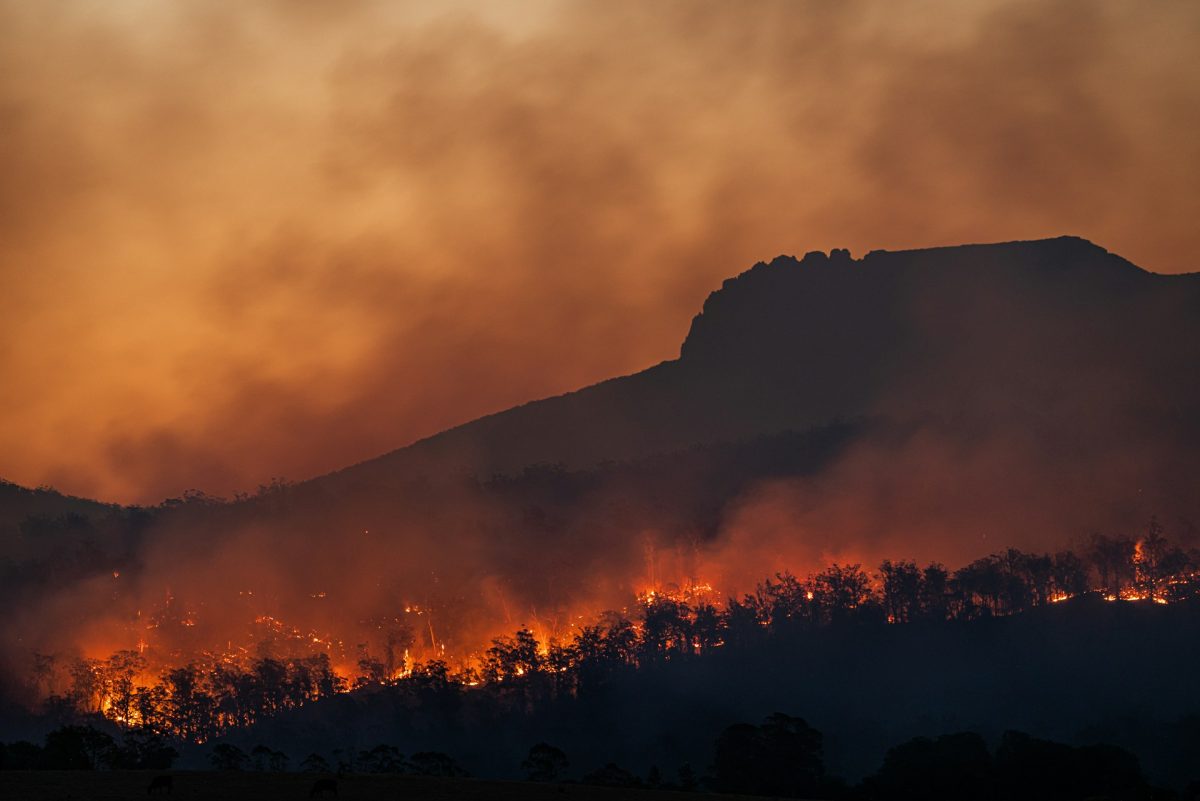
Bushfires below Stacks Bluff in Tasmania, Australia (photo by Matt Palmer on Unsplash)
Kenneth Ethan Frantz: Your book is about how Protestant themes frame the discourse around climate change. So would you mind talking about why you chose that topic? Why is it important?
Susannah Crockford: The topic emerged from a research project which was on the Anthropocene and it was funded by the European Research Council. And my part of that project was to study social responses to climate change, which I thought was important because there’s a lot of research on, say, the technical causes of climate change, i.e., there’s more carbon dioxide in the atmosphere that’s causing the average global temperature to increase. That then causes all these other effects like more extreme weather events. And there’s sort of a good understanding of how that works, but where there is less of an understanding is: Why aren’t people doing more about that? Where are social and political systems, in fact, working against mitigating that effect? And why is it, even though we know quite well what is causing climate change — it’s overwhelmingly fossil fuels — why are we still reliant on fossil fuels? In fact, world governments subsidize fossil fuels to the tune of about $7 trillion a year.
So why is all that happening? And I think the reasons why that’s happening are social and political. So that’s sort of where I started. And then the more I did my research, the more I realized that it is a technical problem in the chemical composition of the atmosphere. It is also a social and political problem, but it is also something of a spiritual crisis. And it was this sense of spiritual crisis that to me was so striking because it was felt by people who were not explicitly religious. So my book isn’t about Protestants, for example. It is about people who live in societies that have a history of Protestantism and how the ideas and concepts in that sort of religious history continue to influence the way that they understand climate change today.
KEF: The methods are interesting because you do use more ethnographic site work and you use some analysis of the media. So why those methods in particular when studying these theological motifs, as you call them?
SC: So I started off by doing interviews. So that’s where I started methodologically. By training I’m an anthropologist, but what I tend to do is more participant observation. This project started off with just interviews and then I expanded out from those interviews to do more participant observation fieldwork, which is where you join in and live as people do. So for example, I went to activist workshops or courses. I went to various protests because Extinction Rebellion, which is this big movement in Europe, it was sort of in America, but not quite as popular in America. But that all started while I was doing my fieldwork. So I started attending those protests and also the school strikes, which is where school students were refusing to go to school. It was started by Greta Thunberg. That was very popular in the country I was living in at the time, which was Belgium.
So I started with interviews, continued out to participant observation. And then I also included how these various things I was looking at were mediated through various different media forms. I looked at news media and social media primarily because I think, especially when it comes to climate change, the societies I was looking at are not as directly affected as some countries in the world are. For example, there’s islands in the Pacific which are rapidly sinking. That’s not happening in the places largely that I went to. So most people understand and relate to climate change through the media, and therefore the media they consume really does affect how they understand climate change. Do they think it’s an existential threat or do they conversely think that it’s a hoax spread by the government? And whether they thought it was real and existing or whether they thought it was a hoax, that really did line up very neatly with the kinds of media they consumed.
So that’s why I thought it was very important to bring in how climate change was mediated because it’s not something that is direct. It’s sort of this abstract concept, and it’s very hard to directly know it because even the things that we do directly know, well, these are actually weather phenomena. It’s heat waves, it’s hurricanes, but you can experience those without thinking of them in terms of this concept, this abstract concept of climate change. So then actually media becomes very important. It has this pivotal role between scientists, between policymakers, between publics, and connecting them in a way that is legible. And unfortunately, a lot of media sources are not doing that in a way that encourages constructive action on climate change. They either tend to dismiss it as a hoax or alternatively, they talk about it in this very sensational way as this sort of apocalypse, which reinforces this theological motif of it being the apocalypse.
But then doing anything about it becomes sort of ridiculous or too hard in the media narratives that I studied. So the more I realized this, the more I thought it was really important to combine all of these different methods to understand what these social responses to climate change were. So talking to people directly, living with them and doing as they did, and then also looking at the media they consumed and analyzing that.
KEF: And on the topic of methods and data, you do visit a wide variety of different sites. You visit places in the American South, UK, the Nordic countries. So why did you take that approach?
SC: I wanted to do a multi-sited study partly because of the nature of climate change itself and partly because of the way climate change has been written about in previous ethnographies in anthropology, which is my primary field. So on the latter point, a lot of climate ethnographies are sort of local studies of the way that long-term weather changes that are driven by climate change are affecting specific groups of people. There’s a lot of that and it’s very good work, but I wanted to connect places that seemed disparate in order to show how they were connected through climate change, whether that’s through contributing to it or being excessively impacted by it in order to write something ethnographically because ethnography tends to be local, but I wanted to write something ethnographically that could in fact try to at least represent this concept of global climate change. So that’s why I started talking about discourse, and I thought in order to talk about discourse you should go to lots of different places.
And that’s also partly about climate change itself as a phenomenon. It is a phenomenon that cannot be contained to specific local places, something that is impacting, say, coastal Louisiana. Its causes are sort of driven by decisions that are made in Washington, but also decisions that are made by people who work on oil rigs. So it is this interconnected problem. So in order to approach that interconnected problem, I wanted to use a number of different places to show that sort of network of interconnections. And the fact that all of these places are in the Global North was also significant because I think again, a lot of the work specifically in anthropology really looks at the Global South and that’s very good. But then I think you’re missing part of the picture, and it sort of reifies that notion that’s still present in the Global North, that we’re not really affected by climate change yet.
It’s not really our problem yet. It’s something sad that’s happening to people far away. And I wanted to push against that notion to show how it is, in fact, affecting us now and how, in fact, we’re very responsible for that now, especially through our political decisions. And that’s why religion started to become really important. I really didn’t set out to study religion. I set out to study climate change, which I thought didn’t have anything to do with religion, but that sense of interconnection, that really pointed me towards why religion was important because a lot of the people that I was working with, my interlocutors, just didn’t really know how to come to grips with their own complicity, how much they benefited from these systems that were at the same time destroying the ecosystems that they also greatly valued. And in order to approach these really significant questions, the kind of questions that someone like theologian Paul Tillich would call questions of ultimate concern, you really start moving into a theological register.
KEF: You mentioned a thread throughout that people believe if you can get others to believe the right thing, they will start to behave correctly.
SC: So this is sort of the information deficit model, and it’s very common in science communication and climate communication. All we need to do to get action on climate change is to provide people with information about how bad it is, then they will make the right choice to do something about climate change. This model, by and large, doesn’t work that well because people don’t just passively receive information and go, “Okay, I will absolutely do what you’re saying I should do.” Communication is much more complicated than that. And then also you have all these social and political blocks. Just because scientists are putting out one message doesn’t mean the media is mediating it in the way that scientists want them to. And then of course you’ve got your political level. Just because scientists are putting out this message doesn’t mean that politicians are going to say, “Yes, we’re going to do that.”
Because actually politicians have a number of other interests, many of which are based in the interests of capital, i.e., what makes a lot of money rather than what is best for ecosystems. And that is, in fact, one of the big blocks there. And in terms of where religion affects this, I would say is that it’s not that religion determines the way people receive the information about climate change. It’s more that when people think about climate change, there’s this sort of assumption of right and wrong belief.
And that’s one of the things which I trace these sort of Protestant theological motifs that there is, if you have your right belief, you will do the right thing. And that’s this very kind of Protestant notion that if you have the right faith, you have the right belief, you’ll do the right thing and that leads you to be one of the elect. And this, I think, is very much underlying this information deficit model. If we give them the right information, they’ll go and do the right thing. So that’s why the model doesn’t work, is what I’m arguing, is because actually it’s not based on an empirical evaluation of how people communicate. It’s based on these ideas about belief which are in fact coming from religion.
KEF: On the topic of taking action, you do talk about a lot of activists thinking of themselves as saviors or messiahs or —
SC: It’s not that they think of themselves as messiahs. It’s just that this language of saving the earth is very strong in activism. So it’s not that they individually think I’m going to go out there and save everyone, but it is that they think of the earth as something that needs saving.
And when you think of it in this soteriological mode, this again kind of brings up these inheritances from Protestantism that it is an individual that is going to do that. So we focus a lot then on individual actions to save the planet. So you recycle, you turn your lights off at night, but none of these are actually that impactful. If you want large-scale systemic change, then that actually does need to work at the level of social structure. So I sort of refer to a few events that have decreased carbon emissions. None of them were actually done on purpose to lower carbon emissions. One was the COVID pandemic, and another one was the fall of the Soviet Union. Now, those did lower carbon emissions because they caused a mass reduction in industrial production. None of that is going to be caused by our individual actions. So activism as a way of saving the earth by making us change who we are as individuals really isn’t going to work.
And I think a lot of activists do actually are aware of this and do know this. And that’s another one of the points I make in the book that they sort of push against this sort of frame that’s put upon them as being people who are trying to save the earth, but it’s still out there and it’s something that still very much curtails the discourse around the way that activism is understood and received. What’s interesting about activism actually is that it doesn’t really work on the level of the policies that it’s trying to change. Activism very rarely works to change the policies they’re intentionally trying to change. What it changes is the people who are in those movements. So it does cause this individual transformation, but it’s of the activists, not of the thing that they’re trying to change.
KEF: You did mention in the conclusion that you yourself are trying not to get caught up struggling with apocalypticism and trying not to give into fatalism because it hasn’t been decided yet.
SC: What I found with this research was it really did start from a place of me wanting to understand what was happening in the climate crisis better because I had heard that it was very bad and I really didn’t want it to be that bad. And then the more I researched, the more I discovered it actually really is. It really is that bad. And this leads to a very understandable period, not just for me, but for many of the people that I met through my research, of just this period of almost despair of what do you do? Do you have children? What job do you do? Do you try and go live on a farm somewhere, wherever that is? How do you live in this world which you have been told by very credible sources is dying in various ways through mass extinction, through climate change?
And how do you live in that world? That’s a very hard world to live in. So I try and come to terms with that on a personal level as a way to help others also come to terms with that. Not to judge themselves for having these feelings, not to feel guilty, but then also at the same time to understand that it isn’t decided yet, there are still things you can do and that the decisions that you make now matter a lot and that you’ll probably make poorer decisions if you’ve given in to despair than if you do not. So that is the overall message, especially from the conclusion, is that it’s everything that you decide — even though I know I just said little individual decisions don’t matter — but the way you choose to live your life actually matters a lot to you and the way that you feel about living in this time, which is hard.
It is a hard time to be alive. So just to not give into that sense of despair and that sense of grief and to try and still do something purposeful even though you’re in a time where you have way fewer options than maybe people did in the past, even just the generations before you did. And that even though you live in this time of limited agency, fewer options and limited possibilities, it still matters what you do, even just on the level to you.
KEF: A lot of the motifs you pointed out were interesting, but one that stuck out to me was the idea of sacrifice. According to some, for the greater good or for wellbeing, some people or some land or water has to be sacrificed. I know the book is about climate change, but that did connect to a lot of other big environmental issues. I think the AI data centers definitely came to mind in terms of sacrificing land, sacrificing water, sacrificing communities.
SC: Certain pieces of land are used up and sacrificed, and what we really need to ask there, where this idea of sacrifice or this motif of sacrifice is being used, is what is this greater good? At least with fossil fuels, you can argue they do power most of the economy. Now the argument against that is you can replace it with other sources of fuels which are less extractive and have fewer impacts. They don’t have no impacts, but they have fewer impacts, so we can switch to renewables. Now with AI data centers, what is the greater good? I think that actually the idea that whole communities, pieces of land, whole reservoirs are being just sacrificed. And for what? What does AI do that we in fact cannot do ourselves? Why are we giving up all of these resources for this?
What is this idea of greater good and who does it really serve? Because sacrifice can be an incredibly meaningful act if it is done willingly for a purpose that the person sacrificing themselves sees as meaningful. But the problem, especially when we’re talking about environmental impacts, is that the communities, the lands being sacrificed have not consented to it. Often they don’t even know it’s happening until it’s already happened. I talk a lot about coastal Louisiana and the effects of the oil and gas industry there. Now that all happened and then years later the health effects and the effects on the communities there became apparent. So they didn’t consent to it. They didn’t know why it was going to happen. And the same thing basically you can say is happening with things like AI. We don’t know the implications of using this technology. A number of harms have already been identified.
Why are we then doing this? Why is this sacrifice being made? And are those who are sacrificing these resources even aware that that’s what’s happening? I recently read that there’s a massive data center being planned for the north of the county that I live in. And I think that this is a horrendous idea and I just hope that we can stop them because it’s just so unnecessary. You don’t need to continue to set fire to resources just to kind of keep feeding this planet-burning plagiarism machine. It’s so unnecessary.
It’s much, much worse than fossil fuels. Fossil fuels can at least be transitioned away from, and there’s at least some excuse there that fossil fuels, when we started burning them, the understanding of their effect was much less. At least if you go back to say the 1700s and the early 1800s. But even then, the greenhouse effect’s been known since the early 1900s, so we really should have gotten on with transitioning away from fossil fuels by now.
Kenneth Ethan Frantz is a freelance writer and a doctoral student in sociology at the University of Oklahoma. You can follow him on Bluesky @kennethefrantz.bsky.social.