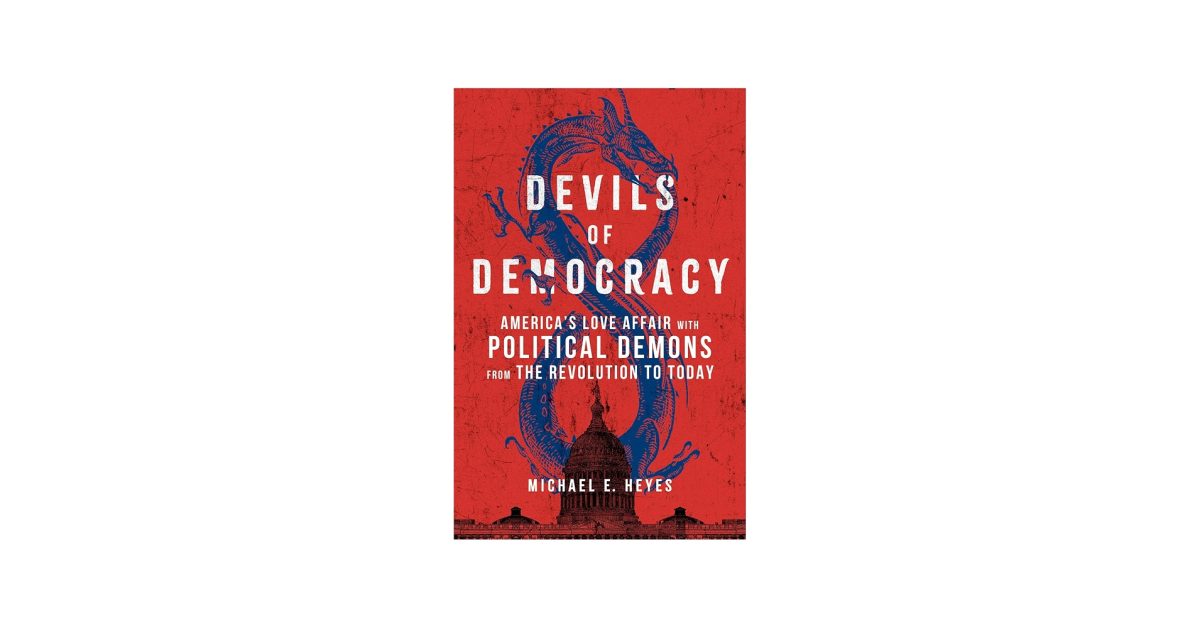
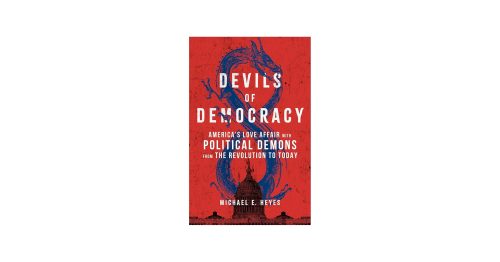
DEVILS OF DEMOCRACY: America’s Love Affair with Political Demons from the Revolution to Today. By Michael E. Heyes. Minneapolis, MN: Broadleaf Books, 2026. 333 pages.
The title of the book — Devils of Democracy — may be a bit misleading. At first glance, you might think this was simply a book about metaphorical political demons that inhabit the current political sphere, but in reality, this is a book about belief in real demons. At the same time, there is a thread that is focused on the way conspiracy theories work, that is, conspiracy theories laced with beliefs in the demonic. Devils of Democracy isn’t just about the connection of demons to American politics, since the author, Michael E. Heyes, takes things back to ancient times. In other words, Devils of Democracy is a rather complex book. That’s not surprising because the connection of belief in demons and politics is itself complex.

Robert D. Cornwall
Devils of Democracy: America’s Love Affair with Political Demons from the Revolution to Today was written by Michael E. Heyes, an associate professor and chair of the Department of Religion at Lycoming College in Williamsport, Pennsylvania. The version of the book I read and on which this review is based is an Advanced Reading Copy. Heyes’ Devils of Democracy examines the relationship between belief in demons and politics, and as such is connected to his larger interest in monsters and demons. This book, though it covers a lot of ground, is deeply concerned about contemporary political life, including the role of belief in demons among supporters of Donald Trump.
That support includes the embrace of spiritual warfare as a political art. Many of those who embrace spiritual warfare are also Christian Nationalists, people such as Lance Wallnau and Paula White, two strong Trump supporters. A central theme in the book is Heyes’s suggestion that “Americans, as it turns out, love political demons” (p. 7). This love of political demons goes back to the beginnings of American history. It was also a significant driver of support for both sides of the Civil War, with each side seeing the other as in league with the Devil.
Heyes divides Devils of Democracy into five parts, taking the reader on a historical journey from the ancient world to the present. Part I is titled “Thousands of Years of Demons: A History.” It comprises two chapters. Chapter 1, “In the Beginning,” takes us back to the biblical story and the role that Satan and demons play in it. Whereas Chapter 1 introduces us to the Devil and the idea of demons, Chapter Two, “Dealing with Demons,” focuses on the New Testament, especially Jesus’s ministry of exorcism. From the New Testament, Heyes takes us forward into early Christianity, including the ideas found in the writings of Augustine, among others.
Part II is titled “The First American Apocalypse.” This section focuses on the Seventeenth and Eighteenth Centuries. This section also has two chapters, the first of which is titled “The Papal Beast and the French and Indian War” (Chapter 3). Here we discover how belief in the demonic functioned during a time of war pitting the predominantly Protestant British American colonies and the Roman Catholic French. For many Protestants, the Pope was the anti-Christ, so you can see how this would work during a time of war.
The second chapter in the section is titled “A Revolutionary Apocalypse” (Chapter 4) and focuses on the Revolutionary War. Here we discover, for example, that the Stamp Act was portrayed in demonic terms, such that its agents were demonic agents. Though George III was Anglican, he was portrayed by many as being a secret Papist, and therefore in league with the Papal Beast. Connected to this chapter is “The Modern Takeaway,” which focuses on apocalyptic movements such as William Miller’s and the more recent predictions of Harold Camping. Heyes points out that mixed into the apocalyptic theories has been belief in American exceptionalism.
Part III is focused on “Spiritualism to the Civil War: The Nineteenth Century.” We sometimes forget how popular spiritualism, which includes efforts to speak with the dead through seances and other mediators, was during the nineteenth century. Spiritualism may not be as popular today as it was then, but there are links between the contemporary world and nineteenth-century efforts (think the Ouija Board) to contact the dead. This section has six chapters, beginning with Chapter 5, “Speaking with the Dead,” which is followed by a chapter titled “The New Witches of Endor” (Chapter 6). This latter chapter focuses on the language of witches in relationship to spiritualism and the beginnings of opposition.
The discussion of opposition continues in Chapter 7, “The Wages of Sin Is Death.” Here Heyes develops more fully the belief in demons and the attribution of demonic influence to spiritualism, even if that wasn’t how Spiritualists understood themselves. Chapter 8, titled “Abominable Beliefs, Abominable Politics,” is intriguing because Spiritualists were connected to more progressive political and cultural movements, beginning with the idea of free love, which emphasized the freedom of women to make their own choices in matters of education, marital status, and other social realities. Related to this is Women’s Suffrage, which was again supported by people connected to Spiritualism. Finally, there was a connection to abolitionism, which was embraced by many Spiritualists. Many anti-spiritualists opposed these social justice issues.
When it comes to the Civil War, Abraham Lincoln was connected to the demonic by his opponents. Thus, we have Chapter 9, “Abraham Lincoln’s Pact with the Devil.” Heyes notes that there has been a lot of attention given to the question of whether Lincoln was, in fact, a Spiritualist. While the evidence is inconclusive, it reminds us of the interest people have in Lincoln’s spiritual/religious views. Chapter Ten is titled “The New Black Magic,” a chapter that focuses on new inventions that made Spiritualism more popular and more individualistic, such as the development of the Ouija Board. Spiritualism as a movement in American life peaked in the 1920s and then began to wane in popularity, though this has not been true of the spiritualist tools such as the Ouija Board.
The section closes with a “Modern Takeaway” that focuses on the relationship of gender and conspiracy, with women being more attracted to Spiritualism and the opposition to Spiritualism by anti-spiritualists focusing on gender. Think of the popular view that witches are generally women. Heyes offers an intermission before taking up Part IV, which focuses on the role of dispensationalism in anti-spiritualism and discussions of the demonic. The first three sections set the table for what is to come in the twentieth and twenty-first centuries, which are the focus of Parts IV and V.
Part IV, “The New American Apocalypse,” focuses on the twentieth century, taking note of how concern about the demonic emerges, starting with the work of “Merrill Unger: The First Horsemen of the New American Apocalypse” (Chapter 11). Heyes introduces us to Merrill Unger, a professor at Dallas Seminary, who offered academic treatises that provided a foundation for later discussions of the demonic. This is followed by a chapter focusing on “Michael Harper: The Second Horseman of the New American Apocalypse” (Chapter 12). Whereas Unger wrote academic treatises, Harper built on and popularized those views for a lay audience.
Chapter 13 is titled “Fertilizing Fear Through Film,” which focuses on the films of the sixties and seventies, including “Rosemary’s Baby,” “The Exorcist,” and “The Omen,” which brought the demonic to the attention of a larger population, setting the stage for later panics. Chapter 14 focuses on Billy Graham’s preaching that included giving attention to the dangers of the demonic. That is followed by a chapter that explores the ministry/writings of “Frank and Ida Mae Hammond: The Fourth Horseman of the New American Apocalypse.”
Together, these chapters set up Chapter 16, “The Satanic Panic.” This panic took place in the 1980s and 1990s, which I remember well, as questions were raised about day care centers and efforts to lure teens into Satanic allegiance through music and roleplaying games such as Dungeons and Dragons. If you were around during that period, you will remember the panic, which seems strangely similar to the current anti-Trans movement, where politicians suggest that schools are turning children into transsexuals. We also see a return of this kind of panic in modern conspiracies such as QAnon.
The first four sections serve as a prelude to Heyes’ discussion of the contemporary scene. Heyes titles Part V “Rise of the New Apostolic Reformation: The New Millennium.” This is a movement that is linked to Christian nationalism and the MAGA movement. Several books have appeared of late addressing the rise of the New Apostolic Reformation. This is a movement connected to figures including the late C. Peter Wagner, who was for many years a professor of church growth at Fuller Theological Seminary (my alma mater). The NAR has become closely connected with the political fortunes of Donald J. Trump.
This section includes seven chapters, beginning with Chapter 17, “Out with the Old and In with the New Apostolic Reformation.” This chapter introduces the reader to the NAR, taking note of its key players, including Wagner and Lance Wallnau. After introducing the movement, Heyes turns to the practice of “Spiritual Mapping” (Chapter 18), which explores the role demons play in the theology and practice of this movement. The focus here is on forms of spiritual warfare that Wagner and others embraced. Connected to the NAR is dominion theology, which involves the idea that Christians should take dominion over society.
Thus, in Chapter 19, he discusses “Dominion, He Wrote,” which introduces the Seven Mountain Mandate and R.J. Rushdoony’s theonomy. I found it interesting that Heyes brought Open Theism into the conversation, which has progressive leanings. Still, apparently Peter Wagner embraced a view of God similar to those adopted by many who would not want to be associated with Wagner and the NAR. Chapter 20, “Whatever It Takes,” focuses on the embrace of the NAR leaders of Donald Trump, who was seen as God’s chosen candidate to shake things up, including their presence at the January 6, 2021 attack on the Capitol. While Heyes doesn’t go into the detail that Matthew Taylor does in his book The Violent Take It by Force: The Christian Movement That Is Threatening Our Democracy, he offers a slightly different vantage point.
Of course, this movement was supportive of Trump’s return in 2024. Among the themes discussed here is the Jezebel Spirit that was attached first to Hillary Clinton and then to Kamala Harris, suggesting that both were possessed by a particular demonic spirit. Chapter 21, “The Monster Manual,” introduces us to more demonic spirits that drive politics, including Leviathan, Molech (abortion), and more. This chapter leads us to Chapter 22, “Conspiracy!” In his introduction, Heyes pointed out how conspiracy theories drive political and cultural debate, often fueled by ideas concerned with the demonic. So, here he addresses several ways that conspiracy theories form, expand, and influence people. Central to the discussion is the way we handle knowledge in an age of social media and anti-intellectualism. He insists that “Demonic Conspiracies are the Worst!”
Heyes concludes Part V and Devils of Democracy itself in Chapter 23, which is titled “What Happens Next.” While Heyes approaches the topic as a historian of religion who focuses his attention on the demonic in history, this is not simply an academic treatise. He believes, rightly in my view, that we are facing dangerous times. So, he closes by addressing some of the dangers, such as the possible movement from spiritual to actual warfare, taking note of Pete Hegseth’s embrace of the teachings of Doug Wilson and his infatuation with the crusades.
Heyes points to some of the dangers that face us, including the internet and how it influences us, together with anti-intellectualism and a feeling of powerlessness, all of which open us up to misinformation. He advises us to quit the conspiracies, think carefully about religion, and demand transparency from leaders, especially about their religious influences. Heyes can’t say whether demons exist, but clearly many people do believe in them, and this belief has consequences, not all of which are good, making Devils of Democracy a valuable read.
This review originally appeared on BobCornwall.com.
Robert D. Cornwall is an ordained minister in the Christian Church (Disciples of Christ). Now retired from his ministry at Central Woodward Christian Church (Disciples of Christ) of Troy, Michigan, he serves as Minister-at-Large in Troy. He holds a Ph.D. in Historical Theology from Fuller Theological Seminary and is the author of numerous books, including “Eating With Jesus: Reflections on Divine Encounters at the Open Eucharistic Table” and “Second Thoughts About Hell: Understanding What We Believe” coauthored with Ronald J. Allen. His blog Ponderings on a Faith Journey can be found here.