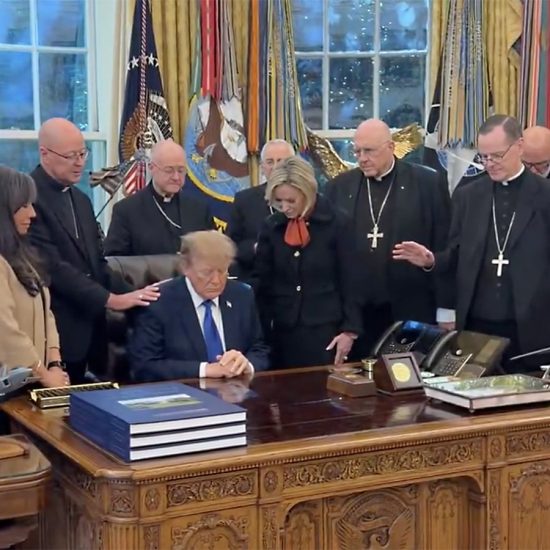
(RNS) — Many have puzzled over the unusual number of pastors, former pastors, and seminarians running for Congress as Democrats this year, but not the Rev. Adam Hamilton. Asked in August about the trend, Hamilton, a United Methodist megachurch pastor running an unexpectedly competitive race for U.S. Senate in Kansas as a Democrat, answered immediately.
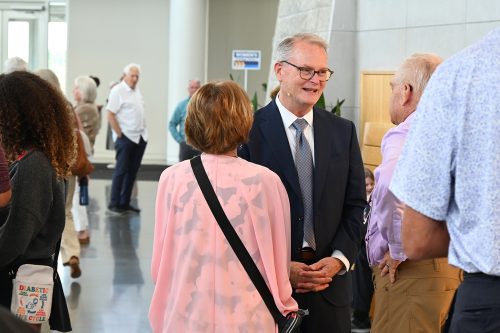
The Rev. Adam Hamilton, center, speaks to congregants after a service at Resurrection United Methodist Church, Sunday, Aug. 30, 2026, in Leawood, Kan. (RNS photo/Kit Doyle)
“Since the beginning of 2025, things are so abnormal in Washington, D.C.,” he told Religion News Service, explaining he believes actions by the Trump administration have spurred people to wrestle with what, exactly, constitutes American values.
“I think there’s a lot of religious people — especially, I think, mainline Protestant pastors — who are saying: Somebody’s got to do something,” he said, adding that pastors-turned-candidates like himself are “feeling the sense of call, and I’m going to attribute it to the Holy Spirit.”
It’s a sentiment shared by a surprising number of Democratic candidates this election cycle. Of the nine pastors, former pastors and seminarians running for Congress as Democrats this year, six — including four locked in tight, widely watched races — belong to mainline Protestant denominations, such as the UMC, Presbyterian Church (USA), and Evangelical Lutheran Church in America.
The candidacies have put a spotlight on the theology of primarily white mainline Protestants, a politically moderate group whose clergy skew liberal and whose members make up around 13% of the U.S. population, according to the Public Religion Research Institute. The slate of mainline candidates with religious training follows a nearly decade-long spike in political engagement largely in response to the rise of President Donald Trump and his evangelical supporters. From Texas to Iowa to Kansas, mainline Protestant candidates, while careful to voice support for the separation of church and state, are giving voice to forms of public theology that could reclaim a position their tradition lost decades ago: a recognized Christian power in U.S. politics.

Religious leaders gathered for an interfaith vigil pose for a portrait, Saturday, Oct. 18, 2025, before joining a “No Kings” demonstration in Times Square in New York. (RNS photo/Fiona André)
Heath Carter, a scholar of American religion at Princeton Theological Seminary, said mainliners are having a moment partly because they have grown so frustrated with the longstanding dominance of conservative evangelicals in U.S. politics.
“You probably see people who’ve wanted to say, ‘Hey, this is not the full extent of Christian witness. These folk actually don’t have a monopoly on Christian public witness,’” Carter said. “There are these other traditions of justice-oriented, pluralism-affirming, democratic Christian theology and politics that we want to tap into.”
A more than 100-year split
This unusual political moment, Carter said, is rooted in a split that has divided U.S. Christians for more than a century. Beginning in the 1920s, conservative-leaning Christians began blasting the theology of so-called “modernist” Christians, relative theological liberals who embraced a less literal approach to the Bible and concepts such as evolution. The conservative Christian bloc eventually broke away in protest, branding themselves “fundamentalists” and later embracing the term evangelicals.
Meanwhile, liberal-leaning Christians became an ascendant force within mainline denominations, emerging as the leading religious influence in the U.S. for most of the 20th century. Their clergy forged alliances with Black Protestants during the Civil Rights Movement. And by the 1980s, mainliners were already engaged in heated debates over gay and lesbian rights, with many major denominations eventually moving to ordain LGBTQ+ people and allow clergy to officiate same-sex marriages.
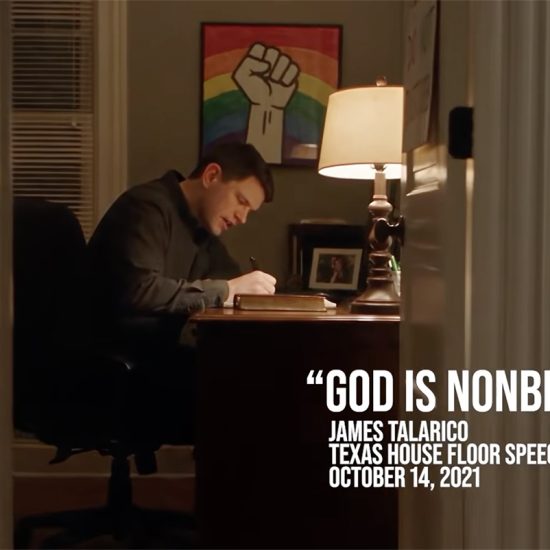
That history impacted Texas state Rep. James Talarico, a PC(USA) seminarian running a closely watched campaign for U.S. Senate in the state. The Democrat grew up attending St. Andrew’s Presbyterian Church in Austin, a deeply liberal PC(USA) church whose pastor, the Rev. Jim Rigby, was put on trial by the denomination in the early 2000s for ordaining a lesbian and officiating a same-sex marriage before the denomination approved such practices. (The charges were eventually dismissed on a technicality.)
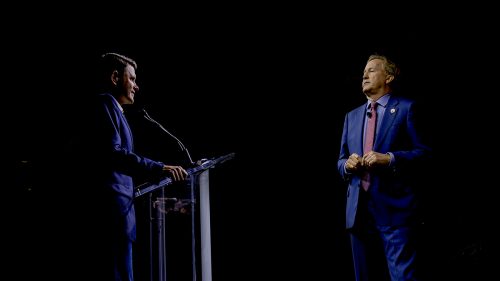
Photo illustration with James Talarico and Ken Paxton, Democratic and Republican nominees for U.S. Senate, at their respective state conventions in June. (Source photos by Eddie Gaspar/the Texas Tribune)
When Talarico, who cites Rigby as a spiritual mentor, entered politics years later, he imbued his political rhetoric with liberal theology. He told Religion News Service in 2023 that he staunchly opposes Christian nationalism and believes using political power to hurt LGBTQ+ people and other marginalized groups is “blasphemous.”
But the mainline embrace of LGBTQ+ rights in the 2010s coincided with an overall reduction of membership and followed an era where conservative Christians — particularly evangelicals — reentered politics with a fervor. Rising to power as “values voters” in the ’90s, evangelicals and other conservative Christians have long derided the mainline embrace of LGBTQ+ rights, often suggesting those who do are un-Christian.
That tradition persists: Pastor Robert Jeffress, a vocal Trump supporter who leads the Southern Baptist megachurch First Baptist Dallas, said on a podcast last month with Texas Lt. Governor Dan Patrick that Talarico is not a Christian, citing the representative’s past statements on gender and sexuality.
He reiterated that stance in an interview with RNS, saying Talarico’s beliefs “disqualify him from being a Christian, and especially a Christian pastor.”
Jeffress also voiced skepticism of the Democratic clergy and seminarians running as Democrats this year, noting most “come from mainline denominations that tend to be more liberal in their theological beliefs, and are becoming a decreasing part of the American population.”
Even so, Jeffress acknowledged that evangelicals — including his own denomination — are now losing members as well. And what mainliners lack in numbers, they have made up for in visibility during the rise of Donald Trump. During his 2016 presidential campaign, Trump was still a mainliner himself — a Presbyterian like Talarico, having been baptized in a church that is currently PC(USA). But members of the denomination outraged by his rhetoric about immigrants launched an effort to kick him out (they were unsuccessful, as Trump was not an active member of any congregation), and mainline Protestants quickly emerged as some of his loudest religious critics after he assumed the presidency. By the time he left office in 2020, Trump had changed his religious affiliation to “non-denominational.”
Around the same time, mainline clergy such as the Rev. Sarah Trone Garriott, an Evangelical Lutheran Church in America pastor in Iowa, and the Rev. Lindsay James, a PC(USA) pastor who previously served as a chaplain on college campuses, began to enter politics. James ran and was elected to the Iowa House of Representative in 2019; in her campaign launch speech, she cited opposition to Trump’s proposed border wall. A year later, Garriott was elected to the Iowa state Senate, telling RNS at the time that she saw running for office as part of a “calling” to “care for my neighbor” and be “interconnected with others.”
Thus began an embrace of politics that the Rev. Brian Ellison, a PC(USA) pastor who serves as Stated Clerk of the Synod of Mid-America and leads a group that advocates for LGBTQ+ people in the denomination, sees as a departure from past eras when mainliners were more reticent when it came to discussing their faith in public. Mainline Protestants, he said, “have at times sort of apologized for their public witness” or used secular language “so as not to be accused of violating a separation of church and state.”
But recent years, he said, have seen mainline clergy “demonstrating a level of comfort and confidence in talking about a Christian approach to public policy.”
Mainline clergy clash with ICE
When Trump regained the presidency in 2024, mainliners — alongside many other people of faith — became even more visible in their pushback. On his first full day in office, Bishop Mariann Budde — a leader in the Episcopal Church, another mainline denomination — made headlines for delivering a sermon challenging the president as he sat in the pews, with the prelate calling on him to “have mercy” on immigrants and transgender children. A few months later, videos emerged of mainline pastors being shot in the head and face with pepper bullets and rounds by Department of Homeland Security officers as they protested the president’s immigration policies. Dozens of mainline clergy have since been arrested during similar demonstrations, including at least one pastor from all seven denominations historically associated with the mainline tradition.
As mainline clergy and seminarians began filing to run for Congress this year, most launched campaigns that struck a more centrist tone than their colleagues protesting in the streets. But much like the attacks lobbed at Talarico in Texas, their conservative opponents voiced theological criticisms at them anyway, mostly around LGBTQ+ issues.
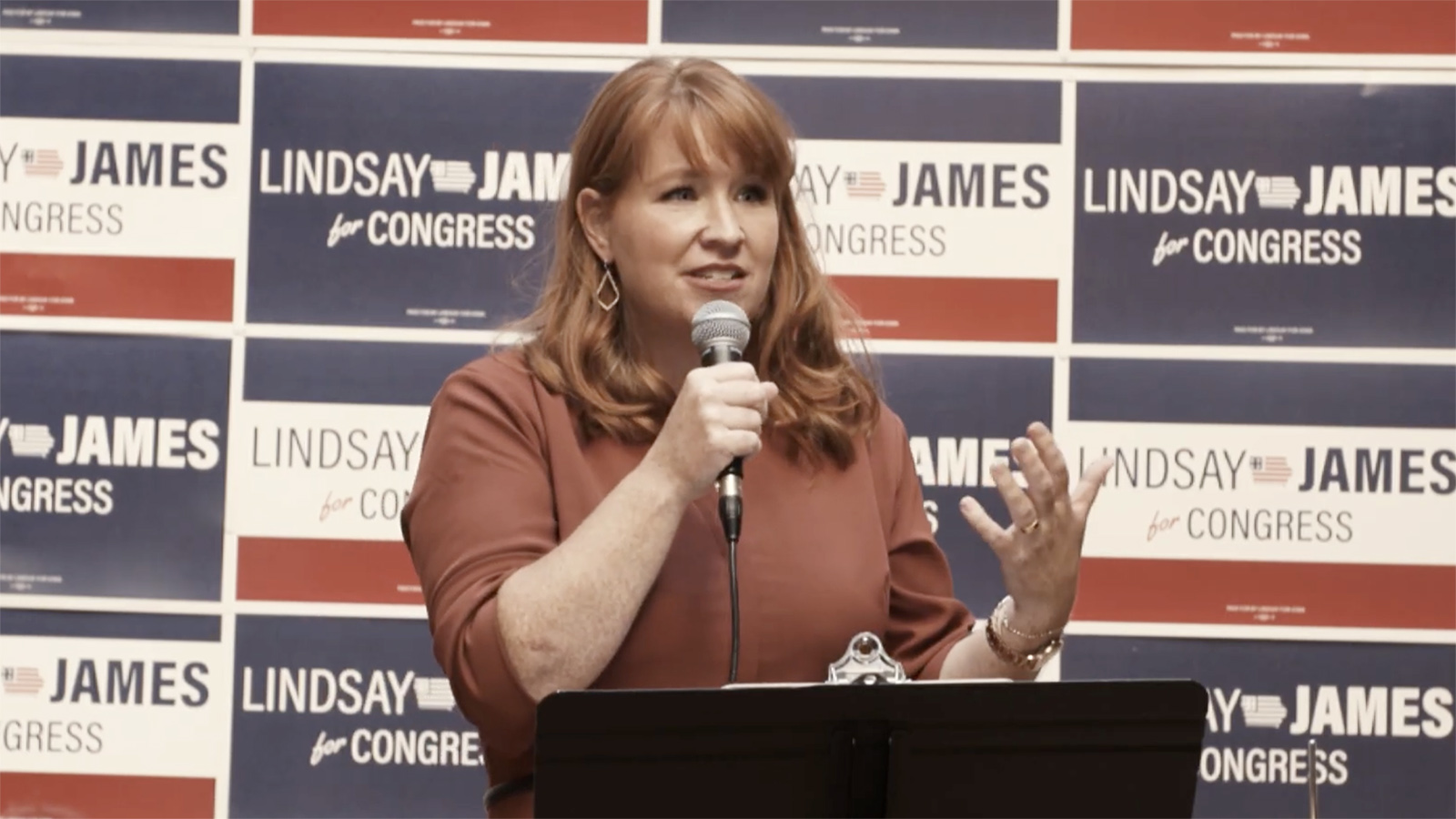
Iowa Democratic congressional candidate the Rev. Lindsay James speaks during a campaign event. (Video screen grab)
James and Garriott, for example, now both Democratic congressional candidates in Iowa, have been derided by Republicans in the state as “pastors in name only,” or “PINOS,” who “don’t profess the true gospel of Jesus Christ.” Hamilton, arguably the most centrist of the four, both politically and theologically, has been criticized by Vice President JD Vance for his church’s sponsorship of a local pride parade.
And last week, Hamilton’s opponent, Republican Sen. Roger Marshall, attended a faith-themed event hosted at Exodus Church in Wichita, Kansas. There, Exodus’ pastor, the Rev. Kyle Lammott, expanded on a public letter he organized earlier this month, which argued Hamilton should repent for theological positions, such as his belief that the Bible contains errors — a belief common among mainliners for more than a century.
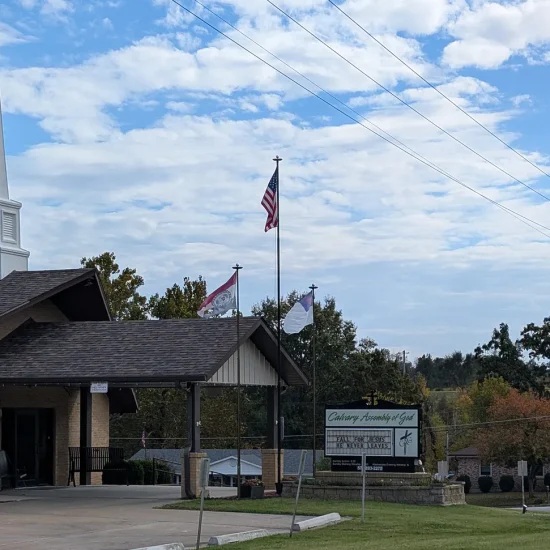
It was a theological clash that may have been set up a century ago. Exodus Church is affiliated with the Communion of Reformed Evangelical Churches, a small denomination co-founded by controversial Idaho Pastor Doug Wilson. A self-described Christian nationalist, Wilson told RNS in 2023 that in his vision for a Christian America, liberal Christians — including, he noted, a hypothetical liberal Methodist — would not be able to hold office. He based his position on arguments written by fundamentalists who split with liberal Christians in the early 1900s, saying he agreed with those who believed liberalism was “another religion entirely.”
Whether Hamilton or any of his fellow mainline candidates end up in Congress remains to be seen. Unlike other Democratic clergy candidates who are likely to win, such as Black Protestant megapastor the Rev. Freddie Haynes III running in Texas’ deep-blue 30th district, the four closely watched races involving mainline clergy and seminarians could go either way.

Democratic Senate candidate the Rev. Adam Hamilton speaks to Kansans during a campaign event at Transport Brewery, Monday, Sept. 1, 2026, in Shawnee, Kansas. (RNS photo/Kit Doyle)
Yet for all the pushback Hamilton and his fellow pastors have received, for the first time in decades, it’s mainliners, not evangelicals such as Jeffress and Wilson, who are poised to be the main religious story this coming Election Day. And even if some or even all of the mainline candidates fall short, their campaigns still managed to make races competitive in places where Democrats have long struggled.
“I do think Christian faith, rightly construed and in a pluralist way, can be a really, really smart strategy for Democrats to pursue in these states that they haven’t been as strong in,” said Carter, the Princeton Seminary scholar.