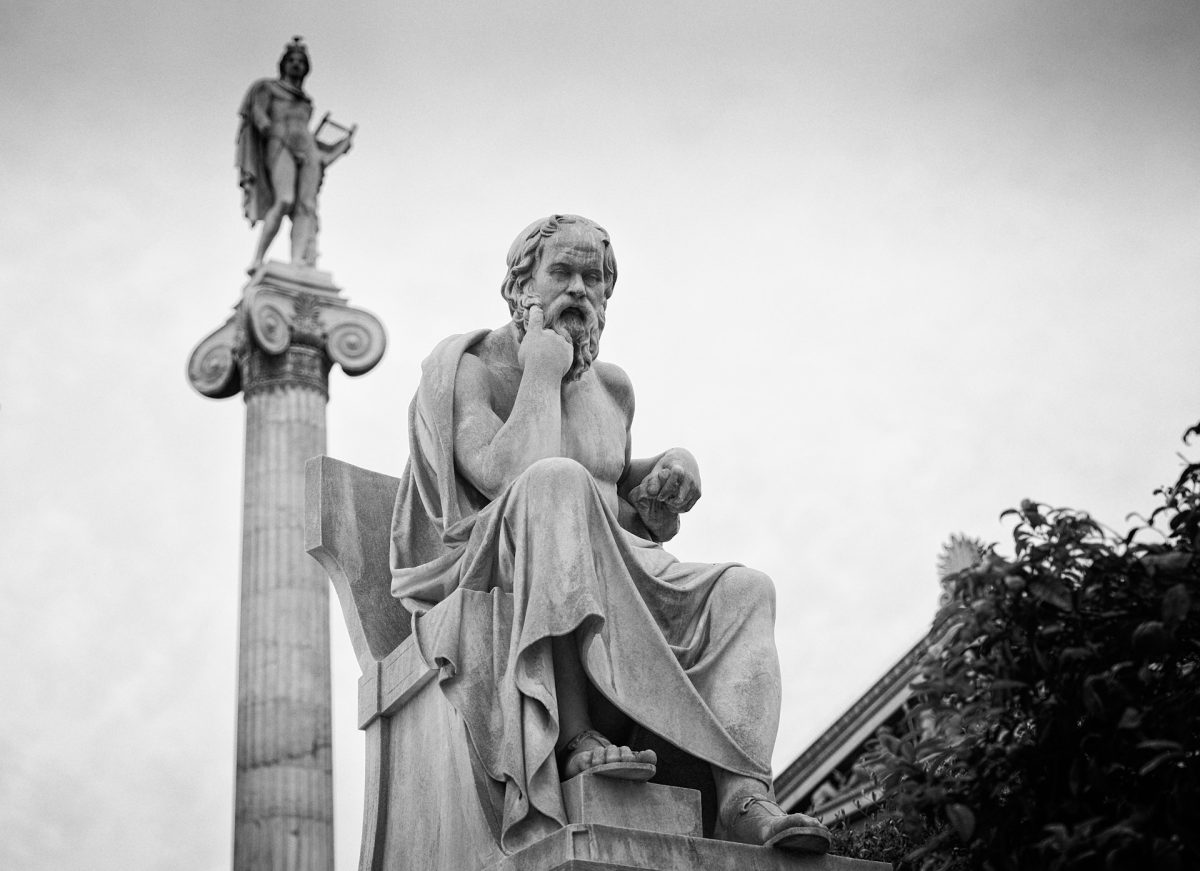
Socrates never claimed to have the right answers. What he insisted on relentlessly was that the person arguing in bad faith was the real threat. By that standard, the Israel-U.S.-Iran conflict may be the most philosophically dishonest war in a generation. It is also, by the terms of the very traditions being invoked to justify it, a religious one, not in the sense of being about religion, but in the sense of violating it.

Michael Mellette
All three parties have reached for their sacred texts not to illuminate a hard question, but to foreclose it. Scripture does not enter the argument as evidence. It enters as a conversation stopper: there is nothing to discuss because God has already decided. That is not religious conviction. It is rhetorical cowardice dressed in the language of faith. And each of the traditions being weaponized in this conflict has a name for it.
Judaism calls it lo tissa, the third commandment, commonly rendered as “do not take the Lord’s name in vain.” The rabbinical tradition has long understood this more precisely: do not invoke God’s authority for what is false, empty, or self-serving. To attach the divine name to a lie, or to a political agenda dressed as divine will, is among the gravest violations in Jewish law. Not because the name is merely a word, but because the invocation claims God as guarantor. And God, in the tradition, does not guarantee liars.
Christianity inherits the same commandment and sharpens its ethical demand. The Sermon on the Mount insists, “Let your yes be yes and your no be no.” Do not inflate ordinary claims with sacred authority they cannot earn on their own merits. The theological point converges with the Socratic one: honest argument stands or falls by its own reasoning. The moment God is invoked to settle what cannot be settled otherwise, the speaker has replaced argument with authority.
Islam contains a parallel prohibition in yameen al-ghamus — the false oath sworn in God’s name to deceive. It is treated in classical jurisprudence as one of the gravest moral violations, not a minor infraction but a rupture in the relationship between believer and truth. The Qur’anic ethic is clear: invoking God’s name as a tool of manipulation is not piety. It is its inversion.
Three traditions. One prohibition. And across this conflict, all three are violated in ways that extend far beyond leaders to the publics who repeat and amplify them.
In Israel, political and religious leaders have invoked biblical categories such as Amalek, Purim, and covenantal claims to the land in ways that frame military and territorial objectives as expressions of divine mandate. That rhetoric has not remained confined to official discourse. It has filtered into settler movements and broader public conversation, where concepts such as milhemet mitzvah (a commanded war) can transform political judgment into religious obligation.
Yet Jewish tradition itself is internally contested on precisely these questions. Alongside texts invoked to justify war stand prohibitions against needless destruction, demands for proportionality, and rabbinic voices insisting that the same scriptures impose strict moral limits on violence. The tradition does not speak with one voice. Every serious student of it knows this. Treating it as if it does — selecting only what supports a predetermined conclusion while suppressing the rest — is precisely the violation the commandment warns against.
In Iran, the mechanism is more institutionalized. Religious authority is embedded within the state, allowing political objectives to be framed as sacred obligations. Claims surrounding nuclear policy, martyrdom, and the authority of the Supreme Leader repeatedly blur the boundary between political loyalty and religious fidelity, making dissent appear not merely incorrect but impious.
In this system, participation, sacrifice, and obedience are often described in explicitly theological terms. The prohibition on yameen al-ghamus exists precisely to prevent God’s name from becoming an instrument of coercion. When political authority is rendered sacred, disagreement ceases to be part of a shared moral world. It becomes transgression against God himself. That is not the preservation of faith. It is its conversion into state power.
In the United States, the pattern emerges through a different institutional framework but similar rhetoric. Political and religious leaders have justified military policy and foreign alignment through appeals to biblical prophecy, covenant theology, or claims of divine favor. Opposition is reframed not as disagreement but as spiritual failure.
Here again, the theological issue is not sincerity. The commandment against taking God’s name in vain does not distinguish between manipulation and presumption. It forbids the transformation of political judgment into divine decree — precisely because once that transformation occurs, reasoning ends.
Across all three contexts, the structure is the same: political claims are insulated from scrutiny by being wrapped in sacred authority. Each tradition contains internal resources for questioning war as well as justifying it. The abuse occurs when one reading is elevated above contestation and presented as the settled will of God. At that point, followers are not merely given instructions. They are given absolution in advance.
The underlying strategic questions in this conflict are real and unresolved. Serious people can and do disagree about them. That disagreement is where reasoning should take place. But those questions cannot be answered by appeal to scripture. The moment God is invoked as argument rather than as private conviction or moral motivation, the willingness to be wrong is surrendered.
God, by definition, cannot be wrong. To wrap a position in divine authority is to declare it beyond the reach of correction. When this move is made by leaders, it does not remain confined to them. It cascades outward into religious communities, military institutions, and private conversations where doubt itself begins to feel like disobedience.
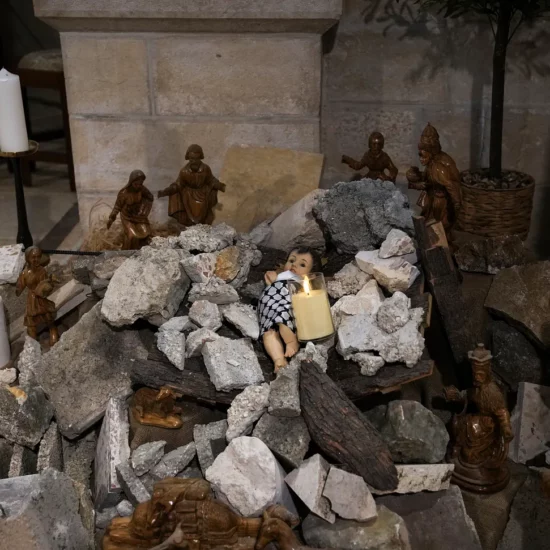
Photo by Vidar Nordli-Mathisen on Unsplash
Socrates was condemned for refusing to accept that kind of authority. He continued to ask questions even when they were unwelcome, even when answers were unclear, even when powerful actors demanded certainty. The standard he insisted on was not correctness, but honesty: arguments must remain open to examination.
The prohibition on taking God’s name in vain expresses a parallel demand. Do not use the sacred to do the work that reasoning should do. Do not shield claims from scrutiny by attaching them to divine authority. And do not pass that shield on to others.
I am not exempt from the standard this essay applies. I too have selected from contested traditions, assigned motivation to complex actors, and reached conclusions about bad faith that cannot be fully verified from the outside. A writer arguing against certainty is still arguing. I am still making claims that can be wrong, still vulnerable to the very substitution of rhetoric for reasoning that the argument condemns. To note this is not to sidestep the critique. It is to keep it honest.
All three parties in this conflict have failed that standard. Not merely as political actors, but as interpreters of the traditions they claim to defend. And in doing so, they have trained entire populations to confuse conviction with certainty, and certainty with righteousness.
The cost is not only intellectual. It is the narrowing of the moral space in which disagreement can occur. And once that space collapses, the only remaining horizon is repetition into the next justification, and the next war. To resist that trajectory requires something simple but difficult: the willingness to be wrong. And that willingness disappears the moment God is made to speak in place of argument.
Michael Mellette is a philosopher and writer. Read more at michaelmellette.substack.com.