NOTE: This piece was originally published at our newsletter A Public Witness.
As Vice President J.D. Vance makes the media rounds to promote his new religious memoir, he explained his faith journey and conversion to Catholicism by citing how Samuel L. Jackson’s character in Pulp Fiction responds to a violent encounter. The first moment of the Quentin Tarantino film highlighted by Vance during an interview on Tuesday (June 30) occurs just seconds after the Jackson monologue used by Pete Hegseth as a prayer during a worship service at the Pentagon in April.
Unlike Hegseth, Vance acknowledged borrowing from the movie and seemed to understand the evolution of Jackson’s character — but it’s still an odd metaphor for his own conversion. And it turns out it’s a story he likes to share to explain how he’s “felt the touch of God” in mystical moments.
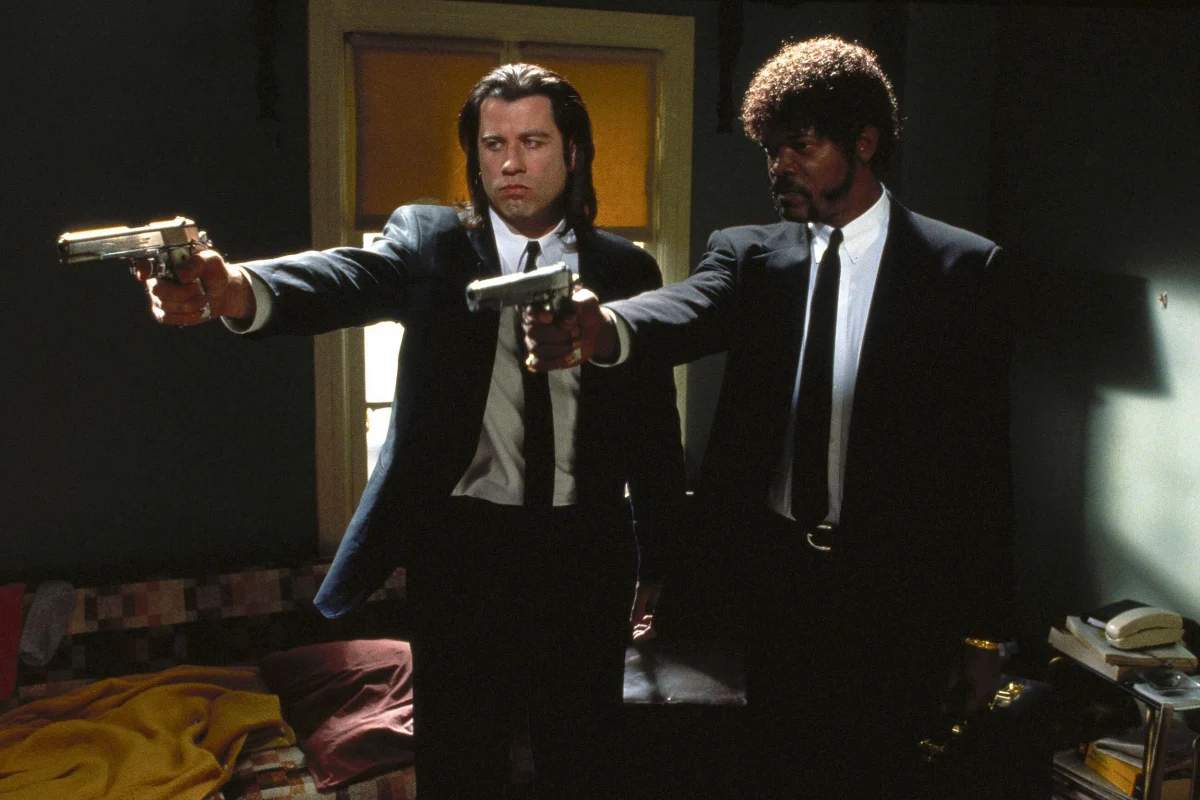
“There’s this quote from Pulp Fiction I keep returning to,” Vance told rightwing podcaster Michael Knowles on Tuesday. “It’s right after Samuel Jackson and John Travolta, these gangsters, just murder a few people, but they miss one guy and that guy’s hiding in the bathroom. So he pops out and he shoots at point-blank range. Samuel Jackson is totally fine, right? Despite the fact that multiple bullets should have hit him. He kind of looks around, kills the guy who tried to shoot him, and then he has this religious sort of epiphany. And that’s really the entire movie from his perspective, is this ongoing religious journey.”
Vance then continued the story by recounting how Jackson’s character talked about the shooting moment in that scene and again later in the movie.
“Now, what’s fascinating about it is he talks about miracles and there’s this debate between him and John Travolta about whether this counts as a miracle,” Vance recounted. “And he says, ‘Look, what matters is not whether this is an ‘According to Hoyle’ miracle, what matters is that I felt the touch of God.’”
Vance then told two stories where he was “feeling the touch of God” in moments he thinks were miraculous, though neither involved violent gangsters. First, he mentioned a 2019 conversation in a bar with conservative pundit Ross Douthat where they were “drinking too much and talking about Catholicism.” Then, for no apparent reason, a wine glass behind the bar “kind of jumps off and shatters on the ground in the middle of this conversation.”
“It sounds insane,” Vance said. “Both Ross and I had this sort of moment. We’re like, ‘Oh, that was really weird.’ And again, is it an ‘According to Hoyle’ miracle? Maybe, maybe not. But I felt the touch of God. … That felt like a very powerful moment.”
His second example was a time when he slept in and figured he would miss attending confession but felt like God told him to go anyway. He made it in time since “every single red light was green.” He added, “Maybe it was just a coincidence of the universe, but I felt the touch of God. I got in line in time.”
Vance didn’t just come up with the Pulp Fiction analogy on a whim during Tuesday’s interview. He actually told a shorter version of it in his memoir, Communion: Finding My Way Back to Faith. In the book, he recounted the bar story and the time he heard a Gregorian-style chant of a Psalm while visiting a Catholic priest that was the same one he liked to listen to while traveling. Noting that skeptics would call those moments a “total coincidence,” he wrote (with the asterisks), “But to quote Samuel L. Jackson from Pulp Fiction: ‘You don’t judge s*** like this based on merit. Now, whether or not what we experienced was an ‘According to Hoyle’ miracle is insignificant. What is significant is I felt the touch of God.’ So yes, during little moments, I felt the touch of God.”
Mediate noted on Tuesday that Vance also told a version of his Pulp Fiction analogy during the 2024 campaign as he spoke at a Faith & Freedom Coalition event. Calling Jackson’s character in the movie “one of my favorite theologians,” Vance told the story with a bit of editing of the movie’s colorful language.

Praying for ‘Great Vengeance’
While Vance cites Pulp Fiction in his book and speeches, Hegseth’s recent viral moment with the movie came after he did not credit the violent film for inspiring a prayer. During the April worship service at the Pentagon, Hegseth read a violent prayer he said had been recited by U.S. military members at the start of a rescue mission in Iran. He also mentioned the prayer reflected Ezekiel 25:17. He did not mention that the language and the inaccurate Ezekiel phrasing were uttered by Jackson’s character in Pulp Fiction. No additional accounts of the Iran rescue mission have confirmed the use of the prayer by military personnel.
After A Public Witness broke the news about Hegseth’s Pulp Fiction prayer, the incident quickly sparked headlines, late-night jokes, and online memes. Despite that, Hegseth has not addressed the controversy, even after a Democratic representative mockingly mentioned it while questioning Hegseth during a congressional hearing.
Hegseth’s use of the Ezekiel 25:17 bit in Pulp Fiction not only showed a lack of awareness of the biblical text but also of the film. While Jackson’s character recites it shortly before unloading his gun on an unarmed man (just before the “miracle” scene), he returns to the topic later in the film to reconsider how he thinks about God, Scripture, and violence. This is what Vance called the “ongoing religious journey” of the character following the “religious sort of epiphany.” But Hegseth’s use of the monologue to justify the war in Iran instead remained embedded in the first scene without the conversion experience.
“Hegseth even gets the Pulp Fiction version of Ezekiel 25:17 wrong,” explained Derek Hatch, a religion professor at Georgetown College, after the Pentagon service. “Hegseth sees a divine sanction of violence that providentially authorizes his military movements and justifies his death-dealing. However, within a movie like Pulp Fiction, thoroughly characterized by violence (and sometimes in a grotesque manner), we find that truly pondering and considering this passage (even though it is not actually Ezekiel 25:17) does not end with lethality but mercy.”
While Hegseth was the key advocate inside the Trump administration to start the Iran war, Vance reportedly was the leading voice who was skeptical about launching the military operation. Apparently, they don’t just disagree on how to interpret a Tarantino movie.
As a public witness,
Brian Kaylor

A Public Witness is a reader-supported publication of Word&Way. To receive new posts and support our journalism ministry, subscribe today.