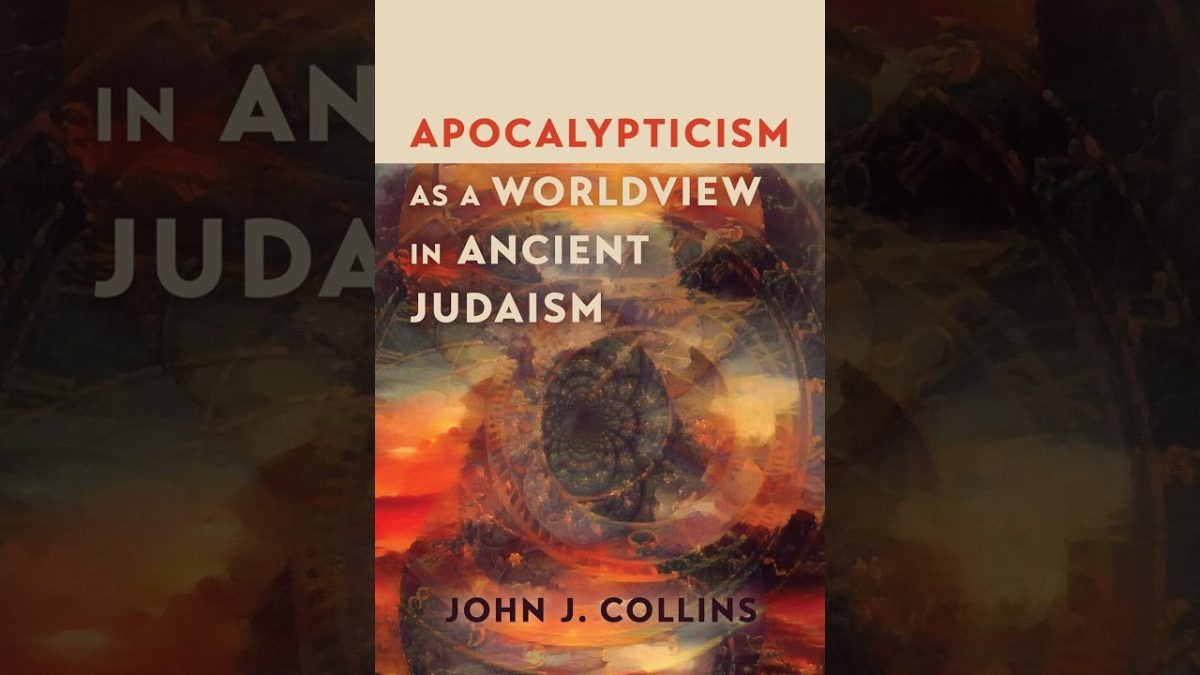
APOCALYPTICISM AS A WORLDVIEW IN ANCIENT JUDAISM. By John J. Collins. Grand Rapids, MI: Wm. B. Eerdmans Publishing Company, 2026. 182 pages.
When people hear the word “apocalyptic,” they may have in mind the end of the world or some other cataclysmic event. That cataclysmic event may or may not include the return to Earth of Jesus, often in the clouds. Other possible apocalyptic events might be natural or human-caused. We might have in mind a nuclear war or the long-term effects of climate change. Natural occurring events might include a tsunami, earthquake, or an asteroid hitting Earth. All of the above have at some point been explored in books, TV, and films. It might entail the return of Jesus or some kind of cataclysm, either human-caused, such as a nuclear war, or the effects of climate change, or a natural phenomenon such as an earthquake. Much of our apocalyptic imagination has been fueled and influenced to some degree by ancient Jewish and Christian works such as Daniel, Revelation, or perhaps a lesser-known but relevant work such as 1 Enoch. For Christians, one of the issues up for debate is whether Jesus was an apocalyptic prophet. If so, then where did his apocalyptic ideas originate?

Robert D. Cornwall
While popular culture offers its take on the question of apocalypticism, scholars have spent considerable time and resources researching and writing about the nature and purpose of ancient apocalyptic works, whether biblical or extra-biblical. One of the key scholars who has devoted his career studying apocalyptic works, especially within Second Temple Judaism, is John J. Collins, the Holmes Professor of Old Testament Criticism and Interpretation Emeritus at Yale Divinity School. His most recent book dealing with apocalypticism is the relatively brief, mostly accessible, and yet highly scholarly book Apocalypticism as a Worldview in Ancient Judaism (Eerdmans, 2026).
He focuses his attention in this particular book on defining what an apocalyptic worldview entails. Thus, this book looks not only at the genre of apocalypse, but the larger worldview that produced such documents as Daniel and Revelation, as well as 1 Enoch. In fact, it is texts like 1 Enoch that are the focus of this book. He writes that “The apocalyptic worldview relies heavily on mythic traditions for its formulation (p. 3). He also distinguishes apocalypticism from millenarianism. While there is overlap between the two, they are not identical. One of the challenges scholars face when dealing with apocalyptic texts is that many of these texts are not extant in their original languages. Although they are Jewish in origin, the copies we have tend to come to us through Christian translations in languages such as Ethiopic or Slavonic.
In the first chapter of the book, Collins speaks of “Genres, Constellations, and Worldviews.” Establishing the genre of apocalyptic literature is a necessary first step in this exploration of apocalyptic worldviews. With that in mind, Collins points out that the “modern study of apocalyptic literature begins with the rediscovery of the book of Enoch (1 Enoch) in Western Europe” (p. 6). That discovery came in 1773, when a Scottish explorer brought back copies of 1 Enoch to Europe from Ethiopia. While that book had been accepted into the Ethiopian canon, to that point it was unknown to Europeans. The discovery of that book opened up the study of a new category of ancient Jewish literature. Then, during the nineteenth century, more copies of 1 Enoch were discovered along with other texts, including the Apocalypse of Baruch. Then came the discovery of the Dead Sea Scrolls, which provided access to even more apocalyptic texts. In discussing these discoveries and the interpretation of the texts, Collins provides us with a brief introduction to the literature and the worldview that is connected with it.
Having established the nature and purpose of apocalyptic literature in the first chapter, including offering the foundation for interpreting present circumstances through the lens of a supernatural worldview, Collins is ready to dive deeper into the apocalyptic worldview in Chapter 2. In the second chapter, which is titled “Changing Views of History,” Collins reveals how apocalyptic writers interpret history using prophetic terms and speaking of divine intervention. As he notes, this view of history is highly deterministic and involves an expectation of an “end” to history, though this view of history does not always speak of the end of time. However, Collins points out that in this literature the end is always “a prelude to a new creation or new life.” So, “the distinctive element in apocalyptic eschatology is the hope for another kind of life, one no longer subject to death and decay, which lies beyond human experience in the realm of the imagination” (p. 51).
In addition to a view of history that involves some kind of end that leads to the hope of a new creation or new life, this literature is expressed, as developed in Chapter 3, through “Mythic Frameworks.” These mythic frameworks include “The Combat Myth,” which is present in other Near Eastern literature, such as the stories of Baal, and the mythological language that is found in Jewish literature, including the Book of Daniel. While there has at times been resistance in scholarly circles to the idea that apocalyptic literature includes the influence of mythical images, Collins demonstrates how this kind of language functions in texts including Daniel. There are other frameworks, such as that of the Watchers in 1 Enoch. Collins concludes that while an apocalyptic worldview isn’t linked to one particular myth, the worldview includes a “sense that the world is controlled by forces beyond human control that can only be understood by the aid of revelation and can only be portrayed by myths and symbols” (p. 74). Here is a good reminder of why literalistic interpretations of this literature quickly break down.
Moving forward, in Chapter 4, Collins speaks of “The Open Heaven.” Here Collins reminds us of the cosmic dimensions of this worldview, such that we find descriptions of angels and demons ascending and descending from heaven. Again, there is an ancient lineage to this concept. It is also within this literature that we find expressions of belief in life beyond death. Through the mythic language present in this literature, we also see the political dimensions of this worldview, as this literature tends to emerge in the midst of political crises or natural disasters. However, the hope of an angelic afterlife offers an escape from the realities of corruption and death.
While often equated with each other, Collins distinguishes between apocalyptic worldviews and millennialism, though they are related. Because of the overlap, the author devotes Chapter 5 to a discussion of “The Pursuit of the Millennium.” While scholars have at times exaggerated the role empire plays in this literature, imperial rule does play a significant role in the literature. This suggests that at least sometimes one of its purposes is that of resistance literature. With that in mind, Collins shares insight into how messianic ideas emerge in some of the apocalyptic texts, including the New Testament. As for millennial ideas, they appear to be a secondary development in sectarian movements.
Chapter 6 is devoted to the reality of “Apocalyptic Literature Transmitted by Christians.” While Second Temple apocalyptic literature is largely Jewish, it has been transmitted largely through Christians. As Collins points out, much of the literature, including 1 Enoch, comes to us in Slavonic, Syriac, Ethiopic, and other translations that were preserved in monastic libraries. As such, the religious beliefs described are different from the Judaism of the rabbis. In other words, they express views that have been more linked to Christians than Jews. Some texts reveal Christian influence, especially when they speak of Jesus. So, there is a need for caution in reading these texts as expressions of Jewish beliefs.
Collins closes with an Epilogue focused on “The Legacy of Apocalypticism.” Here, in closing, he seeks to bring the discussion of the apocalyptic worldview into the present. He points out that apocalyptic ideas have been developed in two forms: “Fundamentalist Apocalypticism.” This form of apocalypticism includes the premillennialism of Scofield, Lindsey, and others, who read apocalyptic texts literally. The other version is secular apocalypticism. In the case of secular apocalypticism, according to Collins, apocalyptic language and ideas are used to describe cataclysms such as the effects of climate change or a nuclear holocaust. While one seeks to interpret the signs of the times as an end-times theology that focuses on divine intervention, the other envisions something nonreligious but human-caused. While there may be other uses of apocalyptic imagery, Collins reminds us that there is still a currency for the concept as a worldview with ancient lineage.
Because people, religious and nonreligious, use apocalyptic imagery and language to describe contemporary realities, it is helpful to understand the origins of this language and the ideas associated with it. While the focus is on ancient Judaism, understanding this material can help us better understand the ministry and message of Jesus and other early Christians, including Paul. By studying apocalyptic ideas, we gain more insight into the traditions that developed after apocalyptic ideas began to permeate religious society. In his book, Apocalypticism as a Worldview in Ancient Judaism, Collins does an excellent job of helping us understand the apocalyptic worldview, including its secular forms.
This review originally appeared on BobCornwall.com.
Robert D. Cornwall is an ordained minister in the Christian Church (Disciples of Christ). Now retired from his ministry at Central Woodward Christian Church (Disciples of Christ) of Troy, Michigan, he serves as Minister-at-Large in Troy. He holds a Ph.D. in Historical Theology from Fuller Theological Seminary and is the author of numerous books, including “Eating With Jesus: Reflections on Divine Encounters at the Open Eucharistic Table” and “Second Thoughts About Hell: Understanding What We Believe” coauthored with Ronald J. Allen. His blog Ponderings on a Faith Journey can be found here.