(RNS) — In early August, Joseph Hazboun visited a newly built home among the fields near Taybeh, considered the last Christian village in the West Bank. Its owner, a local Palestinian Christian, claimed he could not access his property safely because of intimidation by Israeli settlers.
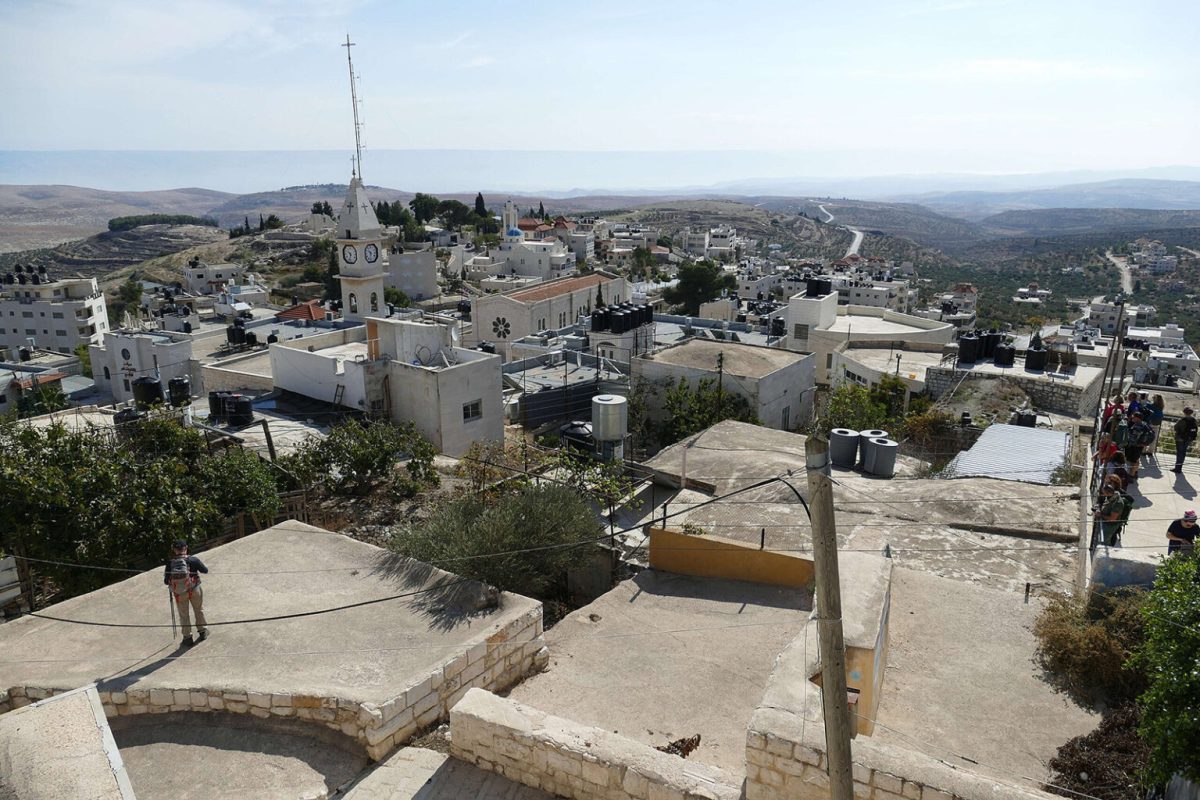
Overlooking Taybeh in the West Bank in 2018. Photo by Bukvoed/Wikimedia/Creative Commons)
As Hazboun inspected fencing that was reportedly cut to allow settlers’ sheep onto the land, a settler approached him driving a tractor at full speed, he said, in an attempt to intimidate and chase him and his group away.
“I witnessed firsthand how this settler terrorizes the local community,” Hazboun said, adding that the man carried a gun concealed beneath his shirt. The intervention of two Israeli peace activists prevented the confrontation from escalating.
Hazboun is the regional director for Palestine and Israel for the Catholic Near East Welfare Association, a papal agency that supports Eastern churches and vulnerable communities and reports to the Vatican. A CNEWA delegation visited Taybeh and nearby properties on Aug. 5, investigating what the organization described as the “systematic intimidation” of Palestinian families by Israeli settlers.
CNEWA documented portions of Hazboun’s encounter in photographs and a video published on its YouTube channel and described the delegation’s findings in an Aug. 7 situation report.
“Standing on that contested hillside, the human cost of the West Bank’s expanding outposts became starkly evident — leaving families stranded away from the very homes they built, caught in a cycle of displacement and daily intimidation,” Hazboun wrote in the report.
The confrontation was one episode in a growing struggle over land in the West Bank, a Palestinian territory captured by Israel in 1967 that remains under its occupation. Settler violence has escalated in recent weeks, drawing widespread condemnation and causing Israel’s military to declare Taybeh closed to non-residents to attempt to prevent attacks.
“This is the worst, the worst crisis that we have witnessed even since 1967,” said Hazboun, who has over 30 years of experience at CNEWA and has lived in the Holy Land his entire life.
Settlers have received support from some far-right leaders in Israel’s government, such as National Security Minister Itamar Ben-Gvir and Finance Minister Bezalel Smotrich, Hazboun said.
Unlike Israel’s large, government-authorized settlements, herding outposts may begin with little more than a tent, a trailer and a flock — a tactic settlers are using to expand. Some will enter private Palestinian properties with their sheep, with some incidents including arson and large, coordinated raids.
“A settler could go anywhere in the West Bank and set up a tent,” Hazboun said. “Then, after a couple of months, it will turn into barracks or a container. Then, after a few months or a couple of years, it will turn into homes and then a settlement.”
Like elsewhere in the West Bank, in Taybeh — the majority-Christian Palestinian village identified as the biblical town of Ephraim, where Jesus took refuge — tensions escalated this summer.
“Taybeh has experienced fires, incursions, attacks on private property, the intimidation of families and obstruction of emergency services,” said Father Bashar Fawadleh, the Latin parish priest of Christ the Redeemer in Taybeh. He said that in June, settlers obstructed Palestinian firefighters from responding to a large blaze near the town.
Bashar described a situation where “insecurity has become a daily reality.” He said that in recent weeks, settlers have cut fences, bathed in private water cisterns and stolen a beehive. Palestinian workers have been impeded from reaching their workplaces, and on Aug. 18, he said, two settlers on horseback terrorized a Palestinian family by approaching the wall of their home.
“For a family, seeing strangers come up to its garden or the wall of its home is not merely an inconvenience — it is a message of intimidation,” Bashar said.
Despite Taybeh’s Christian identity, Bashar underscored that the settler attacks are not motivated by religion. “We are Christians, but we are also Palestinians,” he said. “Settlers entering Palestinian land generally do not first ask whether its owner is Catholic, Orthodox, or Muslim.”
The incursions continued after the Israeli military’s closure of the village two weeks ago, Bashar said. “A decision has value only if it is enforced,” he said.
The priest asked that the restrictions be applied only to those who act illegally to intimidate residents, not farmers, visitors or others who want to support the community.
Bashar said he attempts to guide his flock spiritually through feelings of rage, desperation or the desire to leave.
“Today, perhaps the gravest problem is invisible,” he said. “Residents are beginning to lose the basic sense that they are safe in their own homes.”
The situation in the West Bank also drew the attention of Pope Leo XIV, who made an appeal in his Angelus address on Aug. 16 “for an end to the ongoing violence against the Palestinian civilian population.” Bashar said the pope has continued contact with the only Catholic parish in Gaza, the Holy Family Church, which continues to celebrate Mass and provide shelter as Israeli attacks continue, despite a tenuous ceasefire between Israel and Hamas since October 2025.
The Latin Patriarch of Jerusalem, Cardinal Pierbattista Pizzaballa, visited Taybeh on the feast of Mary’s Assumption into heaven on Aug. 15 — “at a time when many people felt vulnerable and exhausted,” Bashar said. He said the visit reminded the small Christian community that they are not alone.
In his homily at the Christ the Redeemer church, Pizzaballa urged the faithful to “not be afraid” and to remain a Christian voice despite the “very complex situation” in the Holy Land.
“We will continue to do everything in our power to preserve the Church’s presence here, at every level, throughout the Holy Land,” Pizzaballa said.
For Bashar, the message was clear. “We will relinquish neither our presence nor our right to live on this land,” he said.
Palestinian Christians represent only an estimated 1% of the population of the West Bank and Gaza, according to a 2017 Palestinian Authority census. In Gaza, the number of Christians has declined sharply since 1997 to approximately 1,000 before the war, and church leaders say that number is roughly halved today. Taybeh counted an estimated 1,700 residents recently, Bashar said, but the figure is now around 1,200.
Christian charities like CNEWA are attempting to sustain the population by providing food security, part-time employment, maternal and infant care, and educational services tailored especially for young women. The organization aims to help fund a regional football field and a track-and-field space to allow youth in the Taybeh area to have a space to play and grow together.
Hazboun emphasized the importance of “investing in Christian-Muslim relations on a grassroots level,” allowing children to grow and play together to overcome conflict.
But road closures, military blockades, poverty and unemployment continue to threaten the Palestinian population, including Christians. And charities struggle to fund aid in the West Bank as tensions unfold in other parts of the world, including Gaza, Lebanon and Ukraine.
“I do believe that we are very privileged to be Palestinian Christians — we are Christians from the land of Jesus Christ,” said Xavier Abu Eid, a political scientist and a Palestinian Christian.
A former adviser to the Palestine Liberation Organization, Abu Eid said he was almost killed two years ago after an ambush by Israeli settlers as he drove with his pastor from Jericho to Ramallah, not far from Taybeh.
“I think some people are focusing on people that are leaving the country,” he said. “And many Palestinians are leaving, not just Christians.
“But it’s important to support and focus on those who are struggling to stay in Palestine,” he added.