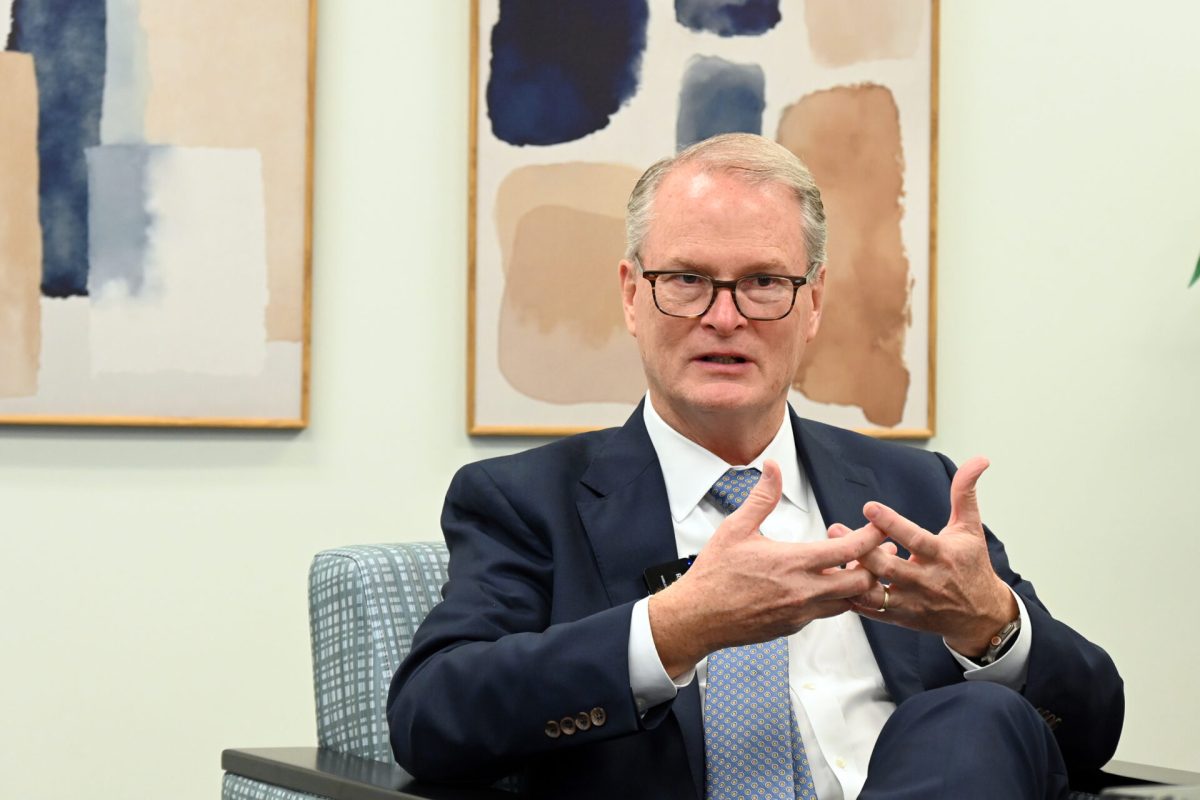
LEAWOOD, Kansas (RNS) — When the Rev. Adam Hamilton returned to Resurrection United Methodist Church last month, the megachurch pastor stood onstage looking almost sheepish. It was his first time preaching there in months, or roughly since he announced he was running for U.S. Senate in Kansas back in April.
The Rev. Adam Hamilton during an interview with RNS at Resurrection United Methodist Church, Sunday, Aug. 30, 2026, in Leawood, Kan. (RNS photo/Kit Doyle)
But as the pastor peered out at the hundreds gathered in one of the church’s three worship spaces, he made a point to thank his congregation for their prayers — whether or not they plan to vote for him.
“There are times when you feel pretty lonely doing this thing that I’m doing, that we’re not talking about here at church,” Hamilton said in his light Kansas drawl — a thinly veiled reference to a provision in the U.S. tax code that bars nonprofits, including churches, from endorsing political candidates. The room laughed knowingly.
The pastor, 62, then bounded offstage and practically sprinted down the roughly quarter-mile hallway toward the church’s main sanctuary, pausing to shake hands with congregants along the way. Within minutes, he was facing thousands in the pews, standing beneath a massive stained-glass window depicting Jesus. As a 100-person choir and full orchestra looked on, he began a sermon that would be broadcast to Resurrection’s nine other sites, reaching more than 20,000 attendees on an average Sunday.
“It’s, again, a joy to be here today,” he said, beaming.
It was an atypical way for any U.S. Senate candidate to spend a Sunday, let alone one running as a Democrat in a state President Donald Trump won by more than 16 points. But Hamilton is used to being an outlier: As a pastor with evangelical chops, he spent decades building a sprawling, politically diverse congregation in a mainline Protestant tradition where megachurches are rare.
“At Resurrection, we bring people together,” he told Religion News Service in an interview. “People are in Sunday school classes or Bible studies together, and they don’t ask before they join the class, ‘Are you a Republican or Democrat?’ They build relationships.”
Hamilton’s style — ambitious yet conciliatory — feels almost archaic in an era dominated by strident political rhetoric. But supporters, including members of his church, say it’s precisely what has built him so much goodwill among his fellow Kansans and Methodists — and what may make him an unusually difficult target for his political opponents.

Democratic Senate candidate the Rev. Adam Hamilton speaks to Kansans during a campaign event at Transport Brewery, Monday, Sept. 1, 2026, in Shawnee, Kansas. (RNS photo/Kit Doyle)
While Kansas hasn’t had a Democratic senator in nearly a century, Hamilton’s candidacy has proven unexpectedly competitive. The Cook Political Report has changed its categorization of the race twice, shifting their analysis from “Solid Republican” to “Likely Republican” to, as of this week, “Lean Republican” — just shy of a toss-up. And the latest Emerson College poll, released last week, has Hamilton backed by 45% of likely voters, essentially tied with his Republican opponent, incumbent Sen. Roger Marshall, who held 43%.
In response, the GOP has sought to undermine what may be Hamilton’s greatest political asset: his faith. Speaking at a Marshall campaign rally last week, Vice President JD Vance attacked Hamilton and the church’s sponsorship of Kansas City Pridefest, noting the event included participation from Sisters of Perpetual Indulgence. The nonprofit group of queer and transgender activists has been condemned by some Christian leaders even as it is defended by others.
Vance argued that by sponsoring Kansas City Pridefest, Hamilton’s church was “supporting groups that spit on God-fearing Americans and mock everything that we hold dear.”
“Ladies and gentlemen, that is not Christianity, that is left-wing radicalism dressed in the skin suit of our religion,” said Vance, a recent convert to Catholicism. “Let’s send it packing in November.”
The rhetoric comes on the heels of attack ads targeting Hamilton that have characterized the pastor as a “woke megachurch CEO.” And back in February, the Kansas Republican Party filed a complaint with the Federal Election Commission alleging Hamilton used resources from his church to promote his campaign exploratory committee.
Attacks on the faith of Democrats are more common than usual this election cycle, as an atypically high number of faith leaders are running for Congress against Republicans. For its part, Hamilton’s campaign has pushed back, denying the allegations in the FEC complaint and calling the vice president’s comments “false.”
Speaking to RNS, Hamilton also accused opponents of having “sewed” pieces of his sermons together for ads to “make me say something I didn’t.”
But the attacks have also revealed the positive reputation Hamilton has forged among his co-religionists. Last week, David Wilson, the United Methodist bishop who oversees Hamilton’s regional conference, published a statement dismissing attacks on Hamilton by Vance and Marshall as “inaccurate and unwarranted,” describing them as an “invective against the church, of which Adam is the founding pastor.”

The Rev. Adam Hamilton preaches an Easter message at Resurrection United Methodist Church in April 2026, in Leawood, Kan. (Video screen grab)
“The language used, in effect, criticizes fellow Christians merely for living up to what Jesus taught in the Gospel texts,” wrote Wilson, who oversees the Great Plains Annual Conference.
A few days later, 120 UMC pastors from across the state signed a public letter to Marshall, urging the senator and the Vice President to tone down the rhetoric.
“When you attack Adam’s pastoral ministry, his home congregation, and our denomination as a whole, you sow seeds of division and dissent,” read the letter. “You tear at the fabric that is the body of Christ.”
And when Marshall derided Hamilton in August as a “megachurch pastor that’s too woke for Kansas,” Hamilton’s campaign quickly noted that the pastor of Marshall’s own non-denominational church has publicly referred to Hamilton as a “middle-of-the-road pastor who is willing to listen to all sides.”
The spiritual solidarity appears to be an outgrowth of the hybrid religious identity Hamilton has claimed throughout his career. To many evangelicals, he feels familiar: he earned his bachelor’s degree at Oral Roberts University, a conservative evangelical Christian school, and he founded Resurrection in 1990 and grew it into a megachurch, a sprawling approach to religious community most common in evangelical Christianity. While preaching, he generally opts for a suit jacket with an open collar rather than the clerical collar and vestments favored by many United Methodist pastors.
And his campaign for Senate, he says, wasn’t born of political calculation, but a call he received from on high after fasting and praying during the Christian season of Lent.
“I’m going to attribute it to the Holy Spirit,” Hamilton said.
Yet Hamilton is also an exemplar for mainline Protestantism, a Christian subcategory that includes the UMC, as well as other denominations, such as the Presbyterian Church U.S.A. The tradition’s members skew older, a demographic shift that appeared to extend to Hamilton’s church: When thousands rose to their feet for the passing of the peace during Hamilton’s return, the prevailing hair color in the room was gray.
Hamilton argues his congregation reflects mainline Protestantism’s complex political identity. Modern mainline clergy trend more liberal than their evangelical counterparts, but many mainline congregations include a significant percentage of Republicans. That includes Resurrection: Of his roughly 24,000 members, Hamilton said, “about 9,000 of those are Republicans, 9,000 are Democrats, and 6 or 7,000 are independents.”
To reach such a broad spectrum of worshippers, Hamilton says he has leaned on a theological approach he calls “progressive evangelicalism,” which he described as “that evangelical gospel of wanting people to know Christ, to surrender their lives to God, to invite the Holy Spirit to work in and through them‚ and then to go out and to work for justice and compassion in the world.”
Both Hamilton and Resurrection members who spoke to RNS were also quick to focus on the church’s humanitarian efforts, such as its blood drives (“We’re the largest source of blood” in Kansas City, Hamilton said).

The Rev. Adam Hamilton, center, speaks to congregants after a service at Resurrection United Methodist Church, Sunday, Aug. 30, 2026, in Leawood, Kan. (RNS photo/Kit Doyle)
Standing outside the church’s Overland Park location last month, Phyllis Morris said she came to Resurrection six months ago at the invitation of a friend. She almost immediately started volunteering with the food program, which claims to have fed 45,000 individuals in Kansas City last year.
“There are a million things they volunteer to do,” Morris said. “That was important to me.”
Within the UMC, Resurrection is often remembered for playing a centrist role in the denomination’s recent history. When debates in the UMC raged in 2019 over same-sex marriage and the ordination of LGBTQ+ individuals, Hamilton emerged as what some called “the Pied Piper for Methodists in the middle,” publicly backing proposals aimed at keeping the denomination together by allowing regional church bodies to disagree.
When the UMC instead voted to implement stronger language barring LGBTQ+ United Methodists from marriage and ministry, Hamilton hosted more than 600 UMC pastors at Resurrection to discuss how to respond. Hamilton disagreed with the denomination’s move, telling RNS at the time, “What’s happened is not OK” and suggesting his church could leave the denomination over the decision. It didn’t, though some conservative-leaning churches have as the UMC eventually became more liberal on LGBTQ+ issues.
Marshall’s campaign is now offering a different interpretation of those same events. Asked about the letter from UMC pastors accusing the Marshall campaign of sowing “seeds of division and dissent,” Brent C. Robertson, Marshall’s chief of staff, argued Hamilton was a source of division.
“Talk of ‘sowing division’ rings hallow (sic) when it was Adam Hamilton who played a central role in the global split of his entire denomination, which caused a quarter of the Methodist churches in Kansas to leave,” Robertson said in an email.

The Rev. Adam Hamilton during an interview with RNS at Resurrection United Methodist Church, Sunday, Aug. 30, 2026, in Leawood, Kan. (RNS photo/Kit Doyle)
Robertson also doubled down on the tone of attacks against Hamilton. Asked about Vance’s remarks, he noted neither “Hamilton nor his church have denied the actual charge” that Resurrection sponsored the pride festival. Doing so, Robertson said, is something “you’d have to live deep inside a woke echo chamber” to not consider “objectionable.”
It’s unclear how those arguments will land with Kansans — especially local Methodists. Almost all of the congregants RNS spoke with at multiple Resurrection locations said they planned to back Hamilton, with most heaping praise on their pastor. One called his candidacy a “blessing.”
And the one Resurrection worshipper who said they did not support Hamilton’s Senate bid signaled discomfort with attacks directed at the pastor. David Izzard, who has attended Resurrection for 13 years, said he does not plan to vote for Hamilton in November because the Democratic Party has “turned into socialism.” But the ads criticizing Hamilton, he said, are a bridge too far.
“The ads they started to run on television must be AI, because there’s things he has never said,” Izzard said. He added: “I don’t trust any of that.”
It’s evidence of the deep well of support Hamilton has built at Resurrection. He said he intends to keep preaching there, win or lose — albeit in a reduced capacity if he manages an upset in November. And he insists his church, and the faith it embodies, remains central to who he is.
“That’s what we try to do every Sunday: to send people out, to go out and to take light into dark places. To bring hope and healing and justice in the world around us,” Hamilton said.
“I think that sounds like a pretty good background for a U.S. Senator.”