(RNS) — The Trump administration notified Congress on Tuesday (Sept. 22) that it once again plans to limit the U.S. Refugee Admissions Program to 17,500 admissions next year, primarily White South Africans.
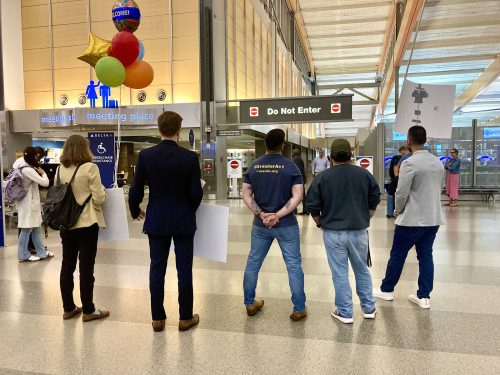
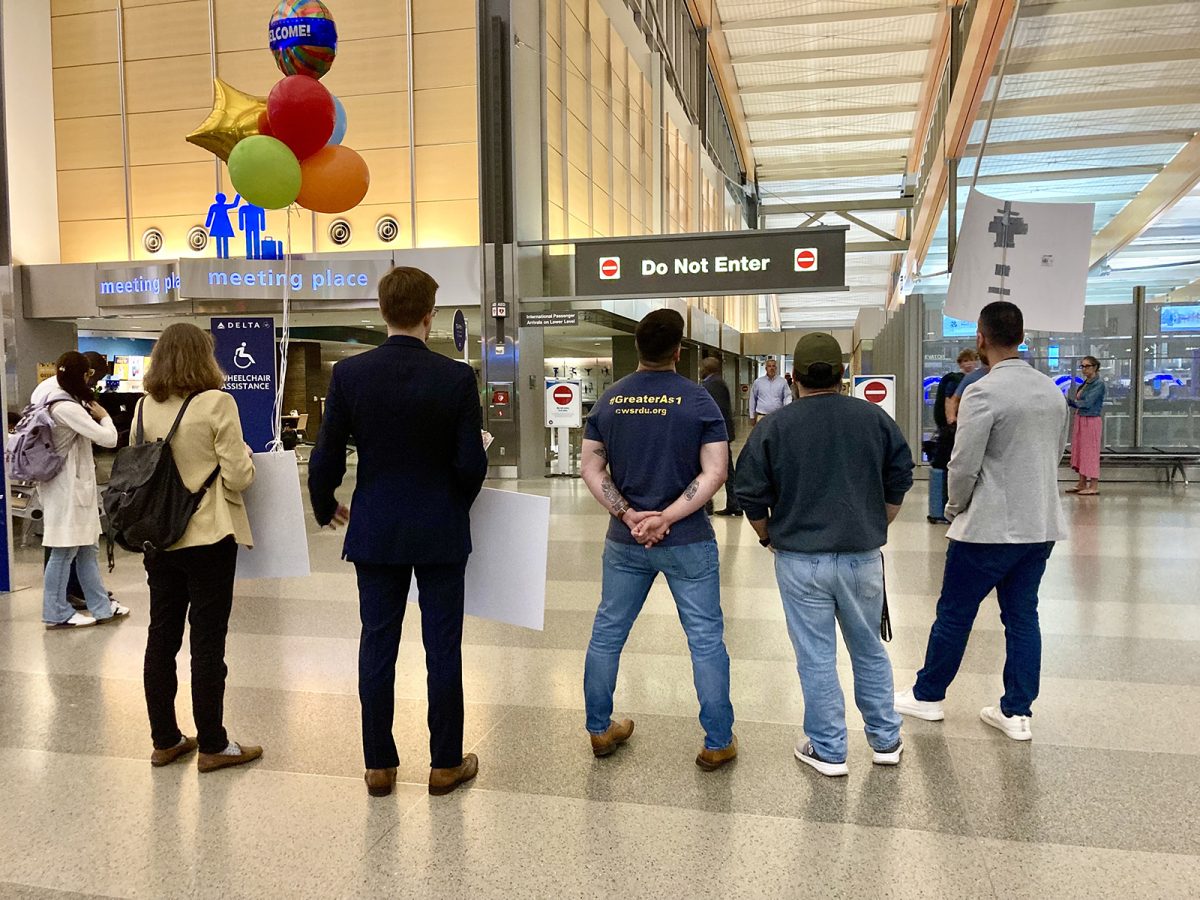
A group waits to greet a Congolese refugee who goes by “Pacito” and his family at Raleigh-Durham International Airport on Thursday, July 10, 2025, in Morrisville, N.C. (RNS photo/Yonat Shimron)
It would mark the second year in a row of historically low refugee admissions prioritizing a group known as Afrikaners. The U.S. has welcomed an average of 92,000 refugees per year since its inception in 1980.
It would also make 2027 the second year in which refugees fleeing religious persecution are afforded no pathway to resettlement in the U.S.
Representatives for faith-based refugee resettlement agencies expressed outrage.
“For more than four decades, America’s refugee program has provided a lifesaving pathway for people fleeing violence and persecution,” Naomi Steinberg, vice president for refugee and immigration policy and advocacy at HIAS, a Jewish refugee resettlement agency, said in a statement. “But again, this administration is diminishing and distorting this legacy in service of its political whims.”
HIAS, along with Church World Service and Lutheran Community Services Northwest, is suing the government for excluding from the refugee admissions process other populations that Congress has specifically designated as refugees of special humanitarian concern. It calls the exclusion discriminatory and illegal.
Those refugees include immediate family members of already resettled refugees, including minor children and spouses, U.S.-affiliated Iraqis and religious minorities, particularly Iranians fleeing religious persecution.
“Since the enactment of these programs, the government has provided for admission of those refugees without fail every year,” said Mevlüde Akay Alp, a senior staff attorney with the International Refugee Assistance Project or IRAP, which is litigating the case. “It’s only under this current administration and with last year’s presidential determination (or refugee cap) that the government is now defying its congressional obligations towards those populations.”
The White House did not respond to a request for comment on Wednesday. On June 30, the government moved to dismiss the suit. It now awaits a decision by U.S. District Judge Jamal N. Whitehead of the Western District of Washington state.
World Relief, a Christian humanitarian organization that also resettles refugees, sent a letter Wednesday to President Donald Trump, urging him to “once again prioritize Christians and other religious minorities fleeing religious persecution.” The letter was signed by “3,466 evangelical Christians.”
In 1989, the late Sen. Frank Lautenberg introduced an amendment to the U.S. Refugee Act designed to help persecuted Jews and Christian minorities leave the former Soviet Union. In 2004, the Lautenberg amendment was expanded to include persecuted religious minorities in Iran, specifically Jews, Christians, Baha’is, Sabaean-Mandaeans and Zoroastrians.
Congress has reauthorized the Lautenberg amendment each year since its creation in 1989 and did so again in February this year. But no new refugees who fall into those humanitarian concern categories have been admitted to the U.S. since January 2025, when Trump took office.
Evangelicals, who make up Trump’s base, have also voiced their displeasure.
“A nation shaped by Christianity and where Christianity is receding would be enriched by the faithful witness of our brothers and sisters,” Daniel Darling, director of the Land Center at Southwestern Baptist Theological Seminary in Fort Worth, Texas, wrote on X.
Presidents set the cap on how many refugees the U.S. will approve through the program each year. Last year, the Trump administration initially set the cap at 7,500 for Afrikaners and later increased the total to 17,500.
The White House contends that Afrikaners face seizures of their land and other forms of persecution and would be likely to assimilate when they come to America. The South African government rejects those claims.
Afrikaners are part of a White ethnic minority that created and led South Africa’s brutal segregationist policies, known as apartheid, for nearly 50 years. That policy, which included denying the country’s Black majority rights to voting, housing, education and land, ended in 1994, when the country elected Nelson Mandela in its first free presidential election.
“A refugee program that centers one group and sidelines all others is an abdication of our global humanitarian leadership and an abandonment of thousands of vulnerable families who put their faith in our country,” said Krish O’Mara Vignarajah, president and CEO of Global Refuge, another faith-based resettlement agency, in a statement.
In a press call on Monday, Vignarajah called the Trump administration’s refugee policy “exclusion by design, driven by a seismic shift in who our government deems worthy of protection.”
By comparison, in fiscal year 2024, under President Joe Biden the U.S. welcomed just over 100,000 refugees from 85 countries.