(RNS) — The Rev. Juan Carlos Calderón voted for Donald Trump in 2024 because he believed Trump shared his values. “I am pro-life from the womb to the tomb,” Calderón said in Spanish. While he immigrated to the U.S. from Venezuela and pastors a majority immigrant church, he wasn’t concerned about Trump’s mass deportation agenda — he said he believed the administration would focus on deporting gang members or immigrants who demonstrate “irresponsibility,” like driving under the influence.
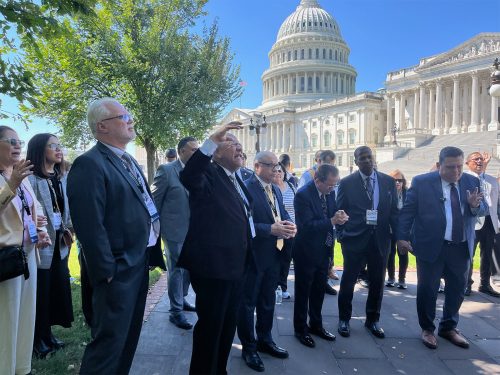
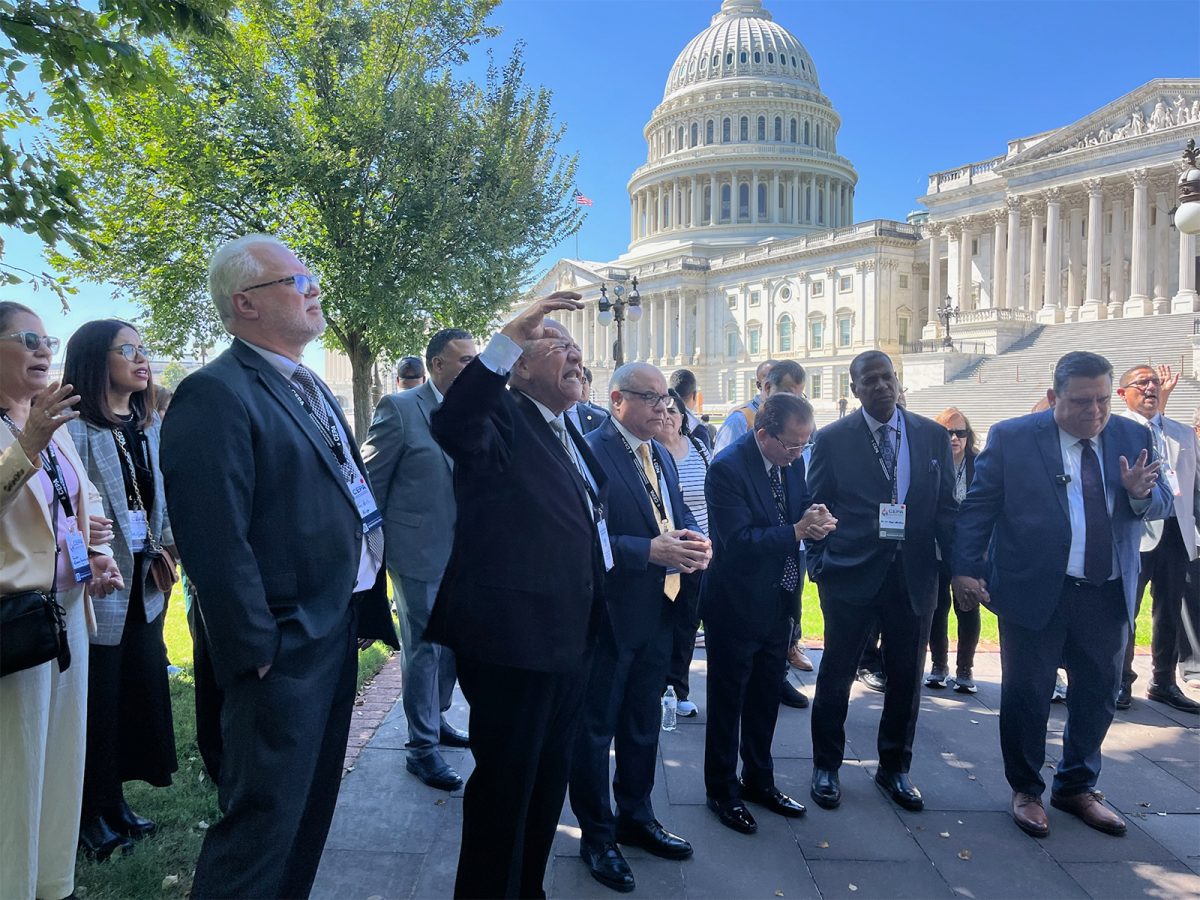
Pentecostal bishops lead prayers Tuesday, Sept. 8, 2026, outside the Capitol during a Confraternity of Pentecostal Entities of the Americas (CEPA) organized event in Washington. (RNS photo/Aleja Hertzler-McCain)
Two years later, his Lake Worth Beach, Florida, church, Un Nuevo Comienzo (A New Beginning), an Assemblies of God congregation, is reeling from the administration’s mass deportation agenda. “I was really wrong,” Calderón said. “They’re not looking for criminals.”
Two of his church members were detained and had to leave the U.S. — neither of them had criminal records, said Calderón. In one case, a pregnant U.S. citizen wife and their two children decided to leave after the father spent three months in detention. Some members of his congregation are now too afraid to go to work or church, and the congregation’s finances have deteriorated as a result. After eight years as a full-time pastor, this year Calderón took on a second full-time job as a warehouse coordinator.
Calderón, who generally has supported Republicans, said he is now inclined to vote for the Florida Democratic gubernatorial candidate, David Jolly. He’s undecided in the Senate race. “Really, my loyalty isn’t to a party,” he said. “My identity is in Christ. My pastoral responsibility is with the people.”
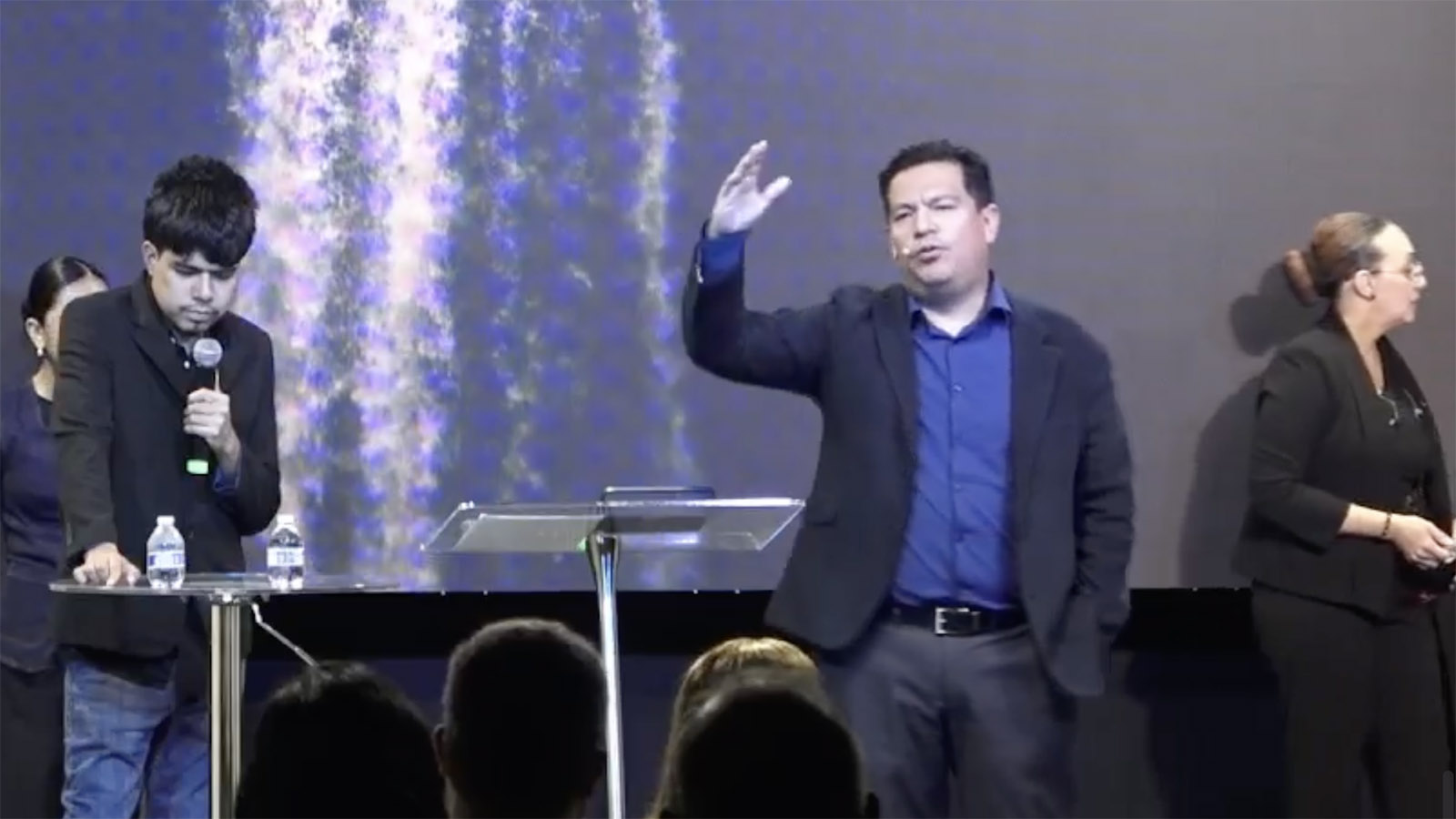
The Rev. Juan Carlos Calderón, center, preaches at Un Nuevo Comienzo (A New Start) church in Lake Worth Beach, Florida. (Video screen grab)
Trump won the 2024 election in part due to a surge in support among Latinos. Hispanic Protestants, like Calderón, were the most pro-Trump religious demographic after white evangelicals, with 64% voting for him, according to a 2024 poll by Public Religion Research Institute. Fifteen percent of U.S. Latino adults are evangelical, according to Pew Research Center. Gastón Espinosa, a religious studies professor at Claremont McKenna College, found that in the 2020 election, a disproportionate number of independent and undecided voters were Latino evangelicals.
Since 2024, polls have shown that growing numbers of Hispanic evangelicals have turned against Trump and the Republican Party. Just 31% of Hispanic Protestants, a group that includes evangelicals and non-evangelicals, view Trump favorably, a 20 percentage point drop since 2024, according to a poll released Tuesday (Oct. 20) by PPRRI, which polls Americans on religion and politics. Favorability for the Republican Party is down from about half (48%) in 2025 to about a third (34%) in 2026, the poll found.
The administration’s immigration enforcement efforts have hit the Hispanic community especially hard. According to a November 2025 poll by Pew, 1 in 5 Hispanics (22%) personally knew someone who has been detained or deported by the U.S. government for immigration reasons. And detentions and deportations have continued at elevated levels throughout 2026, expanding the numbers of people personally impacted.
But it’s still an open question whether Hispanic evangelicals will hold their nose to vote for Democrats or Republicans — or whether they’ll sit the race out altogether.
“The mass deportation strategy along with the tariffs, along with the current war in Iran — all of these choices have actually created a pressure cooker in Latino households,” said José Luis Marantes, the field director for Connected Americans, a new project that describes itself as focused on people ”impacted by extreme immigration enforcement.”
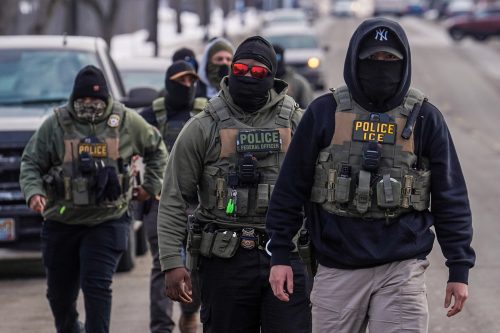
FILE – Federal agents walk down a street while conducting immigration enforcement operations in Minneapolis, Feb. 5, 2026. (AP Photo/Ryan Murphy, File)
Marantes said Hispanic evangelicals, who have long made a “social conservative calculus” that led them to vote for one party “99% of the time,” are now facing an “internal dilemma.”
Calderón lives in one of 21 districts that the Cook Report says is a “toss up” as of Oct. 16 and will decide which party controls the House of Representatives. The Venezuelan-born U.S. citizen said he is so concerned about immigration policies and Congress restoring health benefits cut by the current administration that he hasn’t ruled out voting for Angie Nixon, a Democratic Senate candidate with a democratic socialist background.
Some members of his congregation have said they might not vote at all. “At a certain point, it causes a malaise to see that it’s been years that neither party has had an immigration policy that supports families,” Calderón said. He considers voting a “civic responsibility” and urges eligible voters to go to the polls.
Isai Elias Paredes told RNS he hasn’t voted since the 2016 primaries when he supported then-GOP presidential candidate Marco Rubio. He said he would be unlikely to vote this year. The son of two pastors, he stepped up to support his mother in ministry in their Church of God congregation in Fond du Lac, Wisconsin, after his father was barred from returning to the U.S.
He blames Trump for the immigration policy that separated him from his father and his now ex-girlfriend, who moved back to Nicaragua to avoid deportation, but, as a conservative, he said he believes the Democrats don’t meet “the biblical standard.”
Even some of the Hispanic evangelicals closest to Trump are warning that the administration is at risk of losing Latino support.
“Over 30% of recent deportations involved individuals with no criminal record,” wrote Trump adviser the Rev. Samuel Rodriguez in an August opinion piece in the Christian Post. “If that statistic becomes the defining image of this administration’s immigration policy heading into the midterms, the political consequences will be severe.”
Rodriguez has faced his own backlash. In March, over 200 Latino evangelicals signed a letter accusing Rodriguez of providing cover for the administration’s immigration policies and over-exaggerating the number of congregations he represents as president of the National Hispanic Christian Leadership Conference. In March, he told RNS the letter writers were “bearing false witness.”

The Rev. Samuel Rodriguez with President Donald Trump in the Oval Office, March 5, 2026. (Photo via X/@nhclc)
RNS reached out to Rodriguez for comment on the midterm election. He declined to be interviewed.
Democrats appear to have made little inroads with Hispanic evangelicals. Thirty-five percent of registered voters who are Hispanic Protestants told PRRI they would vote for Democrats if the election were held tomorrow, mirroring the 36% who voted for Kamala Harris in 2024, but only 44% said they’d be voting for Republicans, down from the 64% who voted for Trump in 2024. Another 21% said they didn’t know how they would vote.
It’s not clear that Democrats have made a concerted effort to reach Hispanic evangelicals who are turning on Trump. RNS asked the Florida Democratic Party and Texas Democratic Senate candidate James Talarico’s campaign about their Hispanic evangelical outreach. They both responded by sending links to unrelated information. The Democratic National Committee did not respond to a request for comment.
Jaime Florez, Hispanic outreach and communications director for the Republican National Committee, told RNS that he didn’t “believe in the fidelity” of polling showing decreases in Hispanic Protestant support for Trump, citing polling errors dating back to 2016. He also suggested that the Republicans are not conducting targeted campaigns for Hispanic evangelicals. “We simply don’t find it necessary to create a sub-campaign just to attract a group of people that is included already in the mainstream of our society,” Florez said.
Hispanic evangelicals are running nonpartisan voter turnout campaigns. The National Latino Evangelical Coalition’s campaign has trained about 50 civic ambassadors in Florida, Ohio, New York, New Jersey, Tennessee and Texas to work with local congregations to turn out the vote. Additionally, they’ve trained about 75 poll chaplains in Ohio on de-escalation techniques. A major part of the effort is a voter guide that encourages Latino evangelicals to read Scripture, pray and then reflect on candidates’ character and their policy choices. “Which choice most closely reflects love, justice, mercy, and the common good?” it asks.
The Rev. Gabriel Salguero, NALEC’s president, said his Orlando church will be a polling place. “Making sure people can vote is important for defending democracy. Always remembering, that after elections, we remain neighbors,” Salguero told RNS in an email.

The Revs. Gabriel and Jeanette Salguero lead a service at The Gathering. (Courtesy photo)
NALEC has also consistently advocated for comprehensive immigration reform and policies defending family unity, including in a campaign last December in the Christian season leading up to Christmas. “The nation needs to hear that there are evangelicals of the mind that these indiscriminate enforcement actions don’t represent our deepest values and convictions,” said Salguero of the Advent sermon series and social media campaign.
The Rev. Sarai Luna, a lead pastor at Comunidad Cristiana Emanuel in Edinburg, Texas, which is in a toss-up border district, is encouraging members to stay engaged and said she is increasingly committed to speaking up for immigrants. “I don’t think our values have changed, but I do believe that the human impact that this immigration issue has had on our community has made it very personal to where, as a consequence, people are double-guessing their vote,” Luna said.
In July, two assistant pastors at Comunidad Cristiana Emanuel were detained by immigration agents. Within two days, the married couple — who, Luna said, had valid religious worker visas — were released after national groups, including Connected Americans and NALEC, and candidates, Rep. Henry Cuellar (D-Texas), Rep. Monica De La Cruz (R-Texas) and Democrat Bobby Pulido, advocated on their behalf. The Department of Homeland Security said that the married pastors’ religious visas expired in 2022.
Luna said she won’t tell her congregation how to vote, but she asks them to stay involved after election day. “At the end of the day, whether my candidate wins or not, I feel like we have to end up working with whoever is elected,” she said.
In September, Marantes and Agustín Quiles, the founder of Mission Talk, helped mobilize 50 Hispanic Pentecostal bishops and denominational leaders to go to Washington, D.C., to pressure the Trump administration to extend Temporary Protected Status for Salvadorans and Haitians. Some of the leaders told RNS they didn’t regret supporting Republicans, while others threatened change at the ballot box.
Marantes said, regardless of how Hispanic evangelicals vote, the leaders are “operating from a more critical and not fully bought position to the current party in power.” Their unified voices on TPS were notable. The Trump administration subsequently decided to delay ending TPS for Salvadorans.