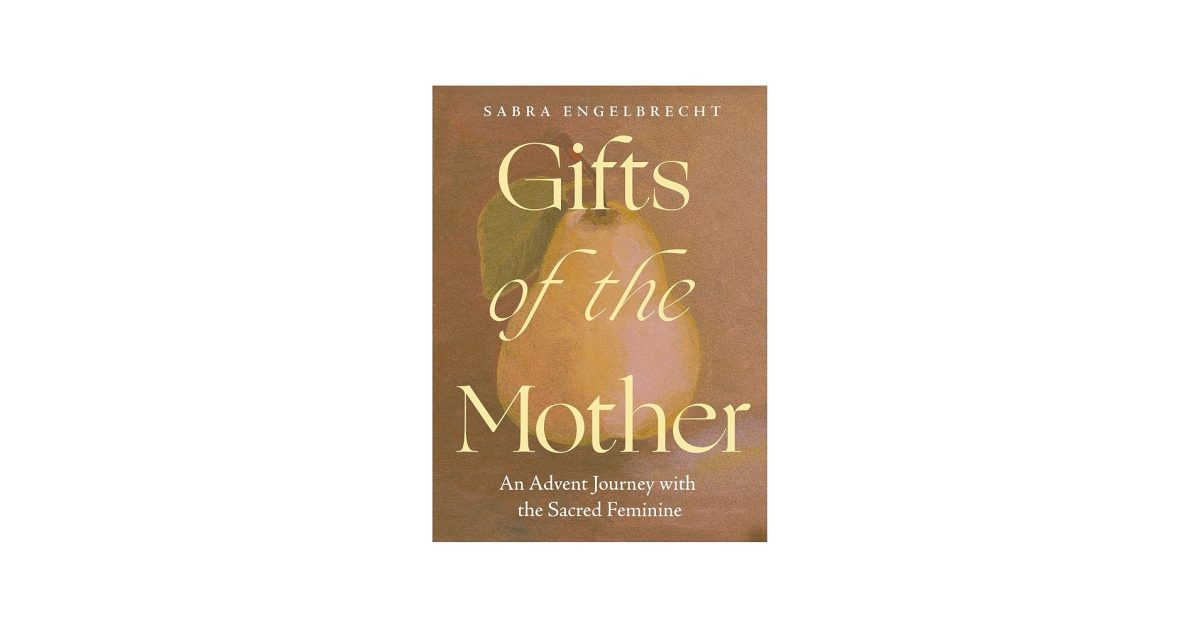
GIFTS OF THE MOTHER: An Advent Journey with the Sacred Feminine. Minneapolis, MN: Broadleaf Books, 2026. Xviii + 199 pages.
The three Abrahamic religions — Christianity, Judaism, and Islam — are not only monotheistic but tend to speak of God in masculine terms. This is especially true of Christianity with its trinitarian understanding of God. As the Creeds declare, God is one God existing as three persons: Father, Son, and Holy Spirit. So, Christians tend to use masculine pronouns when speaking of God. Therefore, it has been difficult for most Christians to speak of God in feminine terms despite there being multiple places in Scripture where God is described using feminine terms and images.

Robert D. Cornwall
Could it be that God is, in truth, non-binary? The use of masculine language and imagery to speak of God is problematic for many, especially women who struggle to find themselves reflected in God’s person. With this being the case, it is always helpful when resources emerge that invite us to reimagine God’s person and to speak of God in feminine terms. The challenge for us, especially when speaking of God as mother, is to speak in a way that doesn’t add another person to the Godhead.
This leads me to Sabra Engelbrecht’s book Gifts of the Mother: An Advent Journey with the Sacred Feminine. As the subtitle notes, Gifts of the Mother is an Advent devotional that invites readers to discover the Sacred Feminine. Engelbrecht is an author, spiritual leader, and mystic who formerly served as the director of ministries for The Gathering United Methodist Church in St. Louis. Engelbrecht’s discovery of the Sacred Feminine came as she attempted to come to grips with her own spiritual identity. She made this discovery when her traditional approaches to God no longer worked for her. While she remained committed to prayer, God seemed increasingly distant.
It was in reading Sue Monk Kidd’s Dance of the Dissident Daughter that she gained clarity in her search for God. By the Sacred Feminine, Engelbrecht, following Kidd, was not an attempt to recast God in female form but to name and image God’s feminine nature. Having made this discovery, Engelbrecht offers Gifts of the Mother as an invitation to readers to engage with the feminine nature of God using tools that she found helpful in her own journey.
These tools include Ignatius of Loyola’s Spiritual Exercises and the process of reading the Bible through lectio divina. When it comes to naming God, she notes that she has “purposely declined to refer to the Divine exclusively as ‘God.’ With few exceptions, the daily prayer will be presented using names, pronouns, and imagery that present God as female” (p. 11). This may be jarring for some, but it is true to Scripture and themes present in Christian tradition, especially among the mystics.
In Gifts of the Mother, Engelbrecht takes the reader on a journey through the season of Advent, a season, like Lent, that many find to be a useful time for contemplation and spiritual renewal. Advent is a season of waiting and preparation that features, among its stories from the New Testament, the Annunciation to Mary and the Magnificat, and so it is a fitting time to explore the Divine Feminine.
Engelbrecht writes that “Throughout Advent, we anticipated a cosmic and mystical birth that is an echo of the creation story found in Genesis. We sing songs about our Creator God coming down to earth in the form of a baby.” She notes that “the way Jesus moved through the world and interacted with its inhabitants clearly reflected a divinity marked by both traditionally masculine characteristics (independent, protective, and action-oriented, for example) and traditionally feminine characteristics (like intuitive, relational, compassionate, healer). Yet we rarely speak of God in feminine terms” (p. xxvi).
As I noted, for Engelbrecht, the Ignatian Exercises provide the foundation for her exploration of the Sacred Feminine. She hopes that the reader will use this as a daily guide to prayer and reflection, creating a rhythm that includes prayer, scripture reading (or another reading for inspiration), a time of reflection, and recalling the insights or themes of the day. She encourages the readers to write this down in a journal over six weeks. Advent itself is usually four weeks in duration, so she extends it a bit. She invites the readers to incorporate a Preparation Week.
Step 1 involves preparing a time. On this first day of the journey, she invites the reader to spend time centering, followed by a word of grace, a word of inspiration, followed by a time of preparation. The goal for this first day is to set a regular time for the devotional. Step 2 is “Prepare to God Deeper.” Here, the reader is invited to plan for the weekly activities that go with the journey. Step 3 involves “Prepare a Place.” She suggests that users dedicate a particular place/space for the daily practice. Step 4 involves “Prepare to Journal.” On this fourth day, the reader is invited to choose a journal, whether it is specially designed for this purpose or simply a spiral notebook. Step/Day 5 is “Prepare an Altar,” a visual marker of the space used in the journey. Step 6, “Prepare Your Heart,” invites the reader to begin journaling. Step 7 is “Prepare to Begin.” This is the final day of preparation. Now it’s time to dive in.
The four weeks of Advent focus on four images: Hope (Week 1), Peace (Week 2), Joy (Week 3), Love (Week 4). Along the way, Engelbrecht engages with the Advent/Christmas story, with a special emphasis on Mary, the mother of Jesus. As she focuses attention on Mary, she also engages with Mary’s interactions with Elizabeth. The sixth week in this journey focuses on Christ. That is, on the birth of Jesus (incarnation). The journey is designed to conclude on Epiphany.
In all, the five weeks of the journey through Advent and Christmas are pretty traditional. The difference is that in this devotional the prompts are designed to focus our attention on the feminine nature of God by addressing God as Mother or using other forms of feminine imagery to speak of God. By doing this, she focuses our attention on ways we can speak of and imagine God, so that we might dive deeper into our understanding of God. Engelbrecht is aware that this will be challenging to many who are simply not used to addressing God in feminine terms. However, she believes that at least for some this will be spiritually enlivening.
While Sabra Engelbrecht’s Gifts of the Mother is organized as an Advent devotional, it can be used at any time of the year because the focus is on the way we imagine and speak of God. I am often reminded of Mary Daly’s famous dictum: “If God is male, then male is God.” By contemplating the Sacred Feminine, we can gain a fuller understanding of the nature of God, while letting go of the vestiges of patriarchalism that too often affect the way we engage with one another as male and female. So, whether used during Advent or some other part of the year, Gifts of the Mother is an insightful invitation to a reimagined understanding of the God we encounter in Scripture.
This review originally appeared on BobCornwall.com.
Robert D. Cornwall is an ordained minister in the Christian Church (Disciples of Christ). Now retired from his ministry at Central Woodward Christian Church (Disciples of Christ) of Troy, Michigan, he serves as Minister-at-Large in Troy. He holds a Ph.D. in Historical Theology from Fuller Theological Seminary and is the author of numerous books, including “Eating With Jesus: Reflections on Divine Encounters at the Open Eucharistic Table” and “Second Thoughts About Hell: Understanding What We Believe” coauthored with Ronald J. Allen. His blog Ponderings on a Faith Journey can be found here.