This article is the first in a series on faith and protest.
(RNS) — Two years ago, the Rev. Quincy Worthington did not consider himself an activist. The minister of a Presbyterian Church (USA) congregation in Highland Park, Illinois, he was outspoken on issues such as racial justice, but his public advocacy was mostly limited to statements and attending an occasional protest.
Last fall, however, Worthington found himself hauling fellow faith leaders off the pavement after they had been beaten and arrested by state police for protesting outside a U.S. Immigration and Customs Enforcement facility near Chicago. He has endured enough tear gas and pepper balls, shot by U.S. Department of Homeland Security agents, that he now knows when to tighten the straps of his gas mask.
And as the immigration resistance gained national attention, Worthington appeared on a network news show to make theological sense of it all.
But it was when his daughter’s high school teacher mentioned to the class that Worthington was an example of someone “trying to make a difference” that he found himself grappling with the impact of his actions. “I’m just some guy, you know?” he said.

The Rev. Quincy Worthington. (Courtesy photo)
Worthington is one of hundreds of local faith leaders who over the past year engaged in high-profile and, in many cases, high-risk activism against the Trump’s administration mass deportation effort. As the Department of Homeland Security rolled out immigration enforcement campaigns in cities across the country, clergy rushed to learn how to stay safe while using protest tactics that employ encrypted messaging apps, updating nonviolent strategies last used widely during the Civil Rights Movement of the 1960s.
That era may be the last time that a faith-based coalition, mostly made up of mainline Protestants and Jews, has so publicly and collaboratively resisted government authority on a social issue they regard as a spiritual one. Today’s clergy and their congregations were supported by networks of faith activists who pass tactics, rhetoric, and even songs from one city to the next.
While the federal immigration crackdown has inspired the agitation of past months, this new iteration of the religious left goes back at least to the period after Oct. 7, 2023, when faith-driven protesters opposed Israel’s 2023 invasion of Gaza in retribution for Hamas’ massacre. Though Oct. 7 stressed or broke apart some relationships among progressive faith leaders, groups such as Jewish Voice for Peace and Rabbis for Ceasefire that were at the forefront of pro-Palestinian campaigns signaled the power of street demonstrations in general and their strategies in particular.
These groups, in turn, credit other contemporary protest movements, such as Black Lives Matter, a mostly secular movement that grew up in the wake of the killing of Michael Brown in Ferguson, Missouri, in 2014, and existing, mostly secular immigrant rights activists such as Free DC and the Latino group Mijente.
Shortly after DHS launched “Operation Charlotte’s Web” in Charlotte, North Carolina, in November, members of Amity Presbyterian Church announced the congregation would host a training on how to respond to the influx of federal immigration agents into its neighborhood. Later that evening, nearly 300 people filled the sanctuary to listen to representatives from Siembra NC, a secular immigrant rights group.
But the faith-based resistance of the past few months equally drew toolkits dating back to the LGBTQ+ rights protests dating to the 1980s. “We really owe everything to the rich traditions of social justice, both historically and across issues today,” said Stefanie Fox, executive director of Jewish Voice for Peace. Fox cut her organizational teeth working for Act Up, a group that blocked streets and disrupted Mass at St. Patrick’s Cathedral in Manhattan with their “die-ins” to demand health care for gay men during the AIDS pandemic.
“There’s this long and circling conversation across issue areas, groups and movements, passing those skills and lessons and methods back and forth,” said Fox. In 2023, when JVP protesters chained themselves to the White House gates to demand a ceasefire in Gaza, they were tapping a technique used by suffragettes in the early 20th century.

Attendees practice patrol duties during an immigration training session at Amity Presbyterian Church in Charlotte, N.C. (Photo by the Rev. Megan Argabrite)
The new shape of religious left protest, however, could be seen as a natural result of the ubiquity of mobile technology, which allows for highly decentralized and often spontaneous efforts over the past year. Pastors, rabbis, and lay Christians, Jews, Hindus, and Muslims seemed to be everywhere on the streets of Los Angeles, Chicago, Charlotte, and Minneapolis. They joined encrypted Signal chat threads. Phalanxes of clergy and lay protesters rushed to the scene of immigration enforcement to catch agents on video and alert the surrounding community of their presence, or popped up to demand ICE agents leave church property.
“Things are operating very locally right now,” said the Rev. Susie Hayward, a United Church of Christ pastor who has been a key organizer of faith-based resistance to DHS in Minnesota. “There’s a very particular threat that we are facing right now, and we have to have techniques — new techniques — to be able to respond to the flood of ICE agents and to how they operate,” said Hayward.
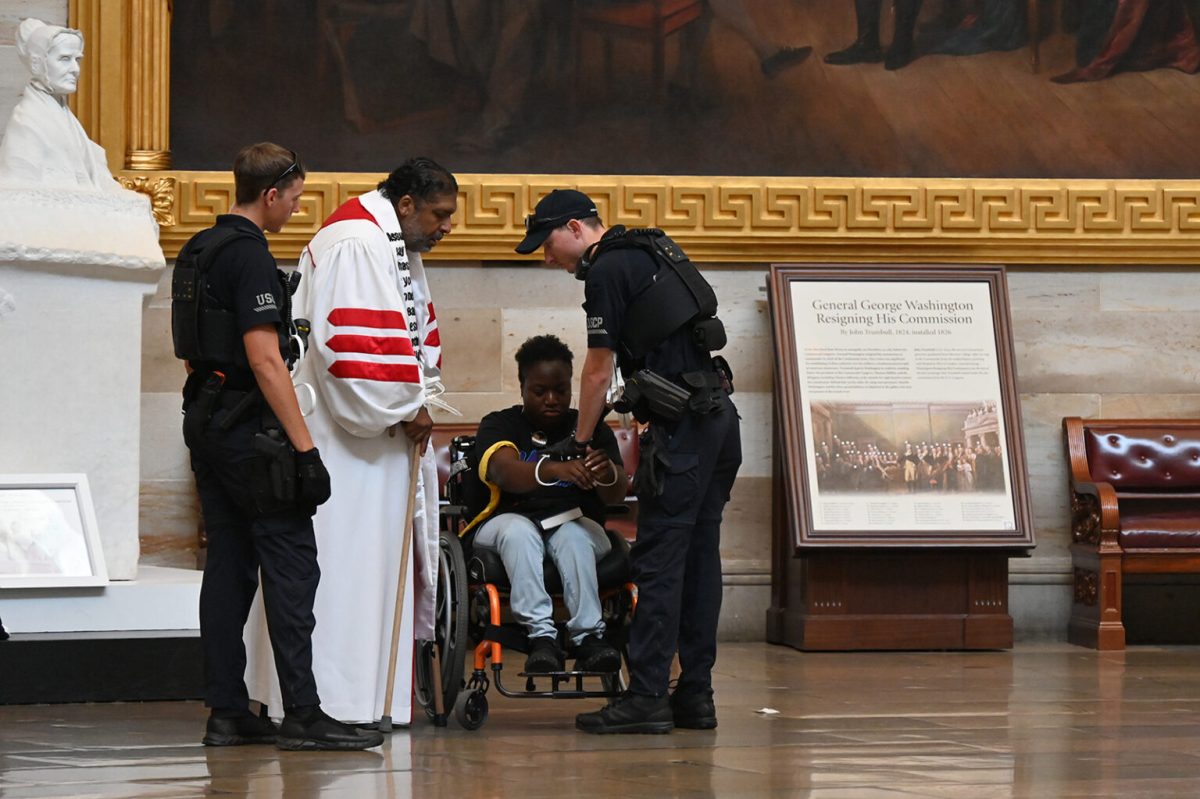
The locally focused shape of this movement means that it lacks, for better or worse, a central spokesperson. It’s a shift even from recent years, when prominent activists such as the Rev. William Barber operated as centralized organizers to muster waves of protest during Trump’s first term. That activism persists: Barber, who has also been a vocal critic of DHS, was escorted out of the U.S. Capitol in handcuffs last summer during a protest against a bill that funded the president’s overall agenda, and dozens of faith leaders were arrested on Capitol Hill in January as part of protests against the mass deportation effort.
Police arrest the Rev. William Barber II and Suvya Carroll in the U.S. Capitol Rotunda, Monday, June 2, 2025, in Washington. (RNS photo/Jack Jenkins)
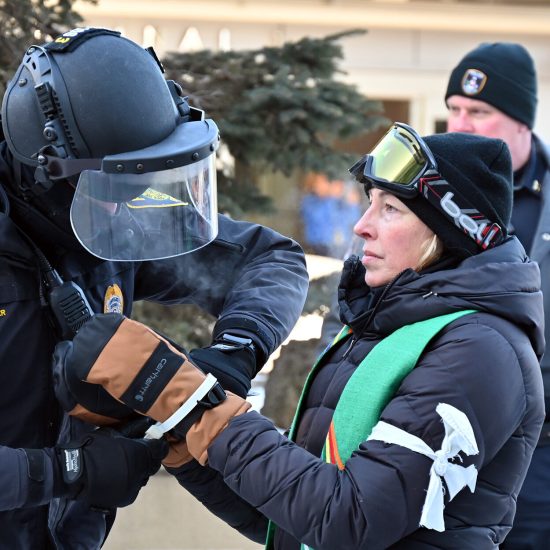
But those demonstrations, where the arrests were predictable and arguably pre-ordained, differ from the resistance to DHS, which has seen more than 108 mostly anonymous faith leaders have been arrested over the past year in often dramatic protests,
This has been a strength of the recent movement, according to Ruth Braunstein, professor of sociology at Johns Hopkins University who studies faith in the public square. “They’re not easily dismissed as national activists who parachute into a local setting,” Braunstein said. “They are quite authentically members of their community who understand the needs of the community are tightly linked up with other local leaders and are not as explicitly political — and certainly not partisan — in the way that national leaders are often understood.”

Attendees role-play scenarios of interacting with immigration agents during a rapid response training organized by G92 at Central Christian Church, Saturday, Jan. 24, 2026, in Springfield, Ohio. Faces blurred by RNS. (RNS photo/Kathryn Post)
For many faith leaders on the front lines, it has been a new day, showing a new way of acting out one’s faith in the world.
“I see this moment just like the great awakenings of the past in American history, where there was a new wave of religious awakening that intersected with social and political movements,” said Hayward. “I see this as being one of those times.”
There are risks for clergy in protest beyond being arrested, shot at, or slammed to the pavement. A majority of churchgoers in mainline Protestant churches voted for Donald Trump in 2024, according to political scientist Ryan Burge. This puts them at odds politically with the clergy who occupy the pulpits. The share of clergy in the Episcopal Church, the Evangelical Lutheran Church in America, and the Presbyterian Church (USA) who call themselves liberal hovered around 70% in a 2023 survey; 23% of their congregants did. Liberal clergy are therefore used to walking a careful line when discussing, much less acting on, their politics.
As the Trump administration unleashed an aggressive deportation operation and polls showed growing opposition to Trump’s approach to immigration, many moderate Protestant, Catholic, and Jewish clergy moved further left, and grew more comfortable with activism.
“A lot of colleagues have moved from that space of being a little worried to saying ‘I’ve got to do something,’” said the Rev. Scott Bostic, a United Methodist minister and organizer with the group Free DC.

Rabbi Matthew Soffer in the Judea Reform Congregation sanctuary in Durham, N.C. on March 10, 2026. (RNS photo/Yonat Shimron)
In late January, Rabbi Matthew Soffer of Judea Reform Congregation in Durham, North Carolina, got a call from T’ruah, a Jewish-American human rights organization, asking him to go to Minneapolis. Soffer and his congregation are active locally in social justice efforts, and Soffer had visited Israel after Oct. 7. But, he said, “I wasn’t sure what kind of impact I could make; how I could be helpful” in Minneapolis. He was eventually moved by “the sense that this was a moment to show up.”
In a recent interview, Soffer called his time in Minneapolis, “one of, if not the most, important trips that I’ve ever taken. What I witnessed there, in terms of coalition strength, was unlike anything I’d ever seen. It’s at moments like this that we’re tested. I felt like I needed to shrink the distance between the reality in Minneapolis and the reality in Durham, because we really have to see each other as neighbors.”
For newcomers, the pop-up clergy trainings, like those in Charlotte or Minneapolis, were not only informative, they helped weld together a national network of protests. The more than 600 other faith leaders who came to Minneapolis in January from as far away as Massachusetts and Alaska to take instruction from MARCH, a Twin Cities faith group, packed into Westminster Presbyterian Church to pray, hear testimonies and sing, including an anthem — originally created years ago for an effort led by Rev. Barber — with the refrain “No one is getting left behind this time.”
Meanwhile, religious leaders are quick to note that while the recent wave of faith-based activism has included a number of public protests, those demonstrations often feature less vulnerable leaders by design. Religious communities with large immigrant populations have also engaged in robust organizing, albeit in ways that are meant to be less public.
“With the Trump administration’s arrival the second time, what I witnessed in this community was a desire to have ways to strengthen one another, to be able to sustain what was going to happen,” said the Rev. Hierald E. Osorto, who leads St. Paul’s-San Pablo Lutheran Church in Minneapolis, a congregation with a large immigrant population.

Hundreds of clergy convene at Westminster Presbyterian Church, Thursday, Jan. 22, 2026, in downtown Minneapolis, Minn. (RNS photo/Jack Jenkins)
But the question is whether the broader coalitions that have been built over the past few months, and even years, can be sustained. The urgency and the visibility of pushing back against DHS on the streets of major cities smoothed over serious fissures that divided interfaith groups following the Oct. 7 attack on Israel, when many Jewish participants felt unsupported by progressives of other traditions.
“A lot of people are in conflict, particularly in the Jewish community, and it probably has frayed interfaith relationships of various kinds,” said Rabbi Alissa Wise, who was in Minneapolis for the MARCH training. “I think it’s actually very compelling to give people a path — ‘let’s put our disagreements aside to meet this crisis moment.’”
But now that the immigration crackdown has quieted, if not slowed, the fractures of Oct. 7 may re-emerge. Other ideological or theological divides may also reassert themselves. Catholic bishops have objected to the treatment of immigrants, and Catholic priests have staunchly protected their parishioners who have been subject to ICE detentions. But they are cautious about showing solidarity with the movement as a whole, and evangelical Christians have serious differences with the progressive Christians and Jews who make up the majority of the movement.
Instability, said Johns Hopkins’ Braunstein, is “a somewhat standard feature of how national faith-based organizations engage in some of these debates.” While they come together over an issue like immigration, she added, “those groups would never be able to agree on something involving reproductive health care or another issue.”
But the effect of these faith leaders on the immigration debate can’t be doubted. “Having a national spotlight on these local actors is informing Americans about what is happening on the ground,” said Braunstein. “It also could be informing how they’re making sense of this issue from their own religious perspective. And they might, in turn, be able to pressure national legislators that could affect policy.”
And having gained not only expertise in protest but a growing list of contacts and a new sense of purpose, these individual religious activists have felt a power they had long since ceded to the religious right. It may bring them together again the next time their values and political sensibilities are threatened and send them again onto the streets, to pray and sing and protest again.
If there’s one thing he’s learned from his years in organizing, said Bostic, the FreeDC organizer, it’s that “courage is contagious.”