President Donald Trump and many of his leading Christian supporters and top Republicans are taking part this week in a marathon reading of the Bible in an America 250-themed event billed as encouraging a “return to the spiritual foundation that has shaped our country.”
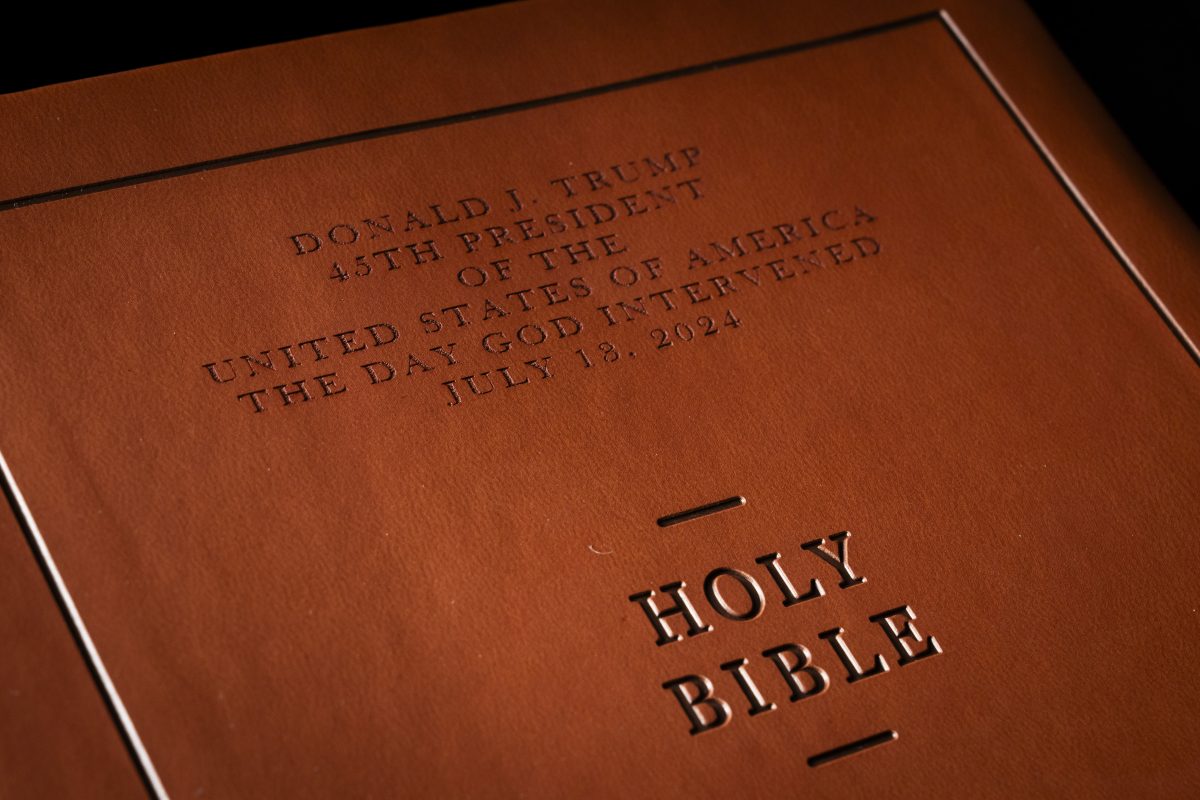
The front cover of President Donald Trump’s “God Bless the USA” Bible in Washington, Tuesday, Oct. 8, 2024. (AP Photo/Ben Curtis)
The America Reads the Bible event — with each participant reading a passage aloud — is being livestreamed this week from the Museum of the Bible in Washington and other locations. It is slated to feature a video of Trump on Tuesday evening reading a passage that called for national repentance in ancient Israel — words that have been used prominently for decades by those promoting the belief that America has been and should be a Christian nation.
The Bible is “indelibly woven into our national identity and way of life,” Trump said in a statement commemorating the event. The statement cited historical figures such as the Puritan leader John Winthrop as “imploring his fellow Christian settlers to stand as a beacon of faith for all the world to see.”
Critics say the event has a highly partisan list of participants and is part of a larger project to connect America’s upcoming 250th birthday with a Christian Nationalist vision that portrays the nation’s founding as essentially Christian, something many historians dispute. White Christians, particularly evangelicals, have been crucial to Trump’s electoral base.
The list of participants — which overwhelmingly includes Republican politicians and Christian supporters of Trump — shows it to be “very much a right-wing MAGA, Christian Nationalist effort,” said Brian Kaylor, author of “The Bible According to Christian Nationalists: Exploiting Scripture for Political Power,” referring to Trump’s “Make America Great Again” movement.
“If they wanted this to be a unifying American project, there would have been a whole lot more attention to getting political diversity and ideological diversity,” added Kaylor, president and editor-in-chief of Word&Way, a progressive site covering faith and politics.
Historian Jemar Tisby, whose books have challenged what he says is enduring Christian complicity in racism, criticized the event on Facebook: “You cannot quote the Bible while justifying violence, war, and exclusion.”
Bunni Pounds, founder of Christians Engaged, said that reading the Bible alone isn’t enough. “Faith without works is dead,” she said, adding: “We need the word first to bring faith into our life.”
Trump’s latest faith-related tensions
The Bible event comes just a week after Trump drew rare criticism from his evangelical supporters for circulating a social media meme in which a white-robed Trump appeared as a Jesus-like healer surrounded by patriotic symbols. Trump removed the image from his Truth Social site while insisting he was depicted as a doctor, not Jesus.
It also comes shortly after Trump’s high-profile clash with the U.S.-born Pope Leo XIV over the Iran war.
Other high-ranking officials have been or will be reading biblical passages in person or by video. They include Cabinet officials such as Defense Secretary Pete Hegseth and Secretary of State Marco Rubio as well as House Speaker Mike Johnson and several other Republican members of Congress. Prominent evangelical supporters of Trump who are participating include evangelist Franklin Graham, pastor Jack Graham, and pastor Paula White-Cain, who heads Trump’s White House Faith Office.
Pounds said that the organization invited Democratic members of Congress as well as leaders of some denominations that might be considered progressive but that they didn’t accept.
Each speaker is taking a turn in the ongoing reading of the 66 books of the Bible as recognized by Protestants. Jews recognize the Hebrew portion of the Bible that Christians call the Old Testament but not the New Testament books centered on Jesus, while Catholics and Orthodox recognize additional books of the Bible that are not included in this reading. The event does include some Catholic representation, including the president of CatholicVote, which endorsed Trump in 2024.
The event involves a comprehensive reading of the entire Bible, from the famous verses (“Let my people go,” “The Lord is my shepherd”) to the obscure. Passages range from the creation of the world to bloody battles and apocalyptic destruction, from exhortations to love of God, neighbor, and the needy to passages telling of Jesus’ life, death, and resurrection.
Trump will read from 2 Chronicles
The scriptural passage that Trump plans to read Tuesday evening in a livestreamed Bible-reading marathon dates back to the depiction of an ancient event — but it’s one that carries a highly charged significance in the current religious and political climate.
It has long been quoted and promoted by those who believe America was founded as a Christian nation and should be one. It’s from the seventh chapter of 2 Chronicles, a book in the Hebrew (Old Testament) portion of the Bible.
The 14th verse — the one most often quoted — says:
“If my people, which are called by my name, shall humble themselves, and pray, and seek my face, and turn from their wicked ways; then will I hear from heaven, and will forgive their sin, and will heal their land.”
Trump is among hundreds who are taking turns reading the entire Bible aloud over the course of a week. Most of the readings are taking place at the Museum of the Bible in Washington, though Trump’s is coming by video from the Oval Office.
A passage often quoted at National Day of Prayer events
The Chronicles passage has for decades been a major theme at annual National Day of Prayer events. Organizers of the America Reads the Bible marathon invited Trump to read from it. “It’s a powerful statement that he decided to read that passage,” said Bunni Pounds, founder of Christians Engaged, which organized the project.
The passage has been recited over the decades at countless rallies, services and events, often organized around the disputed belief that America was created as a Christian nation and needs to repent of its sins and return to God. The passage has particularly been associated with annual events commemorating the National Day of Prayer, which has taken various forms since the mid-20th century and became fixed by law on the first Thursday in May since the 1980s.
The verse is set in a context far from modern America — during the reign of King Solomon in ancient Israel some 3,000 years ago. Solomon is presiding over the dedication of the first temple in Jerusalem, and in a lengthy prayer he asks for divine mercy if a future generation sins, is punished with military or natural disaster and then repents. In the key passage, God replies with a promise of restoration.
Critics say the passage is used out of context
But the use of the passage in modern settings has its critics.
The Chronicles passage is “a popular verse among Christian Nationalists and has been for quite some time,” said Kaylor.
He said its use has taken on a partisan and polarizing tone, often used in tandem with a promotion of a belief in a Christian America in an increasingly diverse country.
“This verse is not about the United States,” said Kaylor, author of “The Bible According to Christian Nationalists: Exploiting Scripture for Political Power.” It is “a promise made to one particular person in one particular moment. It doesn’t really work to pull it out of context and apply it to whatever you want to.”
But many have done so recently and in decades past, either saying America has a divinely ordained destiny similar to ancient Israel’s or simply that they believe every nation has a duty to follow God and repent when needed.
President Dwight D. Eisenhower took the oath of office in 1953 with his hand on a Bible opened to the 2 Chronicles passage. President Ronald Reagan quoted the passage in a proclamation declaring 1984’s National Day of Prayer. A speaker at the 2024 Republican National Convention also quoted it.
The National Day of Prayer, while officially nonsectarian, has long been drawn particular promotion and participation from evangelical Christians. Readings of the “If my people” passage has been a staple of such events.
Politicians, others joining in the Bible-reading marathon
Evangelicals — a loyal Republican voting bloc for decades — have formed a crucial part of Trump’s electoral base. His rallies have featured a fusion of Christian and national symbols and rhetoric, featuring songs like “God Bless USA” and T-shirts with slogans like “Jesus is my savior, Trump is my president.”
Many other Republican politicians are taking part in the Bible reading, along with celebrities, pastors and others. And Trump isn’t the only one reading a passage significant to his office or mission.
Mike Huckabee, a Baptist pastor and U.S. ambassador to Israel, is reading from a Genesis passage in which God says he will bless those who bless Abraham — a passage popular with many evangelicals who believe they have a biblical mandate to support Israel.
David Barton, whose Wallbuilders promotes belief in America as a Christian nation, will read from a passage that gave his organization its name, in which Nehemiah rebuilds the broken walls of Jerusalem.
___
Associated Press religion coverage receives support through the AP’s collaboration with The Conversation US, with funding from Lilly Endowment Inc. The AP is solely responsible for this content.