NOTE: This piece was originally published at our newsletter A Public Witness.
Pete Hegseth has a new favorite Bible verse he likes to quote in speeches — and it’s not Ezekiel 25:17. In multiple speeches over the past few weeks, the man who likes to call himself “secretary of war” invoked the call of the biblical prophet Isaiah. But in this new gospel according to Hegseth, Isaiah 6:8 is no longer about a prophet volunteering to serve God but about soldiers serving the United States of America.
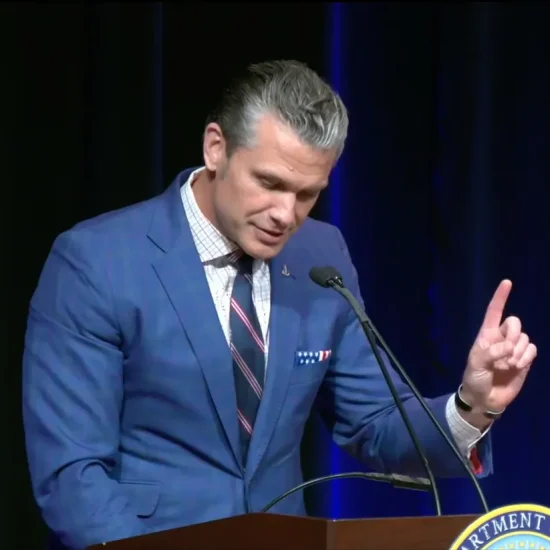
“On a day like today, there’s no better way to start than with a word from Scripture,” Hegseth declared as he started his commencement remarks at the United States Military Academy in West Point, New York, on May 23. “And on a day as special as this for the 998 great Americans of this class, there’s no more fitting verse than from Isaiah 6:8 — Then I heard the voice of the Lord saying, ‘Whom shall I send and who will go for us?’ And I said, ‘Here I am. Send me.’ Four years ago, you raised your right hand, swore an oath to preserve and defend the Constitution. And in that moment, you said to your country, ‘Send me.’”
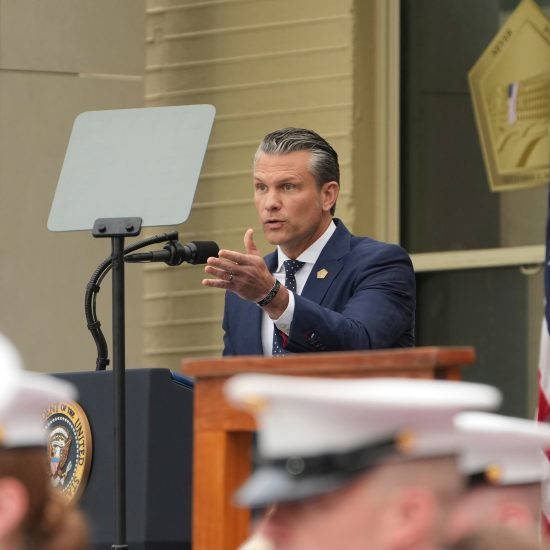
Over the weekend while in France for the 82nd anniversary of “D-Day” in World War II, Hegseth repeated it while speaking to troops stationed in Sainte-Mère-Église. Talking about the storming of the beaches of Normandy, he said, “It was men like you, soldiers like all of you who despite the odds and despite the nature of the enemy, said as is written in Isaiah, ‘Send me.’ And you said, ‘Send me’ when you raised your right hand, and you still are today.” The Pentagon later released a video of Hegseth’s participation in D-Day commemorations, which they titled “The Boys of D-Day Said: ‘Send Me.’” It included shots of him and his family at markers of the war, clips from his speech at D-Day ceremonies in which he included an anti-immigrant screed, and his co-option of Isaiah 6:8.
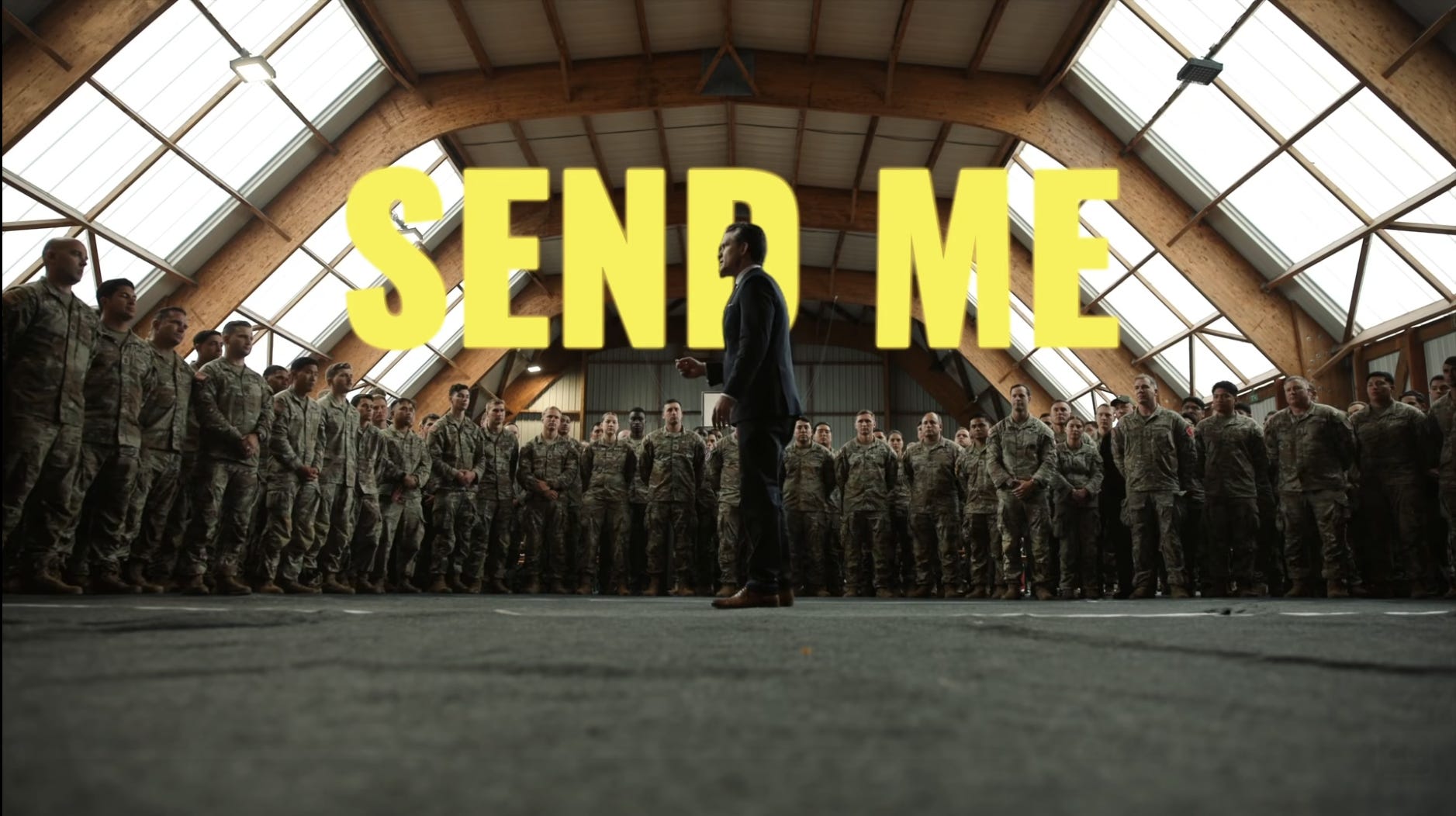
Screengrab of Pentagon video of Pete Hegseth invoking Isaiah 6:8 while speaking to troops stationed in Sainte-Mère-Église, France, on June 6, 2026.
This isn’t the first time Isaiah 6:8 has been co-opted by the Trump administration. Last year, the Department of Homeland Security’s first video that mashed a Bible verse together with footage of militarized agents hunting for immigrants used the verse. But with Hegseth now drafting the verse to serve U.S. military interests, such misuse should be examined and condemned.
The use of Isaiah 6:8 also adds to our understanding of Hegseth’s Crusader ideology, which appears to be closer to a Hollywood version of faith than what the Bible teaches. So this issue of A Public Witness considers the theological problems with Hegseth conscripting Isaiah 6:8 and how his use of Scripture aligns with Bible quotes in violent movies.
God vs. Uncle Sam
To put it simply, Isaiah 6 is not about joining the U.S. military. It’s not even about joining any military.
The chapter is a mystical call of the prophet Isaiah by God to serve God and proclaim messages from God. And these messages include a rebuke of Isaiah’s own nation and warnings of judgment to come (including military defeat by another nation). It’s also a chapter full of awe for God, which is why it’s inspired many hymns, including “Here I Am, Lord,” “Holy is the Lord,” and “Holy, Holy, Holy!”
When Hegseth invokes this passage to describe U.S. soldiers volunteering to serve the nation, he’s clearly changing the meaning of the text and doing so in a heretical manner. In the new revised Hegseth version, it’s not just that U.S. soldiers replace the prophet Isaiah; the United States of America replaces God as the soldiers say “send me” to Uncle Sam.
Christian Nationalism turns the nation into an idol, making it so the call is ultimately not to serve God but to serve (and die) for the nation. Hegseth sees those as the same thing, but they’re not. He argued during his remarks at the National Prayer Breakfast in February that a soldier who dies for the nation “finds eternal life.” With that Crusader theology, Hegseth conflates God and country, making salvation not about the work of Jesus but about a soldier dying for a nation. His co-option of Isaiah 6:8 makes the same fundamental mistake.
Hegseth might think that a call to serve the nation is synonymous with a call to serve God, but that’s simply because of his Christian Nationalist lens. Not all people in the U.S. military are actually Christian (despite his effort to eliminate many religion codes for military members). But he wants to baptize America so that the call of a prophet to preach God’s message can be retranslated as a command by a nation to pick up a weapon and kill someone.
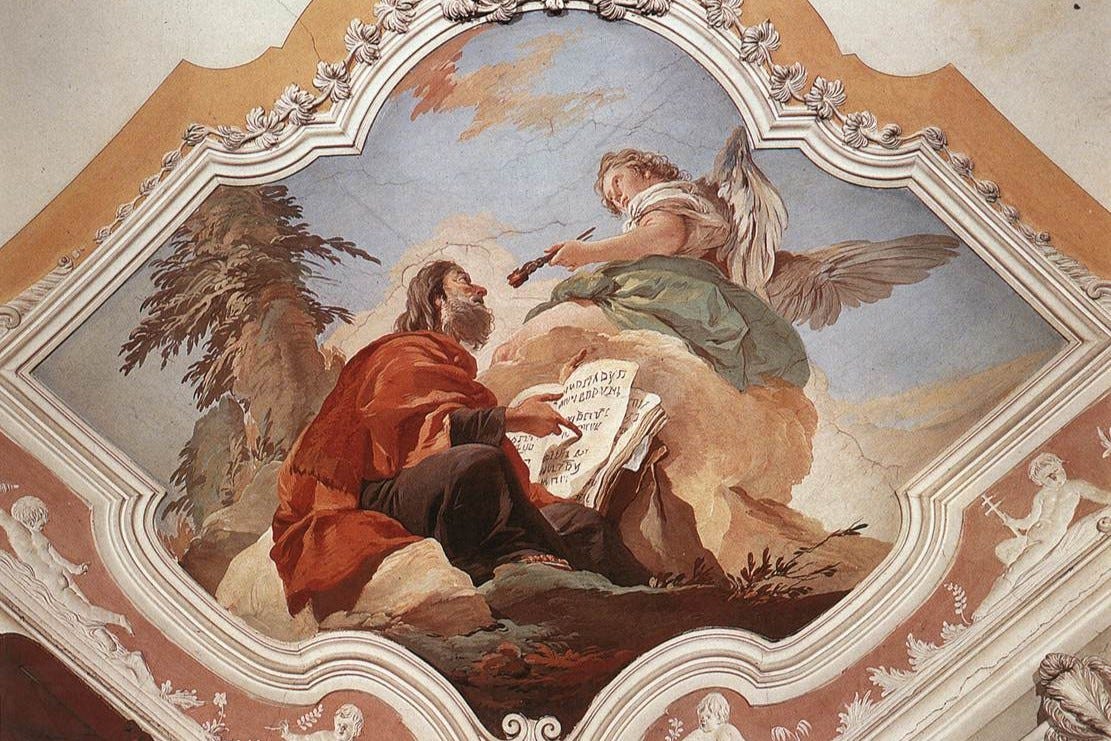
Giovanni Battista Tiepolo’s 18th-century painting The Calling of Isaiah” in Udine, Italy. (Public Domain)
As with much of Hegseth’s rhetoric, it quickly falls apart when we look beyond his made-for-cable-TV buzz words. For instance, his argument about D-Day that those who fought had echoed Isaiah in saying “send me” ignores the fact that many were actually drafted and forced to go. And in his speech to the graduating class at West Point, he used the “send me” rhetoric to take a jab at transgender and nonbinary people.
“Four years ago, you raised your right hand and said, ‘Send me.’ And today, as you join the ranks of the greatest fighting force in the history of the world, we stand together as one army and we say, ‘Send us,’” Hegseth said. “‘Send me’ becomes ‘send us’ because you are one fighting force just as we are ‘one nation under God.’”
“The call is ‘send us,’ not ‘send he, not ‘send she,’ not ‘send they/them.’ It’s ‘send us,” he added. “You can’t throw your pronouns at the enemy.”
Of course, in the text, it is actually a “send he” type of call as it went singularly to just one person. It’s not “send us” because the prophet Isaiah isn’t a unit. But in the verse Hegseth had already read in his speech, there is an example of pronoun-switching. As God says in the text, “Whom shall I send and who will go for us?” This is just one of the biblical passages where a plural pronoun is used for God. And Hegseth can’t throw that away.
While Hegseth’s heretical co-option of Isaiah 6:8 deserves condemnation, it is important to note he’s not the first to misuse the verse this way. Even before DHS used it to bless ICE, President Joe Biden quoted it like Hegseth does now to baptize the U.S. military. After a terrorist bombing in Kabul, Afghanistan, killed 13 American soldiers in 2021, Biden rightly honored their service to their nation and mourned their deaths. But he also christened the entire military, arguing that to enlist is to make a commitment to serve God.
“Those who have served through the ages have drawn inspiration from the Book of Isaiah, when the Lord says, ‘Whom shall I send … who shall go for us?’ And the American military has been answering for a long time: ‘Here am I, Lord. Send me. Here I am. Send me,’” Biden said. “Each one of these women and men of our armed forces are the heirs of that tradition of sacrifice of volunteering to go into harm’s way, to risk everything.”
There truly is no heresy new under the sun. But that doesn’t mean we should shrug as Hegseth today abuses our sacred texts.
Help sustain the journalism of Word&Way by subscribing to A Public Witness!
The Gospel According to Hollywood?
In April, Hegseth sparked international headlines, late night jokes, and countless online memes after A Public Witness broke the news of him offering a violent prayer at a Pentagon worship service that was drawn from a Samuel L. Jackson monologue in Pulp Fiction that largely makes up words claimed to be from Ezekiel 25:17. While a few words in the scene do come from the verse, which Hegseth cited before his prayer, it’s mostly just a mashup of biblical phrases and violent sentiments that Jackson’s character recited before gunning down an unarmed man and that Hegseth prayed to justify the Iran war.
Less obvious than him borrowing from a Quentin Tarantino film is how Hegseth’s broader use of the Bible matches how violent movies cite the “Good Book.” Two other verses he’s repeatedly cited this year are each featured in a prominent scene in an epic war movie.
When DHS used Isaiah 6:8 in a video last year, they did so while taking audio from the 2014 movie Fury, which starred Brad Pitt as a tank commander leading his crew in fighting the Nazis during the last few weeks of World War II in Europe. Shia LaBeouf played Boyd “Bible” Swan, a tank gunner who talks a lot about his evangelical Christian faith. In the scene that DHS stole (and that resulted in the video being taken down on some social media platforms), LaBeouf’s character tries to encourage the others to keep fighting because they’re doing “a righteous act.”
“Here’s a Bible verse I think about sometimes, many times,” he says in the film. “It goes: ‘And I heard the voice of Lord saying, Whom shall I send and who will go for Us? And I said, Here am I, send me!’”
Like LaBouf’s character in Fury, Hegseth now seeks to change the context of the passage to baptize the work of the U.S. military. All while he oversees the ongoing war in Iran, which the Pentagon named “Operation Epic Fury.”
There’s another passage Hegseth has quoted sometimes, many times, this year that also has a famous scene in an epic war movie: Psalm 144:1-2 (about having one’s hands trained for war). He read those verses and several others from that chapter during the January worship service at the Pentagon after explaining that he had prayed through that passage and shared it with others under his command as part of the planning for the military operation in Venezuela a couple of weeks earlier. In March, he read the first two verses during a press conference, that time employing it to support Operation Epic Fury in Iran. The first verse was also included in a violent prayer he read during the March worship service at the Pentagon that he offered in support of the war in Iran.
The first two verses of Psalm 144 are recited during a key battle scene in the 1998 film Saving Private Ryan with Tom Hanks and Matt Damon. In the World War II movie, Barry Pepper plays a religious sniper who is part of the team sent on a mission by the U.S. Department of War to find and extract Private James Ryan. During a fight, the sniper recites the biblical passage while pausing to reload and kill Nazi soldiers.
Unlike with the Pulp Fiction version of Ezekiel 25:17, Hegseth hasn’t included nonbiblical movie lines with his recitations of Isaiah 6:8 or Psalm 144:1-2. So it’s unclear if he was inspired by Fury or Saving Private Ryan.
But with these three passages, his interpretation of the Bible on war and violence seems to align less with biblical analysis and more with a Hollywood approach of grabbing a verse out of context to make audiences see the U.S. military as righteous and on the right side of the fight. While that might work for dramatic effect in a film, it’s dangerous for the head of the Pentagon to do violence against Scripture in order to justify violence against people.
As a public witness,
Brian Kaylor

A Public Witness is a reader-supported publication of Word&Way. To receive new posts and support our journalism ministry, subscribe today.