NOTE: This piece was originally published at our newsletter A Public Witness.
Minnesota state Rep. Mary Franson isn’t worried about car wrecks. That’s why the Republican lawmaker doesn’t wear a seatbelt. After all, her faith is in Jesus Christ, not the automobile industry. And she’s read the Bible and there’s nothing in there that says a car wreck is how her life will end.
Well, that’s not quite what she said, but it’s the same “logic.”
During the March 24 hearing of the Minnesota House Capital Investment Committee, Franson offered an anti-climate change sermon after hearing researchers from the University of Minnesota report on findings about how to better prepare the state’s infrastructure for changes in climate.
“Members, the climate is always changing,” Franson declared. “But what doesn’t change, my friends, and that’s why, when you talk about climate change, I don’t get upset about it, I don’t get worked up about it, is because my faith is not in climate change. It’s not in scientists dictating what we should and should not do to save the environment. Because my faith is in Jesus Christ, right? He’s the same today, tomorrow, and forever, yesterday. And so if you’ve read the Good Book, you know how it ends. It’s not with climate change.”
We assume she meant to add but simply forgot: “And if God meant for people to fly, God would’ve given us wings!”
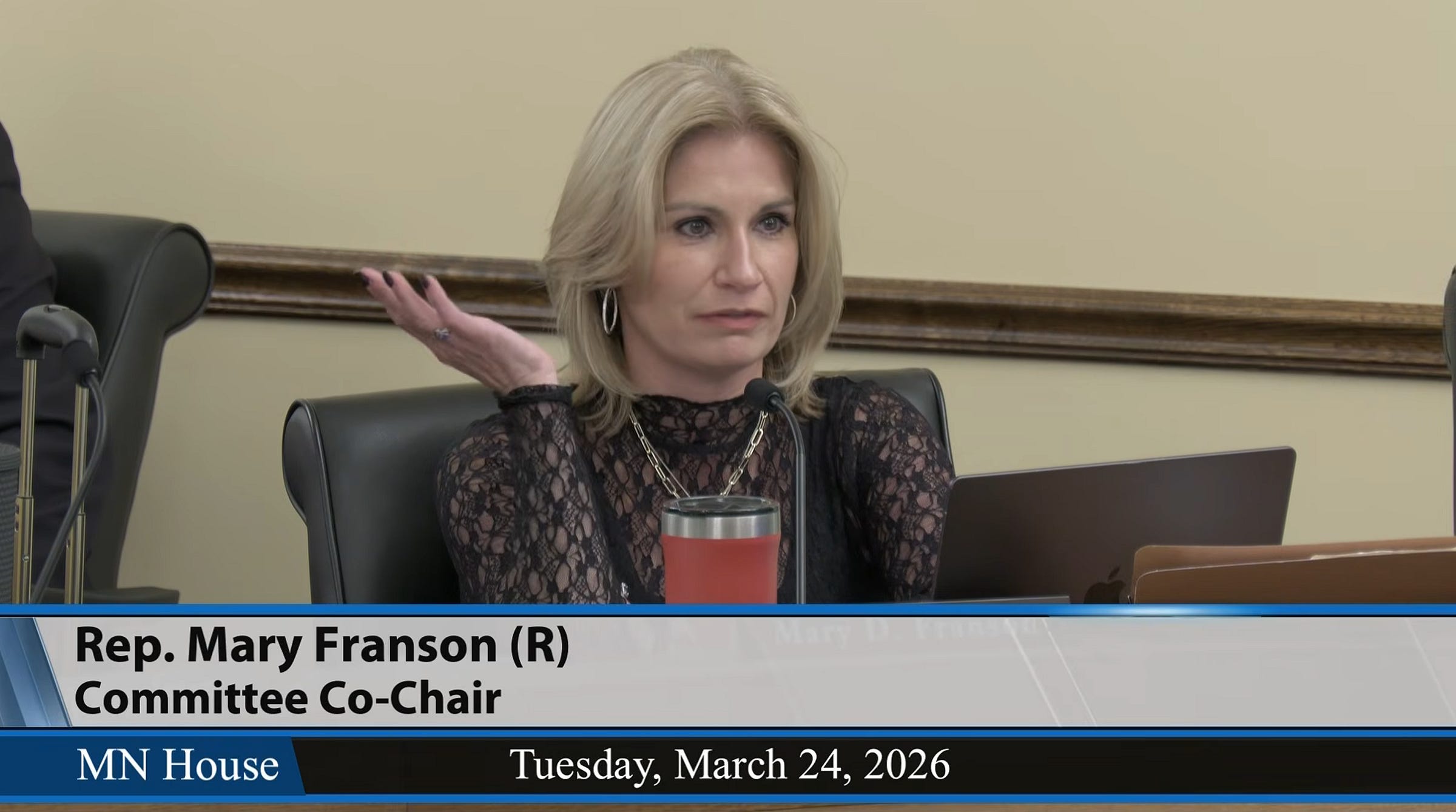
Screengrab as Minnesota state Rep. Mary Franson speaks during a House Capital Investment Committee hearing on March 24, 2026, in Saint Paul.
The state representative who defended ICE’s actions in her state (including the killing of Renée Good) has pushed anti-science and anti-environmental positions before. She rallied against COVID-19 public health measures and broke the masking rules inside the House chamber in 2020. In 2012, she criticized a prayer by the House chaplain at the start of a legislative session for mentioning Earth Day before thanking God for creation and praying for God “to teach us how to care for your world and to be stewards of your creation.” Franson, who previously called Earth Day a “Pagan holiday,” called the prayer “offensive” and said it “may as well been dedicated to ‘Mother Earth.’”
Rep. Jamie Long, the House Democratic-Farmer-Labor Party floor leader, quickly denounced Franson’s comments at the recent hearing, insisting that her “extreme remarks have no place in any arena of serious policymaking.”
“As legislators, we have a responsibility to future generations of Minnesotans, and that includes ensuring our roads, bridges, water infrastructure, and public buildings — not to mention habitats, waterways, and forests — are all resistant to extreme weather events,” he added. “For a co-chair of the committee charged with making these critical investments to turn a blind eye to this reality, and undermine the critical planning necessary to protect our infrastructure, is deeply concerning.”
Climatologist Michael E. Mann, director of the Center for Science, Sustainability, and Media at the University of Pennsylvania, also pushed back against Franson’s remarks: “Nuclear warheads aren’t in the Bible either. Guess we’re all safe.”
While Franson’s rhetoric isn’t unique and she’s hardly the first Christian politician to invoke their faith to justify denying climate science, it’s also worth noting given the importance of the work she’s trying to undermine. Additionally, it’s necessary to remember that far-right figures like her don’t have a monopoly when it comes to Christian responses to climate change. So this issue of A Public Witness considers another dangerous voice against climate action and then the Christians working to love their neighbors and the Creator by addressing this pressing climate crisis.
Venture Apocalypticism
Tech billionaire and Donald Trump ally Peter Thiel has been making headlines for the past several months for an odd reason: his very public obsession with the Antichrist.
You may know Thiel as the co-founder of the online banking company PayPal and the artificial intelligence/government surveillance company Palantir, through his funding of Hulk Hogan’s lawsuit that raised press freedom concerns when it bankrupted the pioneering internet blogging website Gawker, or as the person responsible for the ascendance of J.D. Vance. Whatever you associate him with, he wields significant influence in the conservative political realm as one of the world’s richest mega-donors.
Thiel, who was raised evangelical and has described himself as a “small-o orthodox Christian” with “somewhat heterodox” Christian beliefs, has made a central aspect of his worldview the notion that the harbinger of the end of the world is in our midst. And one group that he strongly believes could be hastening its rise is environmentalists.
The idea of an antichrist is indeed biblical, as outlined in the Epistles of John — but it is used there to merely describe any false prophets who deny Christ. While early Christians used the term to describe Roman persecutors such as Nero, it did not come to be merged with the concept of a singular evil enemy who would rise up to oppose Jesus in the end times until medieval theologians developed the notion.
During a recent series of lectures on “the Antichrist” in both San Francisco and Rome, Thiel attempted to articulate how his libertarian theology explains the moment in history we find ourselves in. He particularly wants us to fear “woke” people who critique the ways technological advancements have contributed to climate change and wealth inequality.
“My thesis is that in the 17th, 18th century, the Antichrist would have been a Dr. Strangelove, a scientist who did all this sort of evil crazy science,” Thiel said in his opening talk last fall. “In the 21st century, the Antichrist is a Luddite who wants to stop all science. It’s someone like Greta [Thunberg].”
“Luddite” is an interesting term to invoke here. It is used casually to refer to someone either opposed to technology or inept at using it. But it is historically derived from skilled textile workers who broke machines to protest low wages and unsafe working conditions. They came to be labeled Luddites in a smear campaign by the 19th-century factory owners.

Peter Thiel offers a pair of hundred dollar bills to attendees during a keynote address at the Bitcoin Conference on April 7, 2022, in Miami Beach, Florida. (Rebecca Blackwell/Associated Press)
In a follow-up interview with Ross Douthat at The New York Times about the Antichrist, Thiel mused that environmentalism is an extremely powerful force in our world, currently just shy of possessing the ability to create a one-world totalitarian state. People who advocate for protecting the environment are getting in the way of Thiel’s vision for technological acceleration through deregulation, and are therefore cast as the most evil of enemies.
This rather absurd way of looking at the world garnered widespread attention, with an episode of South Park even mocking Thiel through a parody of 1973’s The Exorcist. But beyond getting lampooned in popular culture, scholars and theologians also have some strong words for Thiel.
Jesuit priest Antonio Spadaro has called out how Thiel reduces the poor to “a collateral effect of the system” instead of a theological focus. And Italian theologian Father Paolo Benanti wrote that Thiel’s way of thinking can “be read as a prolonged act of heresy against the liberal consensus: a challenge to the very foundations of civil coexistence, which he now considers outdated.”
But religious studies scholar Anthea Butler perhaps summed it up most succinctly, “There are some things that a billionaire can’t buy. An understanding of theology without rigorous study is one of them.”
Help sustain the journalism of Word&Way by subscribing to A Public Witness!
‘A More Just and Flourishing World’
While politicians like Franson and vulture capitalists like Thiel dismiss concerns about climate change and invoke their faith to justify their science denialism, other Christians are instead working to find climate solutions and care for creation. And they do it not in spite of their faith but because of it.
“Creation justice begins with the recognition that we are not separate from the earth, but intimately bound up in it. We are formed from the soil and sustained by the breath of God!” Avery Davis Lamb, executive director of Creation Justice Ministries (formerly the National Council of Churches Eco-Justice Program), told us. “Scripture invites us to move beyond seeing the world as a resource to be used and abused and instead to partner with God in the work of protecting, restoring, and rightly sharing all that God has made.”
“To participate even now — especially now — in that eschatological vision of a heavenly-healed and restored creation,” he added. “And that’s what countless churches across the country are already doing: restoring wetlands and forests, installing solar panels, organizing for clean air and water, standing alongside frontline communities, and reimagining their land, liturgy, and life together for the sake of a more just and flourishing world.”

As Lamb mentioned, many Christian denominations and countless churches engage in creation care and sustainability efforts. The effort he leads, Creation Justice Ministries, represents the environmental justice policies of several major Christian denominations throughout the United States. They work in cooperation with 39 national faith bodies, including Protestant denominations and Orthodox communions, as well as interfaith and regional religious groups.
Additionally, almost every mainline Protestant denomination also has its own creation care organization. Just to name a few, the Evangelical Lutheran Church in America has Lutherans Restoring Creation, the United Methodist Church has Caretakers of God’s Creation, and the Religious Society of Friends has Quaker Earthcare Witness. These efforts include not just practical projects but also the development of worship and discipleship materials to counter the bad theology coming from Franson, Thiel, and others.
“Christians are motivated to care for creation from a variety of paths that lead to something beautiful,” Rev. Scott Hardin-Nieri, co-minister of the creation care program of the Christian Church (Disciples of Christ) called Green Chalice, told us. “Some see the environment, vibrant ecosystems, and creatures as sacred gifts from God as expressed in Genesis 1 to delight in and partner with as a way to honor the gift and Giver. Others see caring for the environment as not only an expression of loving God but also continuing to follow the Greatest Commandment to love our neighbors as we are told in Mark 12.”
“Loving our neighbors includes ensuring there is clean water for those who live downstream, nourishing air for all city dwellers, protection from climate disasters like heat waves and floods, honoring soil by eliminating toxic pollution and growing healthy food, and supporting a healthy climate for present and future generations,” he added. “Others care for the environment because they simply find God there. Over and over again, God whispers to and nurtures our human hearts, bodies, and minds among the forests, near running rivers, ocean waves, and mountain peaks. We are a part of this earth, created alongside and dependent on the creatures and ecosystems of our common home, and as followers of Jesus we are invited to be in right relationship with God, self, neighbors, and creation.”
So while we won’t speculate over the identity of an alleged Antichrist, we join with the many Christians who see the attitudes and policies of people like Franson and Thiel as antichrist. May we instead bear a faithful witness to the call to love our Creator and all our neighbors who live in this beautiful creation.
As a public witness,
Brian Kaylor & Jeremy Fuzy
A Public Witness is a reader-supported publication of Word&Way. To receive new posts and support our journalism ministry, subscribe today.