(RNS) — A prominent Southern Baptist theologian now says that he was wrong to endorse the idea of blasphemy laws in a recent book and during a book tour talk at an Idaho university.
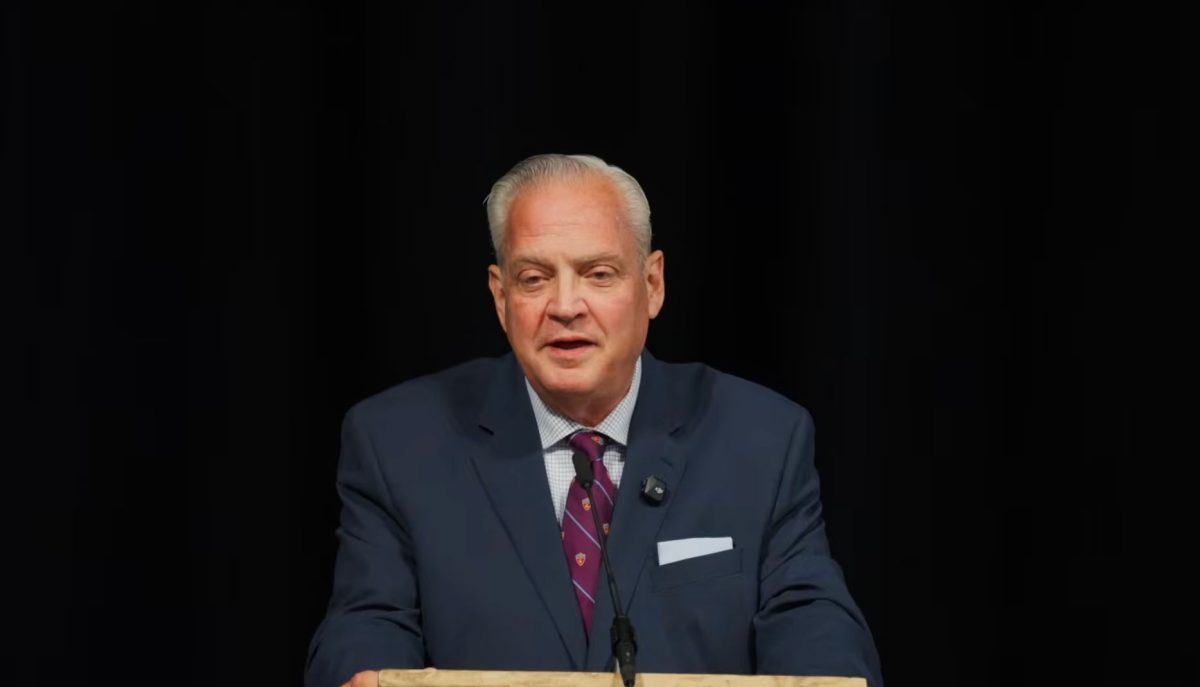
Al Mohler speaks at “Which Way America:The Christian Nationalism debate” on Aug. 7, 2026, in Moscow, Idaho. Video Screengrab
“On this score, to state the matter plainly, I think I blew it,” R. Albert “Al” Mohler wrote in an op-ed Monday (Sept. 14) for World Opinions, a Christian editorial site where he is editor.
“As a Baptist, I would never want to coerce religious belief — period,” Mohler said in the op-ed.
Mohler, longtime president of Southern Baptist Theological Seminary in Louisville, Kentucky, is co-author of “5 Views on Christian Nationalism,” a new book from Canon Press, an evangelical publisher founded by controversial Idaho pastor Douglas Wilson.
During an Aug. 7 event at the University of Idaho, Mohler said Christianity played a key role in the American founding. He lamented that the U.S. Constitution, unlike the Declaration of Independence, makes no mention of God.
“That is a huge problem with the U.S. Constitution,” he said.
The event, sponsored by Canon Press, featured Mohler and Wilson, along with author and pastor Joe Rigney, a leader at Christ Church in Moscow, where Wilson is pastor. Another co-author on the book, Paul Miller, who is a political scientist at Georgetown and is critical of Christian nationalism, also took part in the discussion.
During the discussion, which centered around how to write a new Constitution for America’s future, Mohler argued that the Constitution should make it clear that American culture, law and morals should be based on Christianity.
“I believe they should be acknowledged as Christian and they should be legitimately Christian based upon the very ontological affirmations that were necessary for the American experiment to begin,” Mohler said.
To deny God’s role in America, he said, was “blasphemy against the state.” In the book about Christian nationalism, Mohler argued that such blasphemy should be criminalized, according to Baptist Press, an official SBC publication. He also argued that gay marriage should be outlawed and that atheists “cannot fully contribute to the American order.”
Mohler’s comments went mostly unnoticed until early September, when Baptist Press wrote about his involvement in the book and event. That led to pushback online and a pointed critique from Richard Land, former president of the SBC’s Ethics and Religious Liberty Commission.
In an op-ed for the Christian Post, where he is executive editor, Land said Mohler’s comments contradicted Southern Baptist beliefs.
“The state has no right to impose penalties for religious opinions of any kind,” the Baptist Faith and Message, the denomination’s official statement of faith, reads in a section on religious liberty. As a head of an SBC entity, Mohler is required to abide by the Baptist Faith and Message. Both he and Land served on the committee that revised the SBC’s statement of faith in 2000.
Land also feared Mohler was arguing for a de facto religious test for office, something the Constitution bans.
“For example, Thomas Jefferson, a Unitarian, would be disqualified from holding office, much less being president,” Land wrote.
Mohler said in his op-ed that he opposed any religious test for office and noted that Baptists in the past had been on the “wrong side of the law and the lash,” under state churches. And he rejected blasphemy laws and religious tests for office.
“I have supported religious liberty for all citizens energetically and forcefully,” he wrote. “Needless to say, I fully support our current constitutional order. That is not in question.”
The August event was not the first time Mohler had expressed support for giving Christianity a privileged role in American culture. At the 2022 National Conservatism Conference, Mohler gave a speech warning of the dangers of a secular society.
At NatCon’s 2024 conference, he went further.
“I want to maximize the Christian commitments of the state,” he said. “I call that ‘acknowledgment.’ I’m not claiming that every citizen will be a confessing Christian, but that does not mean they are not obligated to the acknowledgment of the Christian structure of this civilization.”
His comments echoed one of the core principles of National Conservatism.
“The Bible should be read as the first among the sources of a shared Western civilization in schools and universities, and as the rightful inheritance of believers and non-believers alike,” according to those principles. “Where a Christian majority exists, public life should be rooted in Christianity and its moral vision, which should be honored by the state and other institutions both public and private.”